Mississippi Science CHE.3.3
The Standard
- CHE.3
- Students will demonstrate an understanding of the periodic table as a systematic representation to predict properties of elements.
Analyze the periodic table to identify quantum numbers (e.g., valence shell electrons, energy level, orbitals, sublevels, and oxidation numbers).
2026 Mississippi College- and Career-Readiness Standards for Science · Periodic Table
Teacher's field guide
What This Standard Means
What Students Need to Do
- Read an element's period and block to identify its outer energy level and the sublevel being filled. For main-group elements, count valence electrons and predict oxidation numbers in simple compounds. Use orbital boxes to show how electrons fill a sublevel.
What Mastery Looks Like
- For sulfur, a student identifies energy level 3, a 3p last electron, six valence electrons, and an oxidation number of −2 in MgS. They place two electrons in 3s and four across the three 3p orbitals.
Common Misconceptions
- Students may read group 16 as 16 valence electrons instead of six. They may call 3d the filling sublevel for a period 4 d-block element. They may pack p electrons into one orbital or assume an element has the same oxidation number in every compound.
How to Assess It
- For sulfur in MgS, ask students to write its outer energy level, last filled sublevel, valence-electron count, and oxidation number. Have them draw three 3p orbital boxes with four electrons.
Lesson moves
Ways to Teach It
Give pairs 18 counters and s/p orbital-box cards; have them fill sulfur's orbitals, then find its period and block on a table.
Ask, 'Why is sulfur −2 in MgS but sodium +1 in NaCl?' Have students cite each element's group and valence count.
Call out elements from groups 1, 2, 16, and 17; students write period, block, valence count, and common ion charge on mini whiteboards.
Show a bag of road salt labeled NaCl; students locate sodium and chlorine, then explain their charges using valence electrons.
Free download
Printable CHE.3.3 Worksheet
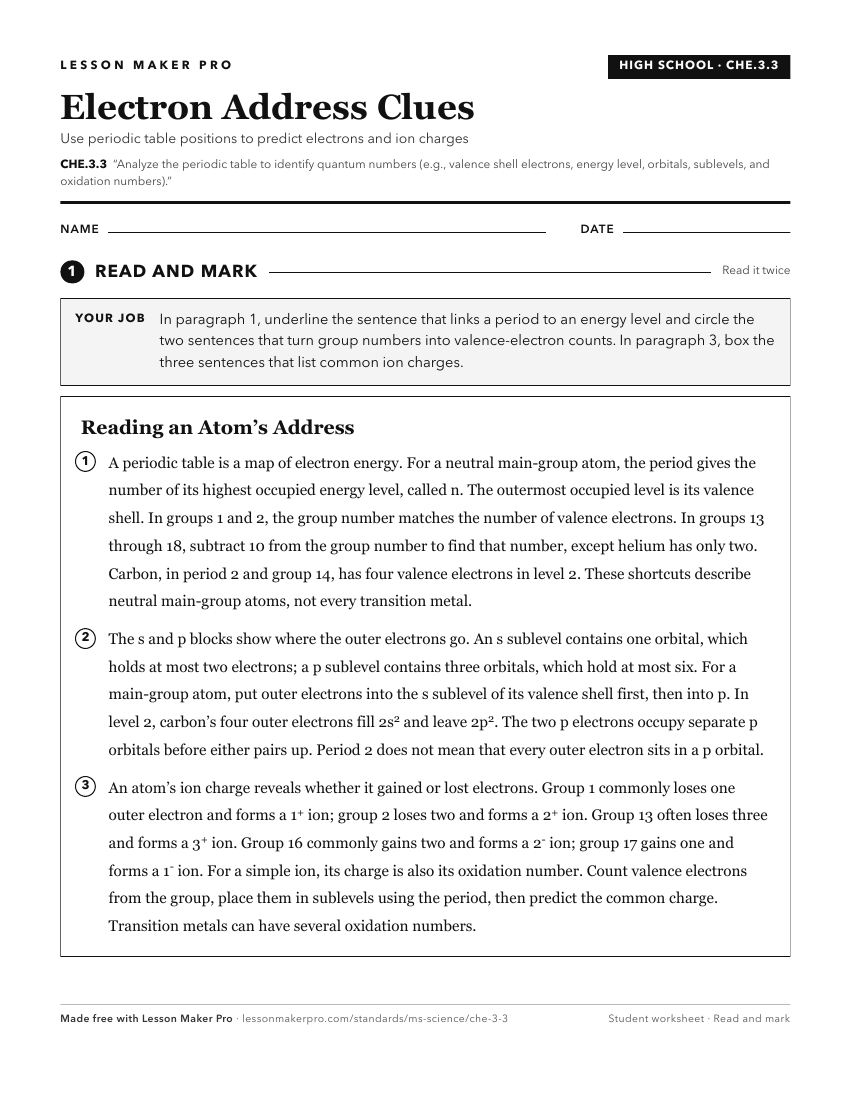
A ready-to-print activity worksheet aligned to CHE.3.3, with an answer key for the teacher on its own page. No account needed.
PDF, US Letter, prints cleanly in black and white.
Download the worksheetKeep exploring
Related Standards
- FB.2.2
Obtain and use information about elements (e.g., chemical symbol, atomic number, atomic mass, and group or family) to describe the organization of the periodic ...
- CHE.3.2
Analyze properties of atoms and ions (e.g., metal/nonmetal/metalloid behavior, electrical/heat conductivity, electronegativity and electron affinity, ionization...
- PHS.3
Students will analyze the organization of the periodic table of elements to predict atomic interactions.
- PHS.3.1
Use contextual evidence to determine the organization of the periodic table, including metals, metalloids, and nonmetals; symbols; atomic number; atomic mass; c...
Turn this exact standard into a lesson
Grade, subject, topic, and the complete standard are prefilled. Create one free, no account needed.
Also for this standard:Make a WorksheetMake a QuizMake a Sub Lesson