Mississippi Science PHS.3.1
The Standard
- PHS.3
- Students will analyze the organization of the periodic table of elements to predict atomic interactions.
Use contextual evidence to determine the organization of the periodic table, including metals, metalloids, and nonmetals; symbols; atomic number; atomic mass; chemical families/groups; and periods/series.
2026 Mississippi College- and Career-Readiness Standards for Science · Periodic Table
Teacher's field guide
What This Standard Means
What Students Need to Do
- Students use atomic numbers and property clues to work out why elements sit where they do. They read symbols and atomic masses, and identify metals, metalloids, nonmetals, families, rows, and columns.
What Mastery Looks Like
- A student places an element on a partial table using its atomic number. They use its group to predict a property. They read its symbol and mass, name its period and group, and classify its type.
Common Misconceptions
- Students may order elements by atomic mass instead of atomic number, which puts potassium before argon. They mix up rows and groups. They may label every element near the zigzag line a metalloid.
How to Assess It
- Give students a table with symbols covered and a card showing Si, atomic number 14, mass 28.09, and moderate conductivity. Ask them to place the card, name its period and group, and classify it.
Lesson moves
Ways to Teach It
Give students cards for the first 20 elements with symbols, atomic numbers, masses, and conductivity clues; sort them into rows and material types.
Ask students why lithium and sodium share a column while sodium and magnesium share a row, using atomic numbers and reaction clues.
Hand out symbol bingo boards; call out 'atomic number 14' or 'group 17 nonmetal,' and have students cover the matching element.
Show a photo of a silicon chip and copper wire; students predict which conducts better, then check a conductivity chart.
Free download
Printable PHS.3.1 Worksheet
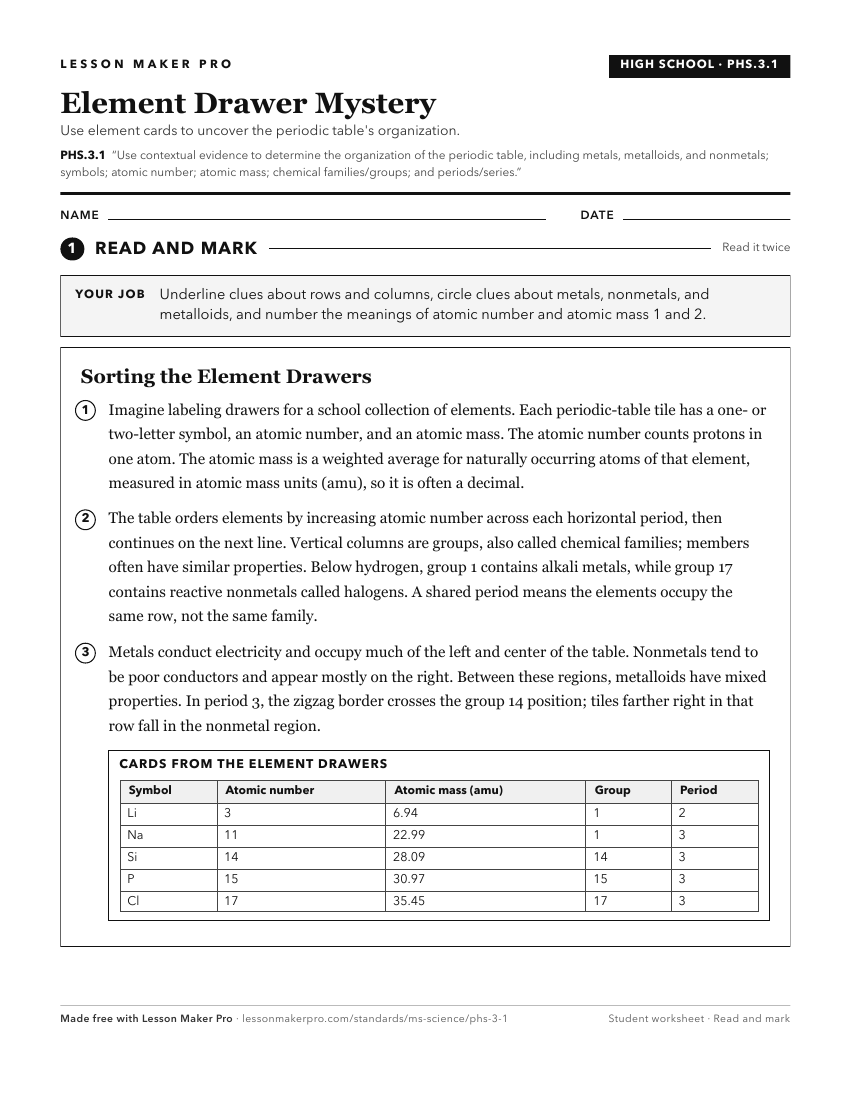
A ready-to-print activity worksheet aligned to PHS.3.1, with an answer key for the teacher on its own page. No account needed.
PDF, US Letter, prints cleanly in black and white.
Download the worksheetKeep exploring
Related Standards
- CHE.3.1
Explore and communicate the organization of the periodic table, including history, groups, families, family names, metals, nonmetals, metalloids, and transition...
- FB.2.2
Obtain and use information about elements (e.g., chemical symbol, atomic number, atomic mass, and group or family) to describe the organization of the periodic ...
- CHE.3.2
Analyze properties of atoms and ions (e.g., metal/nonmetal/metalloid behavior, electrical/heat conductivity, electronegativity and electron affinity, ionization...
- PHS.3
Students will analyze the organization of the periodic table of elements to predict atomic interactions.
Turn this exact standard into a lesson
Grade, subject, topic, and the complete standard are prefilled. Create one free, no account needed.
Also for this standard:Make a WorksheetMake a QuizMake a Sub Lesson