Mississippi Science CHE.4.3
The Standard
- CHE.4
- Students will demonstrate an understanding of the types of bonds and resulting atomic structures for the classification of chemical compounds.
Predict the ionic or covalent nature of different atoms based on electronegativity trends and/or position on the periodic table.
2026 Mississippi College- and Career-Readiness Standards for Science · Bonding
Teacher's field guide
What This Standard Means
What Students Need to Do
- Students predict whether a pair of atoms will form an ionic or covalent bond. They use the atoms’ positions on the periodic table or compare their electronegativity values.
What Mastery Looks Like
- Given Na-Cl, H-Cl, and C-O, a student labels Na-Cl ionic and the other two covalent. They explain each choice using element types or electronegativity differences.
Common Misconceptions
- Students may call H-Cl ionic because hydrogen and chlorine attract electrons with different strengths. Some think atoms on the left side of a periodic-table row attract bonding electrons more strongly than atoms on the right.
How to Assess It
- Ask students to label Na-Cl and H-Cl as ionic or covalent, then justify each answer using periodic-table positions or electronegativity values.
Lesson moves
Ways to Teach It
Give students element cards and a periodic table; have them sort Na-Cl, H-Cl, and C-O into ionic and covalent piles.
Ask: Why is H-Cl covalent but Na-Cl ionic, even though both pairs contain chlorine? Have students write one periodic-table clue.
Show six atom pairs on the board; students race to label each ionic or covalent, then check their answers with electronegativity values.
Show salt and sugar packets, with NaCl and C12H22O11 written on the board; students predict each substance’s bond type from its elements.
Free download
Printable CHE.4.3 Worksheet
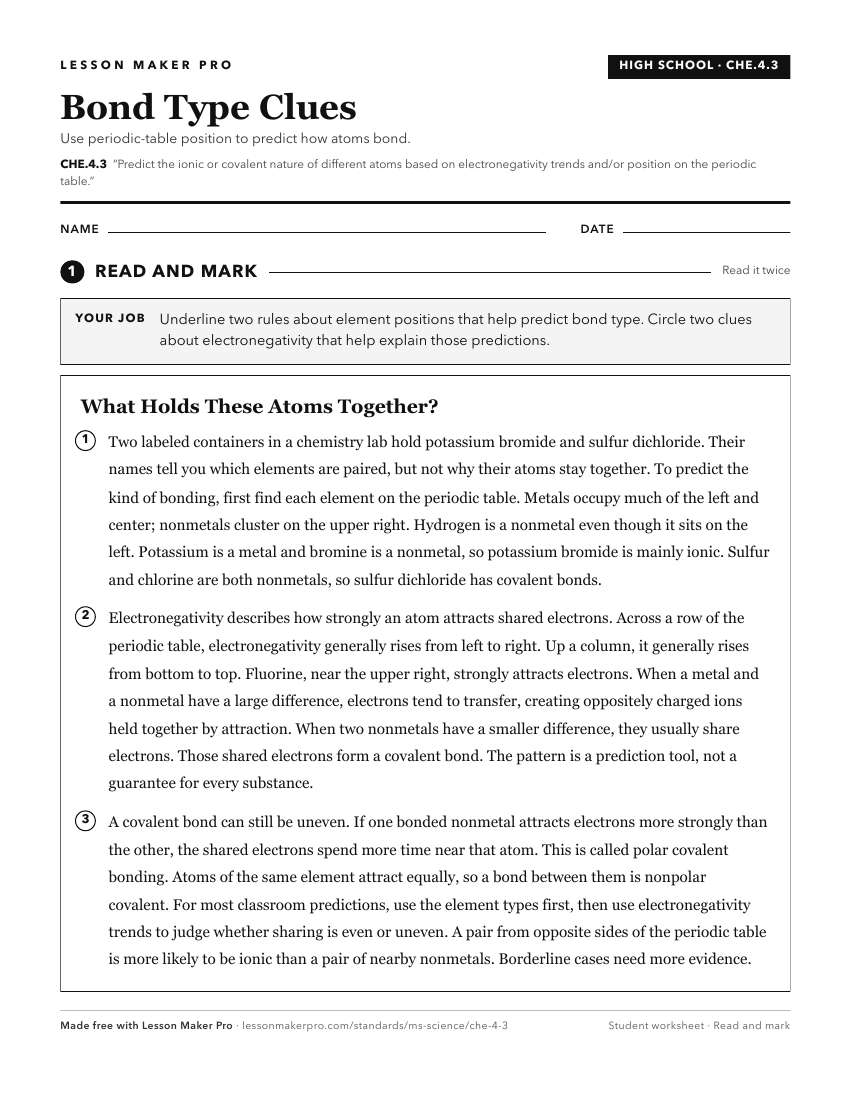
A ready-to-print activity worksheet aligned to CHE.4.3, with an answer key for the teacher on its own page. No account needed.
PDF, US Letter, prints cleanly in black and white.
Download the worksheetKeep exploring
Related Standards
- P.7.5C.4
Predict the properties and interactions of elements using the periodic table (metals, non-metals, reactivity, and conductors).
- P.7.5C.6
Using the periodic table, make predictions to explain how bonds (ionic and covalent) form between groups of elements (e.g., oxygen gas, ozone, water, table salt...
- CHE.3.2
Analyze properties of atoms and ions (e.g., metal/nonmetal/metalloid behavior, electrical/heat conductivity, electronegativity and electron affinity, ionization...
- FB.2.3
Relate chemical reactivity to an element’s position on the periodic table. Use this information to determine what type of bond will form between elements (ionic...
Turn this exact standard into a lesson
Grade, subject, topic, and the complete standard are prefilled. Create one free, no account needed.
Also for this standard:Make a WorksheetMake a QuizMake a Sub Lesson