Mississippi Science FB.2.3
The Standard
- FB.2
- Students will demonstrate an understanding of the structure and interactions of matter and how the organization of matter supports living organisms.
Relate chemical reactivity to an element’s position on the periodic table. Use this information to determine what type of bond will form between elements (ionic, covalent, hydrogen).
2026 Mississippi College- and Career-Readiness Standards for Science · The Chemistry of Life
Teacher's field guide
What This Standard Means
What Students Need to Do
- Use periodic table groups to compare how readily elements react and whether they tend to lose, gain, or share electrons. Predict ionic or covalent bonds from those tendencies. Identify hydrogen bonding between molecules that contain hydrogen bonded to nitrogen, oxygen, or fluorine.
What Mastery Looks Like
- Students explain why sodium readily reacts with chlorine but neon rarely reacts, using valence electrons. They predict ionic bonding in NaCl, covalent bonding in O₂, and hydrogen bonding between water molecules.
Common Misconceptions
- Students may think elements in the same period react alike, or that noble gases react as readily as alkali metals. They may call the O-H bond inside water a hydrogen bond rather than a covalent bond. Some expect two nonmetals to transfer electrons instead of sharing them.
How to Assess It
- Exit ticket: Show NaCl and two H₂O molecules beside a periodic table. Ask students to label the bond in NaCl, the O-H bond, and the attraction between the water molecules, then explain each choice.
Lesson moves
Ways to Teach It
Use counters and periodic table cards to model electron transfer between sodium and chlorine, then electron sharing between two hydrogen atoms.
Ask: Why does sodium bond with chlorine by transfer, while two chlorine atoms share electrons? Have partners cite valence electrons.
Sort cards showing electron transfer in NaCl, electron sharing in H₂, and attraction between water molecules into three bond groups.
Use a road-salt label and a water-drop photo; have students mark ionic bonds in salt and hydrogen bonds between water molecules.
Free download
Printable FB.2.3 Worksheet
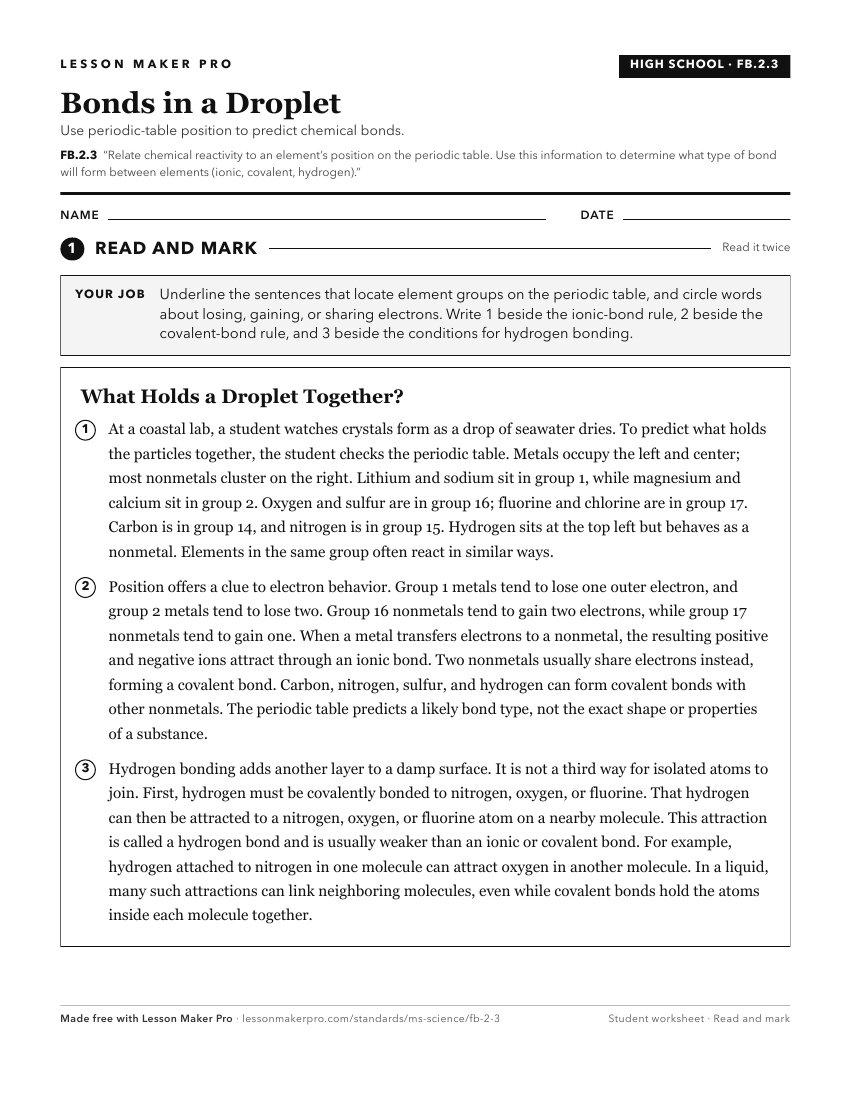
A ready-to-print activity worksheet aligned to FB.2.3, with an answer key for the teacher on its own page. No account needed.
PDF, US Letter, prints cleanly in black and white.
Download the worksheetKeep exploring
Related Standards
- P.7.5C.4
Predict the properties and interactions of elements using the periodic table (metals, non-metals, reactivity, and conductors).
- P.7.5C.6
Using the periodic table, make predictions to explain how bonds (ionic and covalent) form between groups of elements (e.g., oxygen gas, ozone, water, table salt...
- CHE.4.3
Predict the ionic or covalent nature of different atoms based on electronegativity trends and/or position on the periodic table.
- PHS.3.2
Using the periodic table and scientific methods, investigate the formation of compounds through ionic and covalent bonding.
Turn this exact standard into a lesson
Grade, subject, topic, and the complete standard are prefilled. Create one free, no account needed.
Also for this standard:Make a WorksheetMake a QuizMake a Sub Lesson