Mississippi Science P.7.5C
Standard Cluster
Students will demonstrate an understanding of the proper use of the periodic table to predict and identify elemental properties and how elements interact. Develop and use models that explain the structure of an atom. Use informational text to sequence the major discoveries leading to the current atomic model. Collect, organize, and interpret data from investigations to identify and analyze the relationships between the physical and chemical properties of elements, atoms, molecules, compounds, solutions, and mixtures. Predict the properties and interactions of elements using the periodic table (metals, non-metals, reactivity, and conductors). Describe concepts used to construct chemical formulas (e.g., CH4, H2O) to determine the number of atoms in a chemical formula. Using the periodic table, make predictions to explain how bonds (ionic and covalent) form between groups of elements (e.g., oxygen gas, ozone, water, table salt, and methane).
2026 Mississippi College- and Career-Readiness Standards for Science · Organization of Matter and Chemical Interactions
Cluster contents
Standards in This Cluster
P.7.5C is a cluster heading. These are the individual standards under it.
- P.7.5C.1
Develop and use models that explain the structure of an atom.
- P.7.5C.2
Use informational text to sequence the major discoveries leading to the current atomic model.
- P.7.5C.3
Collect, organize, and interpret data from investigations to identify and analyze the relationships between the physical and chemical properties of elements, at...
- P.7.5C.4
Predict the properties and interactions of elements using the periodic table (metals, non-metals, reactivity, and conductors).
- P.7.5C.5
Describe concepts used to construct chemical formulas (e.g., CH4, H2O) to determine the number of atoms in a chemical formula.
- P.7.5C.6
Using the periodic table, make predictions to explain how bonds (ionic and covalent) form between groups of elements (e.g., oxygen gas, ozone, water, table salt...
Teacher's field guide
What This Cluster Means
What Students Need to Do
- Students build atom models and put major discoveries about atoms in order. They use data on physical and chemical properties to tell elements, molecules, compounds, solutions, and mixtures apart. They use periodic table patterns to predict conductivity, reactivity, and bonding, then count atoms in formulas.
What Mastery Looks Like
- A student builds a sodium atom with 11 protons and 11 electrons. They predict that sodium conducts and reacts with chlorine to form an ionic compound, while water has covalent bonds. They read H2O as two hydrogen atoms and one oxygen atom, and identify salt water as a solution.
Common Misconceptions
- Students may use atomic mass instead of atomic number to count protons. They may read H2O as having two oxygen atoms or call salt water a new compound. Some think solid table salt conducts electricity because it contains a metal.
How to Assess It
- Give students a periodic table and ask: “Is sodium a metal? Would solid sodium conduct electricity? What kind of bond forms between sodium and chlorine? How many atoms of each element are in H2O?”
Lesson moves
Ways to Teach It
Give pairs beads and a periodic table; have them build sodium and chlorine atoms, then move one electron bead to model ionic bonding.
Give students five cards on Dalton, Thomson, Rutherford, Bohr, and electron clouds; have them order the cards and explain one model change.
Run a sorting race with cards for H2O, O2, NaCl, salt water, and air; teams label each and count atoms in formulas.
Test copper wire, a plastic spoon, and salt water with a battery-powered conductivity tester; use the results to explain why wires use metal.
Free download
Printable P.7.5C Worksheet
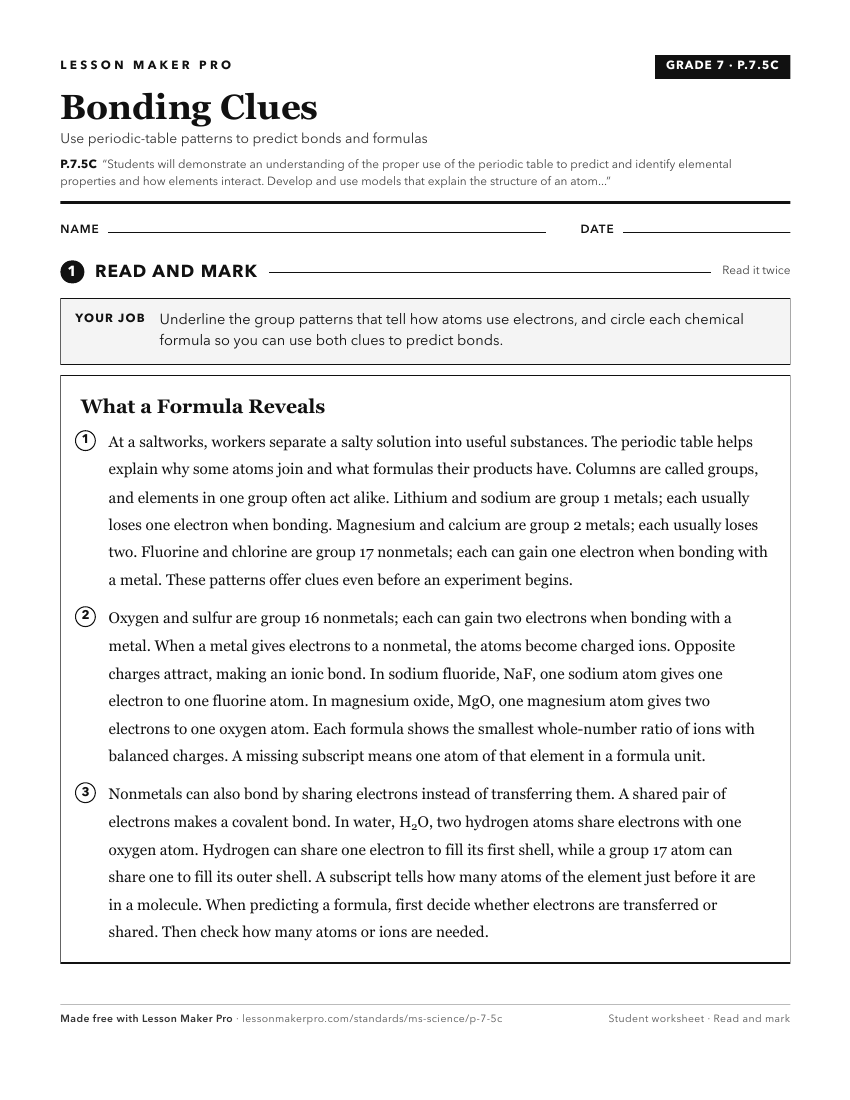
A ready-to-print activity worksheet aligned to P.7.5C, with an answer key for the teacher on its own page. No account needed.
PDF, US Letter, prints cleanly in black and white.
Download the worksheetKeep exploring
Related Standards
- CHE.3
Students will demonstrate an understanding of the periodic table as a systematic representation to predict properties of elements.
- P.7.5A
Students will demonstrate an understanding of the physical and chemical properties of matter.
- PHS.3
Students will analyze the organization of the periodic table of elements to predict atomic interactions.
- P.2.5
Students will demonstrate an understanding of the properties of matter.
Turn this cluster into a lesson
Grade, subject, topic, and the complete cluster are prefilled. Create one free, no account needed.
Also for this cluster:Make a WorksheetMake a QuizMake a Sub Lesson