Mississippi Science P.7.5C.3
The Standard
- P.7.5C
- Students will demonstrate an understanding of the proper use of the periodic table to predict and identify elemental properties and how elements interact.
Collect, organize, and interpret data from investigations to identify and analyze the relationships between the physical and chemical properties of elements, atoms, molecules, compounds, solutions, and mixtures.
2026 Mississippi College- and Career-Readiness Standards for Science · Organization of Matter and Chemical Interactions
Teacher's field guide
What This Standard Means
What Students Need to Do
- Students record physical properties and reactions in a table, then use the results to compare substances. They use particle diagrams to connect atoms, molecules, elements, compounds, mixtures, and solutions to their observations.
What Mastery Looks Like
- Given test results, students identify magnetism and dissolving as physical properties and bubbling with vinegar as evidence of a reaction. They can tell an atom from a molecule in a particle diagram and explain why saltwater is a solution, not a new compound.
Common Misconceptions
- Students may think dissolving makes a new substance or that every clear liquid is a pure substance. They may also think every molecule is a compound, missing that oxygen molecules contain only one kind of atom.
How to Assess It
- Exit ticket: Iron sticks to a magnet, salt dissolves in water, and baking soda bubbles when vinegar is added. Ask students to label each observation as physical or chemical evidence and explain why saltwater is a solution.
Lesson moves
Ways to Teach It
Set out salt, baking soda, water, and vinegar; have pairs record dissolving and bubbling in an observation table.
Show particle diagrams of oxygen gas, water, and saltwater; ask which show an element, a molecule, a compound, and a mixture.
Give pairs particle diagrams and test-result cards for iron, oxygen, water, saltwater, and muddy water; have them match and sort the cards.
Read a sugared sports drink label and identify sugar and salts; explain why the drink is a solution, not a compound.
Free download
Printable P.7.5C.3 Worksheet
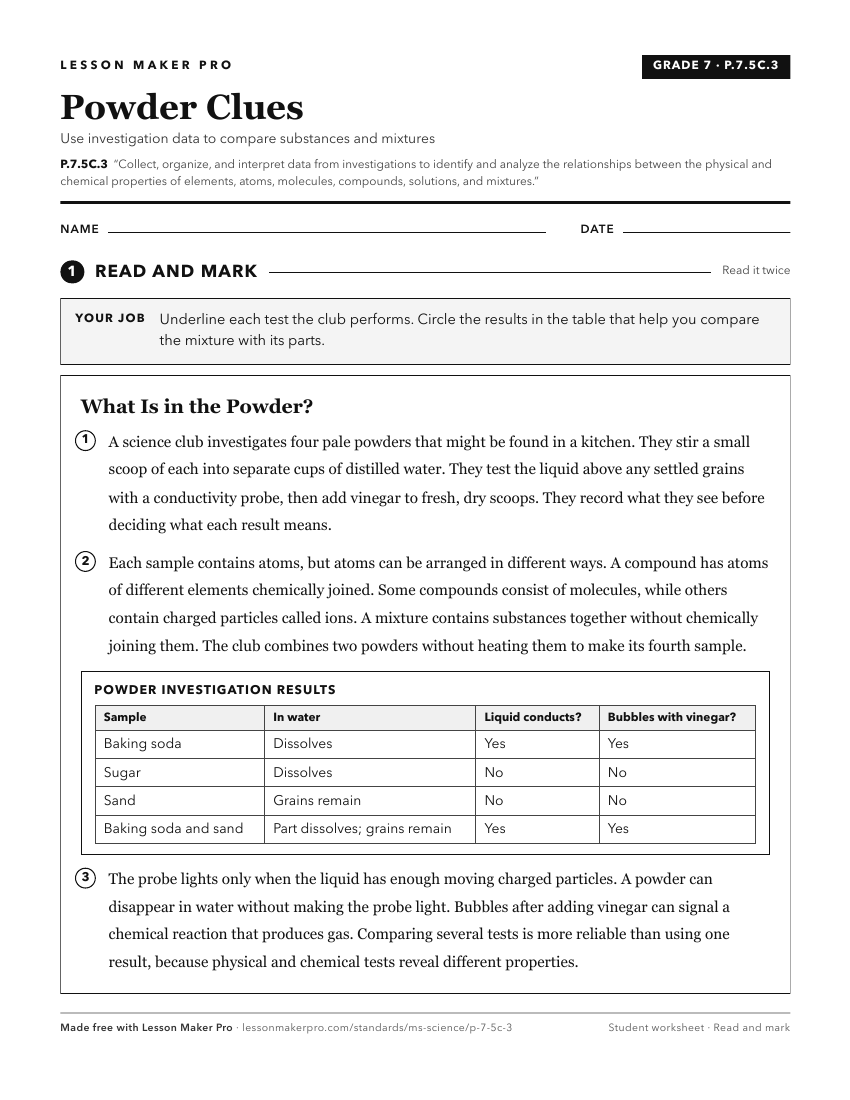
A ready-to-print activity worksheet aligned to P.7.5C.3, with an answer key for the teacher on its own page. No account needed.
PDF, US Letter, prints cleanly in black and white.
Download the worksheetKeep exploring
Related Standards
- P.7.5A.1
Collect and evaluate qualitative data to describe substances using physical properties (state, boiling/melting point, density, heat/electrical conductivity, col...
- P.5.5A.2
Collect, analyze, and interpret data from measurements of the physical properties of solids, liquids, and gases (e.g., volume, shape, movement, and spacing of p...
- P.2.5.1
Conduct a structured investigation to collect, represent, and analyze categorical data to classify matter as solid, liquid, or gas. Report findings and describe...
- PHS.1.2
Use scientific research to generate models to compare physical and chemical properties of elements, compounds, and mixtures.
Turn this exact standard into a lesson
Grade, subject, topic, and the complete standard are prefilled. Create one free, no account needed.
Also for this standard:Make a WorksheetMake a QuizMake a Sub Lesson