Mississippi Science P.2.5.1
The Standard
- P.2.5
- Students will demonstrate an understanding of the properties of matter.
Conduct a structured investigation to collect, represent, and analyze categorical data to classify matter as solid, liquid, or gas. Report findings and describe a variety of materials according to observable physical properties (e.g., size, color, texture, opacity, solubility).
2026 Mississippi College- and Career-Readiness Standards for Science · Organization of Matter and Chemical Interactions
Teacher's field guide
What This Standard Means
What Students Need to Do
- Students observe materials and test properties such as color, texture, and whether they dissolve in water. They sort samples as solids, liquids, or gases and tally how many are in each group. They use their observations and tallies to report what they found.
What Mastery Looks Like
- A student explains that a block keeps its shape, water takes its container's shape, and air fills a sealed bag. They tally samples correctly and use the counts to name the largest group. They describe properties they can observe, such as color or texture.
Common Misconceptions
- Students may call sand a liquid because it pours, though each grain is a solid. They may think air is not matter because they cannot see it, or say dissolved salt has vanished. Some sort materials by color instead of how they behave in a container.
How to Assess It
- Give students a pebble, wooden block, cup of water, and sealed bag of air. Ask them to label each sample, write one observable property for each, tally the three states, and name the group with the most samples.
Lesson moves
Ways to Teach It
Give pairs a wood block, salt, water, and bagged air; have them sort, tally, and test whether salt dissolves.
Ask students to write why sand is a solid even when it pours, using what they see through a hand lens.
Play a card sort with ice, juice, steam, and air in a tire; partners name each state and explain one choice.
At lunch, students identify a cracker, bottled water, and air inside an empty bottle by state and record one property each.
Free download
Printable P.2.5.1 Worksheet
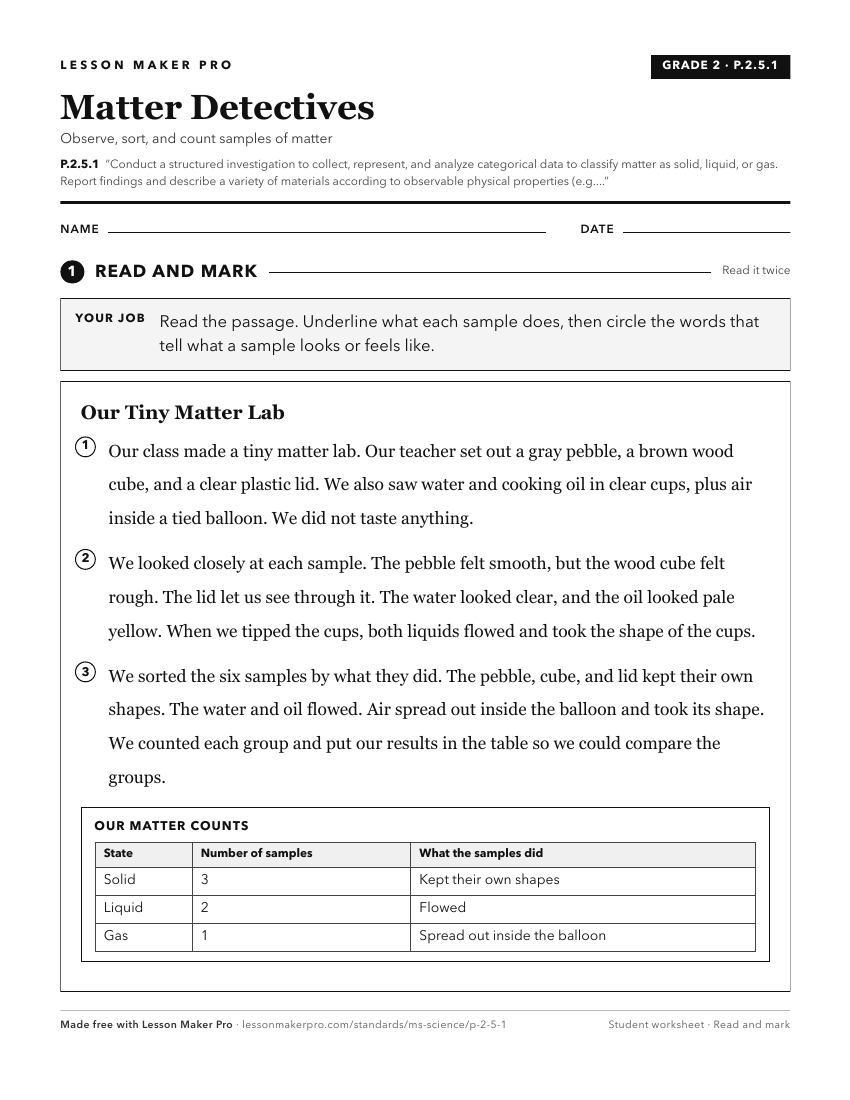
A ready-to-print activity worksheet aligned to P.2.5.1, with an answer key for the teacher on its own page. No account needed.
PDF, US Letter, prints cleanly in black and white.
Download the worksheetKeep exploring
Related Standards
- P.7.5A.1
Collect and evaluate qualitative data to describe substances using physical properties (state, boiling/melting point, density, heat/electrical conductivity, col...
- P.5.5A.2
Collect, analyze, and interpret data from measurements of the physical properties of solids, liquids, and gases (e.g., volume, shape, movement, and spacing of p...
- P.7.5C.3
Collect, organize, and interpret data from investigations to identify and analyze the relationships between the physical and chemical properties of elements, at...
- P.5.5A.3
Analyze matter through observations and measurements to classify materials (e.g., powders, metals, minerals, or liquids) based on their properties (e.g., color,...
Turn this exact standard into a lesson
Grade, subject, topic, and the complete standard are prefilled. Create one free, no account needed.
Also for this standard:Make a WorksheetMake a QuizMake a Sub Lesson