Mississippi Science PHS.1.2
The Standard
- PHS.1
- Students will demonstrate an understanding of the nature of matter.
Use scientific research to generate models to compare physical and chemical properties of elements, compounds, and mixtures.
2026 Mississippi College- and Career-Readiness Standards for Science · Nature of Matter
Teacher's field guide
What This Standard Means
What Students Need to Do
- Students use source data to compare an element, a compound, and a mixture. They compare properties such as solubility and reaction with vinegar, then draw particle models to explain the differences.
What Mastery Looks Like
- A student can label copper, baking soda, and baking soda water correctly and draw a particle model for each. They can explain that dissolving baking soda makes a mixture, while bubbling with vinegar shows a chemical reaction.
Common Misconceptions
- Students may call baking soda water a compound because it looks uniform. They may think dissolving creates a new substance, or that a compound has all the same properties as its elements.
How to Assess It
- Give students this source note: Copper does not dissolve in water or bubble with vinegar; baking soda does both. Ask them to model copper, baking soda, and baking soda water, label each, and identify one physical and one chemical property.
Lesson moves
Ways to Teach It
Have pairs test copper wire, baking soda, and baking soda water with vinegar, then sketch particle models using a reference sheet.
Ask, “Why does baking soda water bubble with vinegar when copper does not?” Have students use their sketches and source notes.
Give teams source cards with solubility and vinegar reactions for copper, baking soda, and baking soda water; match each to a particle sketch.
Use a rusty bike chain photo and research notes on iron, rust, and saltwater to model chemical change versus mixing.
Free download
Printable PHS.1.2 Worksheet
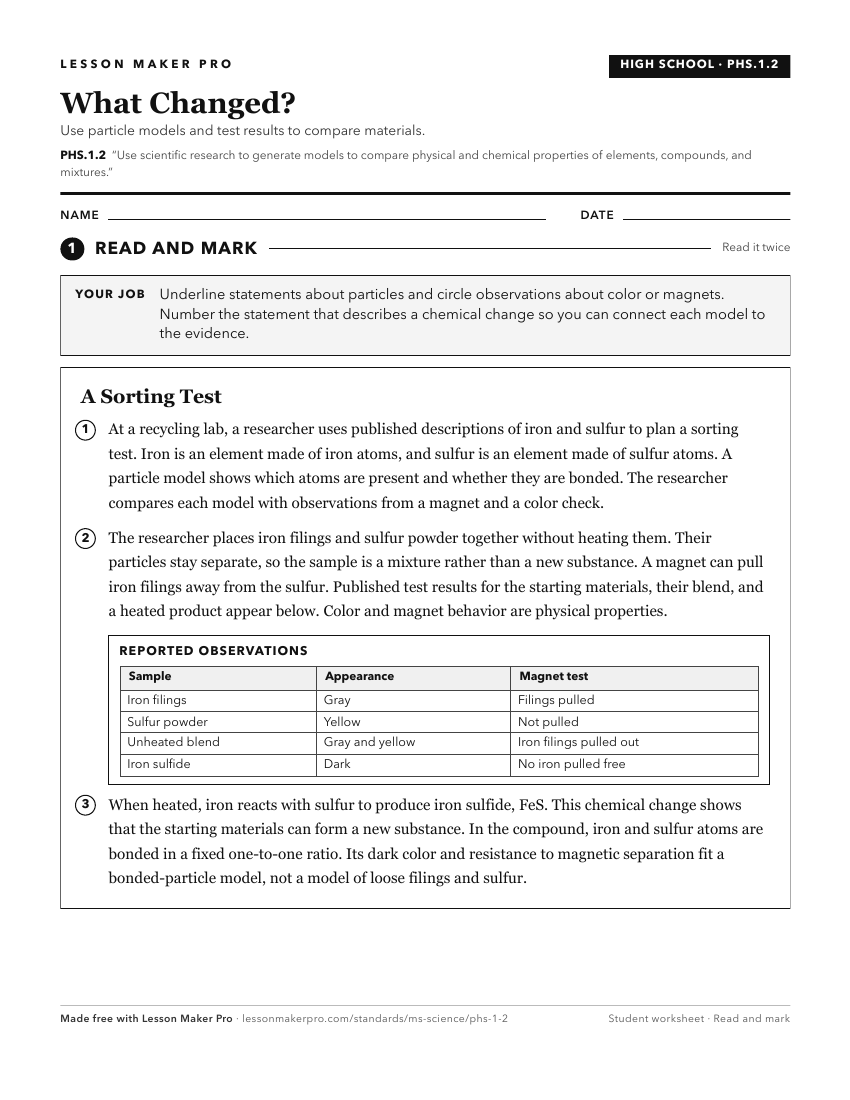
A ready-to-print activity worksheet aligned to PHS.1.2, with an answer key for the teacher on its own page. No account needed.
PDF, US Letter, prints cleanly in black and white.
Download the worksheetKeep exploring
Related Standards
- CHE.4.1
Develop and use models (e.g., Lewis dot, 3-D ball-stick, 3-D printing, or simulation programs such as PhET) to predict the type of bonding between atoms and the...
- CHE.4.8
Plan and conduct controlled scientific investigations to produce mathematical evidence of the empirical composition of a compound.
- P.7.5C.3
Collect, organize, and interpret data from investigations to identify and analyze the relationships between the physical and chemical properties of elements, at...
- P.7.5A.3
Compare and contrast chemical and physical properties (e.g., combustion, oxidation, pH, solubility, reaction with water).
Turn this exact standard into a lesson
Grade, subject, topic, and the complete standard are prefilled. Create one free, no account needed.
Also for this standard:Make a WorksheetMake a QuizMake a Sub Lesson