Mississippi Science P.7.5C.2
The Standard
- P.7.5C
- Students will demonstrate an understanding of the proper use of the periodic table to predict and identify elemental properties and how elements interact.
Use informational text to sequence the major discoveries leading to the current atomic model.
2026 Mississippi College- and Career-Readiness Standards for Science · Organization of Matter and Chemical Interactions
Teacher's field guide
What This Standard Means
What Students Need to Do
- Students read short accounts of atomic experiments and arrange the findings by date. They match each finding to a change in the model of the atom.
What Mastery Looks Like
- They put Dalton, Thomson, Rutherford, Bohr, Schrödinger, and Chadwick in order. They use details from the readings to explain why each discovery changed an earlier model.
Common Misconceptions
- Students may think each new model proved every earlier finding wrong. They may put Bohr before Rutherford or draw modern electrons on fixed circles instead of in a cloud.
How to Assess It
- Give students five dated excerpts about atomic discoveries. Ask them to put the excerpts in order and name one finding that changed an earlier model.
Lesson moves
Ways to Teach It
Give pairs dated discovery cards and atom sketches; have them build a timeline and place each sketch beside the finding it represents.
Ask students to write: Which finding most clearly showed that Dalton's model needed to change? Use a line from the reading.
Play a matching game with scientist names, experiment descriptions, and model sketches; have teams justify each match.
Show a lithium battery label and ask students which atomic discovery helps explain why electrons can move through a circuit.
Free download
Printable P.7.5C.2 Worksheet
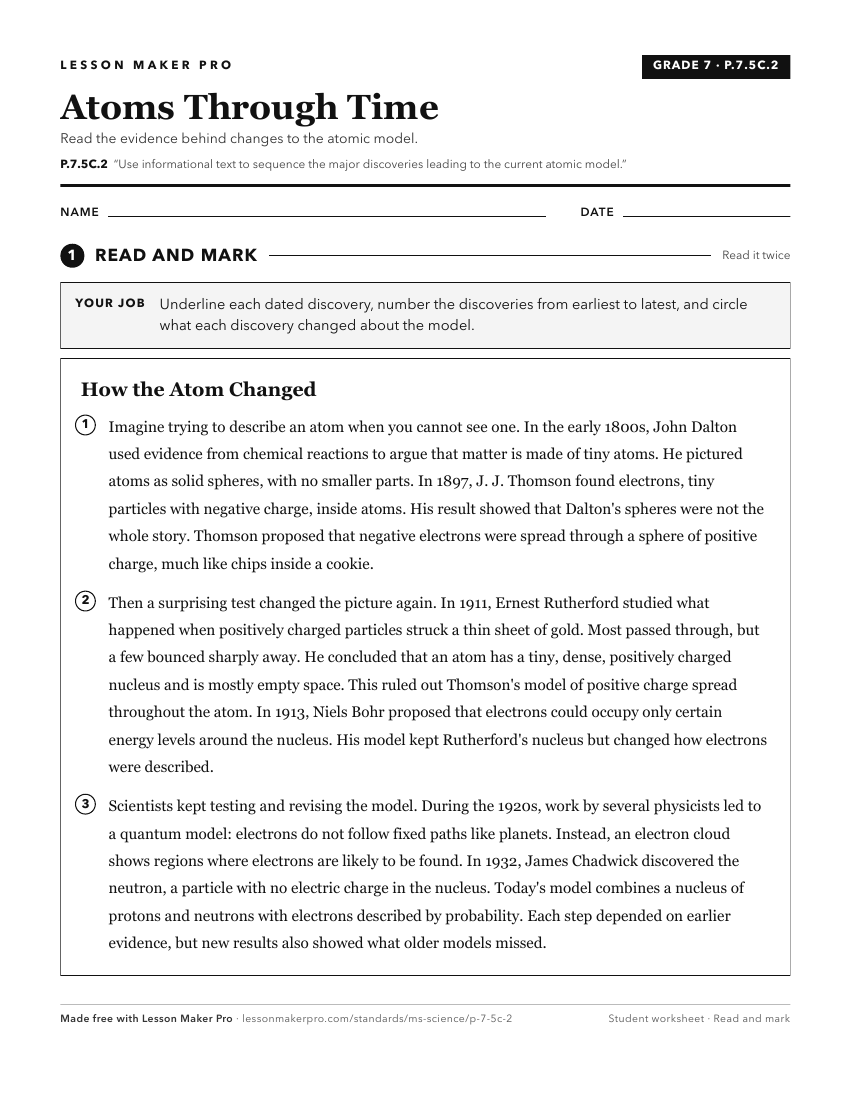
A ready-to-print activity worksheet aligned to P.7.5C.2, with an answer key for the teacher on its own page. No account needed.
PDF, US Letter, prints cleanly in black and white.
Download the worksheetKeep exploring
Related Standards
- FB.2.1
Develop and use simple atomic models to describe the components of elements (e.g., relative position, charges of protons, neutrons, and electrons).
- P.7.5C.1
Develop and use models that explain the structure of an atom.
- CHE.2
Students will demonstrate an understanding of the atomic structure and the historical developments leading to modern atomic theory.
- FSL.1.1
Trace and model the historical development of scientific ideas and theories (e.g., atomic theory, plate tectonics, evolution, genetics, discovery of cells) thro...
Turn this exact standard into a lesson
Grade, subject, topic, and the complete standard are prefilled. Create one free, no account needed.
Also for this standard:Make a WorksheetMake a QuizMake a Sub Lesson