Mississippi Science CHE.2
Standard Cluster
Students will demonstrate an understanding of the atomic structure and the historical developments leading to modern atomic theory. Investigate the historical progression leading to the modern atomic theory, including, but not limited to, work done by Dalton, Rutherford’s gold foil experiment, Thomson’s cathode ray experiment, Millikan’s oil drop experiment, and Bohr’s interpretation of bright line spectra. Construct models (e.g., ball and stick, online simulations, mathematical computations) of atomic nuclei to explain the abundance weighted average (relative mass) of elements and isotopes on the published mass of elements. Investigate absorption and emission spectra to interpret explanations of electrons at discrete energy levels using tools such as online simulations, spectrometers, prisms, flame tests, and discharge tubes. Explore both laboratory experiments and real-world examples. Research appropriate sources to evaluate the way absorption and emission spectra are used to study astronomy and the formation of the universe.
2026 Mississippi College- and Career-Readiness Standards for Science · Atomic Theory
Cluster contents
Standards in This Cluster
CHE.2 is a cluster heading. These are the individual standards under it.
- CHE.2.1
Investigate the historical progression leading to the modern atomic theory, including, but not limited to, work done by Dalton, Rutherford’s gold foil experimen...
- CHE.2.2
Construct models (e.g., ball and stick, online simulations, mathematical computations) of atomic nuclei to explain the abundance weighted average (relative mass...
- CHE.2.3
Investigate absorption and emission spectra to interpret explanations of electrons at discrete energy levels using tools such as online simulations, spectromete...
- CHE.2.4
Research appropriate sources to evaluate the way absorption and emission spectra are used to study astronomy and the formation of the universe.
Teacher's field guide
What This Cluster Means
What Students Need to Do
- Students connect key atomic experiments to the models that followed. They build isotope models and calculate average atomic mass from isotope masses and abundances. They use absorption and emission spectra to explain electron energy changes and identify elements in stars.
What Mastery Looks Like
- Given an experiment, students can say what its results revealed about the atom. They can calculate a weighted average atomic mass and compare it with a periodic table value. They can match bright lab lines to dark lines in a star’s spectrum and explain why the wavelengths match.
Common Misconceptions
- Students may still picture atoms as solid balls, despite evidence for electrons and a small nucleus. They often average isotope masses without accounting for abundance. They may think an element’s absorption and emission lines occur at unrelated wavelengths.
How to Assess It
- Exit ticket: An element has isotopes of 10 amu (20%) and 11 amu (80%). Calculate its average mass, name the experiment that revealed the nucleus, and explain why a dark line in a star’s spectrum could match one of its bright lab lines.
Lesson moves
Ways to Teach It
Have pairs build chlorine-35 and chlorine-37 nuclei with two colors of counters, then calculate average mass using 75% and 25% cards.
Ask: What did Rutherford’s gold foil results show that Thomson’s model could not explain? Have students sketch both models beside their answers.
Hand out cards naming Dalton, Thomson, Rutherford, Millikan, and Bohr; teams match each scientist to an experiment, observation, or atomic claim.
Project solar absorption and hydrogen emission spectra; students circle matching wavelengths and explain how astronomers identify hydrogen in the Sun.
Free download
Printable CHE.2 Worksheet
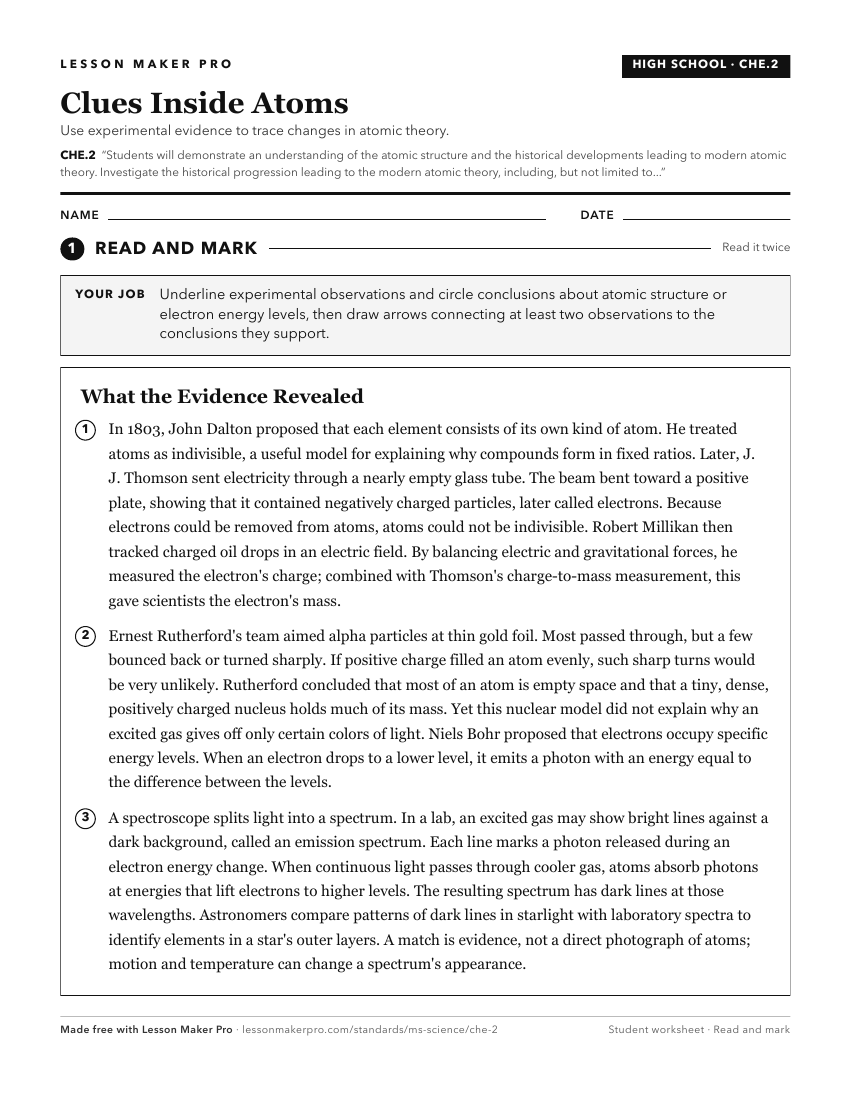
A ready-to-print activity worksheet aligned to CHE.2, with an answer key for the teacher on its own page. No account needed.
PDF, US Letter, prints cleanly in black and white.
Download the worksheetKeep exploring
Related Standards
- PHS.2
Students will demonstrate an understanding of both modern and historical theories of atomic structure.
- PHY.6
Students will demonstrate an understanding of the basic principles of nuclear energy.
- PHS.2.1
Research and develop models (e.g., 3-D models, online simulations, or ball and stick) to investigate both modern and historical theories of atomic structure. Co...
Turn this cluster into a lesson
Grade, subject, topic, and the complete cluster are prefilled. Create one free, no account needed.
Also for this cluster:Make a WorksheetMake a QuizMake a Sub Lesson