Mississippi Science PHY.6
Standard Cluster
Students will demonstrate an understanding of the basic principles of nuclear energy. Analyze and explain the concepts of nuclear physics. Explore the mass number and atomic number of the nucleus of an isotope of a given chemical element. Investigate the conservation of mass and the conservation of charge by writing and balancing nuclear decay equations for alpha and beta decay. Simulate the process of nuclear decay using online simulations and/or laboratory experiences and using mathematical computations determine the half-life of radioactive isotopes.
2026 Mississippi College- and Career-Readiness Standards for Science · Nuclear Energy
Cluster contents
Standards in This Cluster
PHY.6 is a cluster heading. These are the individual standards under it.
- PHY.6.1
Analyze and explain the concepts of nuclear physics.
- PHY.6.2
Explore the mass number and atomic number of the nucleus of an isotope of a given chemical element.
- PHY.6.3
Investigate the conservation of mass and the conservation of charge by writing and balancing nuclear decay equations for alpha and beta decay.
- PHY.6.4
Simulate the process of nuclear decay using online simulations and/or laboratory experiences and using mathematical computations determine the half-life of radi...
Teacher's field guide
What This Cluster Means
What Students Need to Do
- Students use isotope symbols to count protons and neutrons. They balance alpha and beta decay equations by tracking mass number and charge. They explain how nuclear changes release energy and use half-life to predict how much material remains.
What Mastery Looks Like
- Given uranium-238, students identify 92 protons and 146 neutrons and write thorium-234 as its alpha decay product. They know beta-minus decay leaves the mass number unchanged and raises the daughter’s atomic number by one. They calculate that 8 mg becomes 2 mg after two half-lives.
Common Misconceptions
- Students may mistake mass number for neutron count or think alpha decay changes only the atomic number. Some lower the mass number during beta-minus decay. Others subtract the same amount each half-life instead of halving what remains.
How to Assess It
- Exit ticket: Radon-222 has 86 protons and a 3.8-day half-life. Find its neutron count, write its alpha decay equation, and calculate how much of an 8 mg sample remains after 7.6 days.
Lesson moves
Ways to Teach It
Give pairs 40 coins to flip, remove heads after each round, and graph the coins left to model radioactive decay.
Show a fission diagram and ask students to write where the released energy comes from and what stays conserved.
Hand out incomplete alpha and beta decay equation cards; students fill in missing nuclei and check both numbers on each side.
Use an americium-241 smoke detector fact sheet to identify its alpha decay product and discuss why the source stays sealed.
Free download
Printable PHY.6 Worksheet
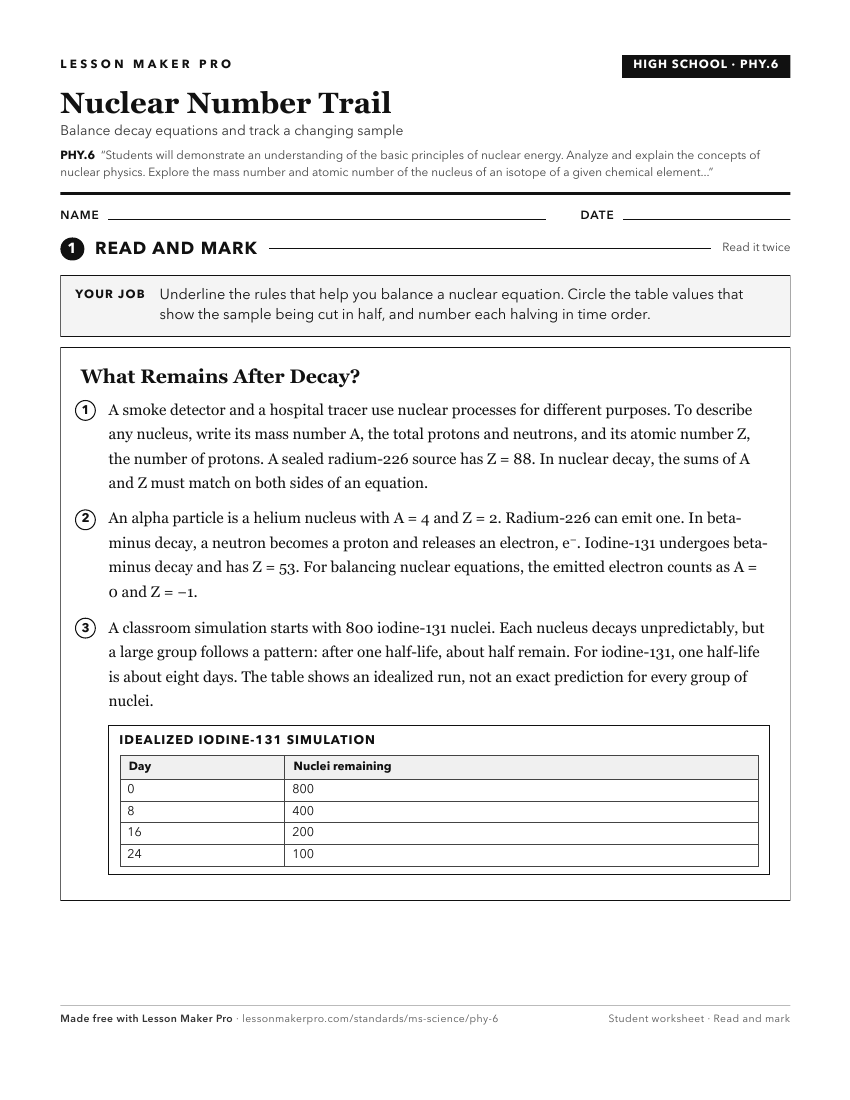
A ready-to-print activity worksheet aligned to PHY.6, with an answer key for the teacher on its own page. No account needed.
PDF, US Letter, prints cleanly in black and white.
Download the worksheetKeep exploring
Related Standards
- P.4.6A
Students will demonstrate an understanding of the common sources and uses of heat and electric energy and the materials used to transfer heat and electricity.
- PHY.3
Students will develop an understanding of concepts related to work and energy.
- CHE.2
Students will demonstrate an understanding of the atomic structure and the historical developments leading to modern atomic theory.
- P.2.5
Students will demonstrate an understanding of the properties of matter.
Turn this cluster into a lesson
Grade, subject, topic, and the complete cluster are prefilled. Create one free, no account needed.
Also for this cluster:Make a WorksheetMake a QuizMake a Sub Lesson