Mississippi Science PHY.6.3
The Standard
- PHY.6
- Students will demonstrate an understanding of the basic principles of nuclear energy.
Investigate the conservation of mass and the conservation of charge by writing and balancing nuclear decay equations for alpha and beta decay.
2026 Mississippi College- and Career-Readiness Standards for Science · Nuclear Energy
Teacher's field guide
What This Standard Means
What Students Need to Do
- Students write alpha and beta-minus decay equations from a parent isotope. They find the daughter isotope by balancing mass numbers and atomic numbers on both sides. They treat mass number as a count of protons and neutrons, not exact measured mass.
What Mastery Looks Like
- Given an unfamiliar isotope, students can write its alpha or beta-minus decay equation and name the daughter isotope. They check both number sums, including the emitted electron's zero mass number and negative charge.
Common Misconceptions
- Students often subtract four from both numbers in alpha decay, though the atomic number drops by two. They may think beta-minus decay removes an electron from the atom rather than changing a neutron into a proton. Some mistake mass number for exact measured mass, which can change as energy is released.
How to Assess It
- Exit ticket: Fill in ²³⁸₉₂U → ___ + ⁴₂He and ¹⁴₆C → ___ + ⁰₋₁e, then show the mass-number and charge sums for each.
Lesson moves
Ways to Teach It
Give pairs 6 red proton counters, 8 blue neutron counters, and an electron slip; have them model carbon-14 beta-minus decay and write the equation.
Ask, "Why does carbon-14 become nitrogen-14 if its mass number stays 14?" Have students explain using proton and neutron counts.
Play decay match: students pair parent isotope cards with daughter and emitted particle cards, then check both number sums.
Show a carbon-dating diagram; ask students to write the decay equation that produces nitrogen-14 and check both number sums.
Free download
Printable PHY.6.3 Worksheet
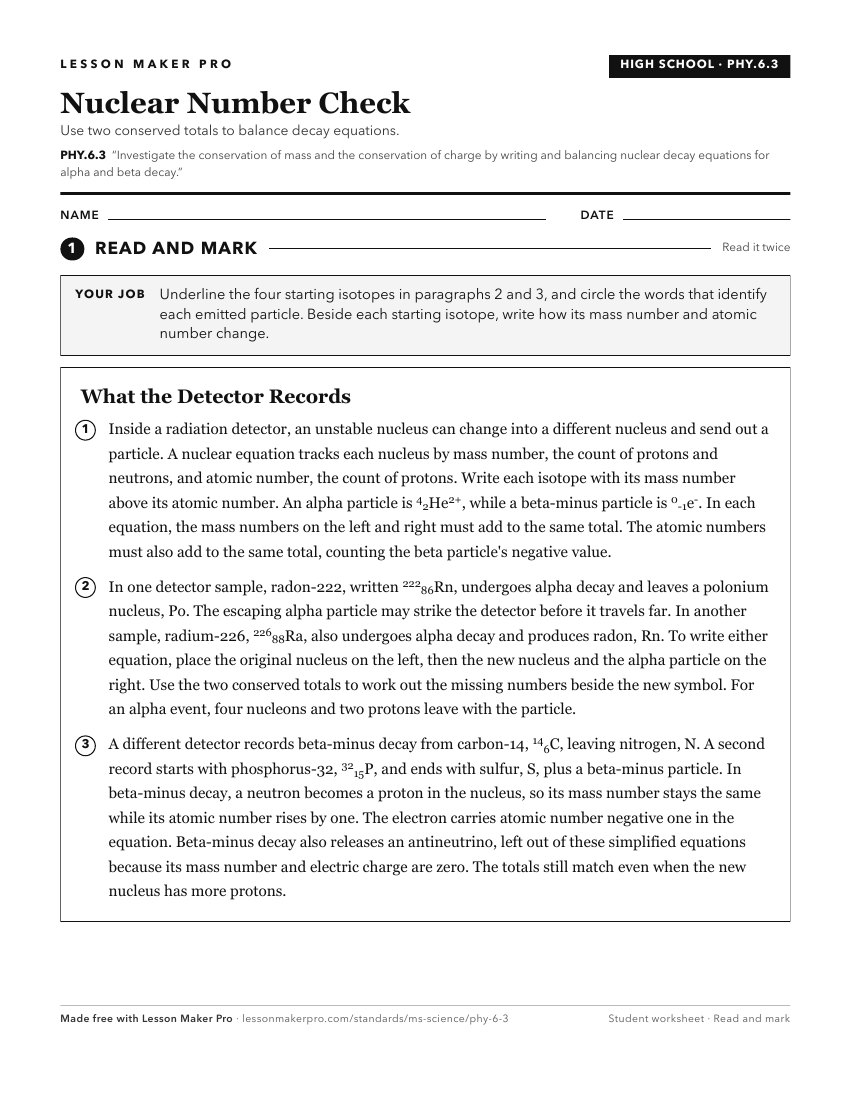
A ready-to-print activity worksheet aligned to PHY.6.3, with an answer key for the teacher on its own page. No account needed.
PDF, US Letter, prints cleanly in black and white.
Download the worksheetKeep exploring
Related Standards
- PHS.4.4
Use mathematical and computational analysis to examine evidence that mass is conserved in chemical reactions using simple stoichiometry problems (1:1 mole ratio...
- PHY.6.4
Simulate the process of nuclear decay using online simulations and/or laboratory experiences and using mathematical computations determine the half-life of radi...
- PHS.4.3
Apply the concept of conservation of matter to balancing simple chemical equations.
- PHY.6.1
Analyze and explain the concepts of nuclear physics.
Turn this exact standard into a lesson
Grade, subject, topic, and the complete standard are prefilled. Create one free, no account needed.
Also for this standard:Make a WorksheetMake a QuizMake a Sub Lesson