Mississippi Science P.4.6A
Standard Cluster
Students will demonstrate an understanding of the common sources and uses of heat and electric energy and the materials used to transfer heat and electricity. Obtain and communicate information to compare how different processes (including burning, friction, and electricity) serve as sources of heat energy. Plan and conduct scientific investigations to classify different materials as either an insulator or conductor of electricity. Develop models demonstrating how heat and electrical energy can be transformed into other forms of energy (e.g., motion, sound, heat, or light). Develop models that demonstrate the path of an electric current in a complete, simple circuit (e.g., lighting a light bulb or making a sound). Use informational text and technology resources to communicate technological breakthroughs made by historical figures in electricity (e.g., Alessandro Volta, Michael Faraday, Nicola Tesla, Thomas Edison, incandescent light bulbs, batteries, Light Emitting Diodes). Design a device that converts any form of energy from one form to another form (e.g., construct a musical instrument that will convert vibrations to sound by controlling varying pitches, a solar oven that will convert energy from the sun to heat energy, or a simple circuit that can be used to complete a task). Use an engineering design process to define the problem, design, construct, evaluate, and improve the device. *
2026 Mississippi College- and Career-Readiness Standards for Science · Motion, Forces, and Energy
Cluster contents
Standards in This Cluster
P.4.6A is a cluster heading. These are the individual standards under it.
- P.4.6A.1
Obtain and communicate information to compare how different processes (including burning, friction, and electricity) serve as sources of heat energy.
- P.4.6A.2
Plan and conduct scientific investigations to classify different materials as either an insulator or conductor of electricity.
- P.4.6A.3
Develop models demonstrating how heat and electrical energy can be transformed into other forms of energy (e.g., motion, sound, heat, or light).
- P.4.6A.4
Develop models that demonstrate the path of an electric current in a complete, simple circuit (e.g., lighting a light bulb or making a sound).
- P.4.6A.5
Use informational text and technology resources to communicate technological breakthroughs made by historical figures in electricity (e.g. Alessandro Volta, Mic...
- P.4.6A.6
Design a device that converts any form of energy from one form to another form (e.g., construct a musical instrument that will convert vibrations to sound by co...
Teacher's field guide
What This Cluster Means
What Students Need to Do
- Students compare heat from burning, rubbing, and electricity. They test materials, trace a complete circuit, and model energy changing into motion, sound, light, or heat. They explain an inventor's work, then build, test, and improve a device.
What Mastery Looks Like
- A student can light a bulb with a battery and wires, show the full circuit path, and predict whether a paper clip or plastic strip will close a gap. They can explain how rubbing hands produces heat and how a buzzer changes electrical energy into sound. They use test results to improve a switch.
Common Misconceptions
- Some students think current stops at the bulb or that a bulb lights without a closed circuit. Others think electricity passes through a wire's plastic coating, or that rubbing makes heat without using motion.
How to Assess It
- Draw a working D-cell, bulb, and two-wire circuit. Mark the complete path, predict whether a paper clip or plastic strip will light the bulb when placed in a gap, and name the energy source that heats a toaster.
Lesson moves
Ways to Teach It
Give pairs a D-cell, small bulb, wires, paper clip, and plastic strip to build a circuit and test both materials in a gap.
Read short accounts of Volta's battery and Faraday's generator; ask students to write one way each invention changed how people used electricity.
Use cards labeled rubbing hands, burning candle, toaster, fan, and LED; teams sort the heat sources and name each energy change.
Design a desk-help signal with a battery, buzzer, and paper-clip switch; test it, improve the switch, and label electricity changing to sound.
Free download
Printable P.4.6A Worksheet
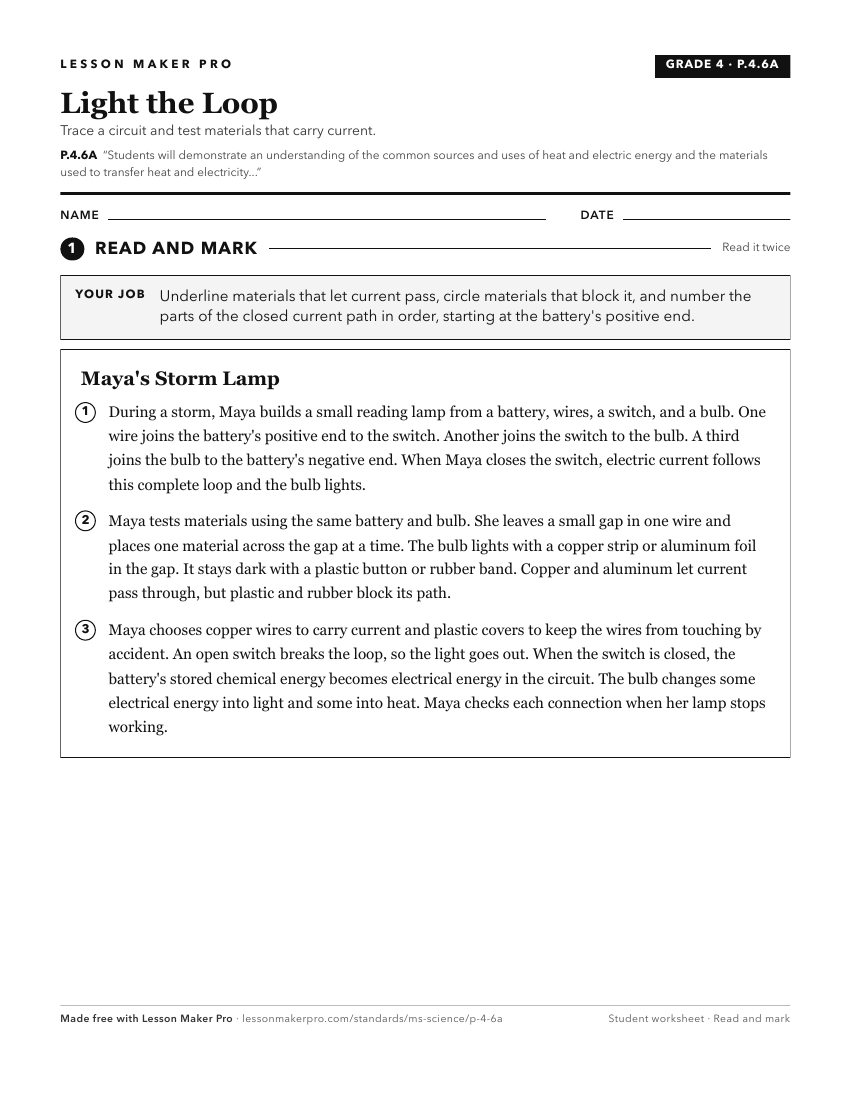
A ready-to-print activity worksheet aligned to P.4.6A, with an answer key for the teacher on its own page. No account needed.
PDF, US Letter, prints cleanly in black and white.
Download the worksheetKeep exploring
Related Standards
- PHS.8
Students will demonstrate an understanding of temperature scales, heat, and thermal energy transfer.
- P.4.6B
Students will demonstrate an understanding of the properties of light as forms of energy.
- E.4.10
Students will demonstrate an understanding of the various sources of energy used for human needs along with their effectiveness and possible impacts.
- PHS.7
Students will examine different forms of energy and energy transformations.
Turn this cluster into a lesson
Grade, subject, topic, and the complete cluster are prefilled. Create one free, no account needed.
Also for this cluster:Make a WorksheetMake a QuizMake a Sub Lesson