Mississippi Science P.4.6A.3
The Standard
- P.4.6A
- Students will demonstrate an understanding of the common sources and uses of heat and electric energy and the materials used to transfer heat and electricity.
Develop models demonstrating how heat and electrical energy can be transformed into other forms of energy (e.g., motion, sound, heat, or light).
2026 Mississippi College- and Career-Readiness Standards for Science · Motion, Forces, and Energy
Teacher's field guide
What This Standard Means
What Students Need to Do
- Students draw models that show energy changing form. They use arrows and labels to show how heat can cause motion and how electrical energy can produce motion, sound, heat, or light.
What Mastery Looks Like
- A student can show warm water heating the air above it, then rising air turning a paper spiral. They can also show electrical energy reaching a buzzer and producing sound.
Common Misconceptions
- Students may label the battery as the sound source instead of showing electrical energy reaching the buzzer. They may show heat turning a paper spiral without showing that warm air moves the paper.
How to Assess It
- Ask students to draw two arrow models: warm water heating air that turns a paper spiral, and a battery running a buzzer. Have them label the energy changes.
Lesson moves
Ways to Teach It
Hang a paper spiral above a bowl of warm water, then sketch how heat makes rising air turn it.
Ask students to draw and explain where electrical energy goes when a hair dryer blows warm air.
Give pairs cards showing a motor, buzzer, flashlight, and heater; have them match each device to its energy output.
Have students trace a toaster’s electrical energy to its hot coils, then to the bread it warms.
Free download
Printable P.4.6A.3 Worksheet
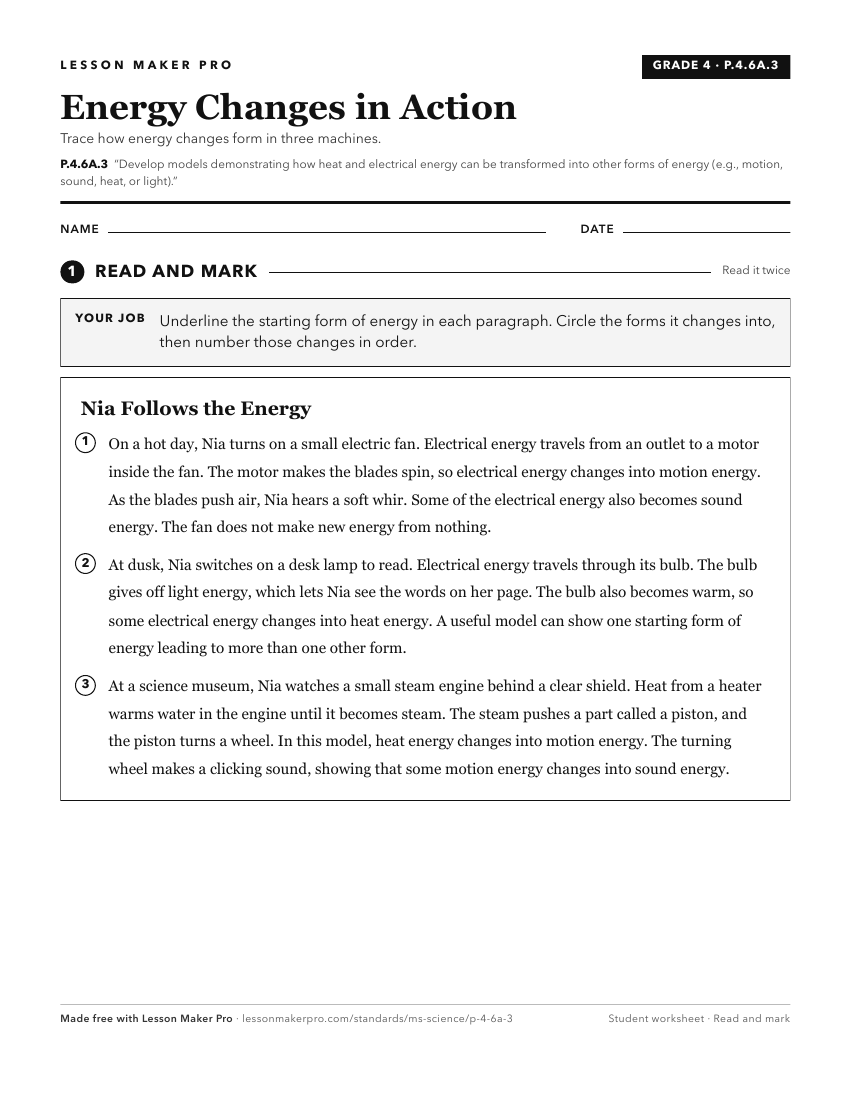
A ready-to-print activity worksheet aligned to P.4.6A.3, with an answer key for the teacher on its own page. No account needed.
PDF, US Letter, prints cleanly in black and white.
Download the worksheetKeep exploring
Related Standards
- P.4.6A.4
Develop models that demonstrate the path of an electric current in a complete, simple circuit (e.g., lighting a light bulb or making a sound).
- PHY.5.4
Develop and use models (e.g., circuit drawing and mathematical representation) to explain how electric circuits work by tracing the path of electrons, including...
- PHS.7.2
Use scientific investigations to explore the transformation of energy from one type to another (e.g., potential to kinetic energy, and mechanical, chemical, ele...
- P.4.6A.6
Design a device that converts any form of energy from one form to another form (e.g., construct a musical instrument that will convert vibrations to sound by co...
Turn this exact standard into a lesson
Grade, subject, topic, and the complete standard are prefilled. Create one free, no account needed.
Also for this standard:Make a WorksheetMake a QuizMake a Sub Lesson