Mississippi Science P.4.6A.4
The Standard
- P.4.6A
- Students will demonstrate an understanding of the common sources and uses of heat and electric energy and the materials used to transfer heat and electricity.
Develop models that demonstrate the path of an electric current in a complete, simple circuit (e.g., lighting a light bulb or making a sound).
2026 Mississippi College- and Career-Readiness Standards for Science · Motion, Forces, and Energy
Teacher's field guide
What This Standard Means
What Students Need to Do
- Students build or draw a simple circuit with a battery, wires, and a bulb or buzzer. They trace a complete path from one battery terminal, through the device, and back to the other terminal.
What Mastery Looks Like
- A student draws connections from both battery terminals to separate contacts on the bulb, with no gaps. They can point to a place where breaking the path would turn the bulb off.
Common Misconceptions
- Students may connect both wires to the same battery terminal or to the same part of the bulb. They may think one wire is enough, or that the path ends at the bulb.
How to Assess It
- Give students a drawing of a battery, a bulb with its two metal contacts labeled, and two loose wires. Ask them to connect the wires, trace the complete path, and mark one place a break would turn off the bulb.
Lesson moves
Ways to Teach It
Give pairs a battery holder, two clip wires, and a bulb in a socket; have them light it, remove one clip, and sketch both setups.
Show drawings of a complete circuit and one with a loose wire. Ask, "Which bulb lights, and where does the path break?"
Give pairs circuit cards with one missing connection; have them draw the missing wire and trace the path with a finger.
Have students inspect a battery-powered flashlight, find its battery contacts and switch, and draw why opening the switch turns off the light.
Free download
Printable P.4.6A.4 Worksheet
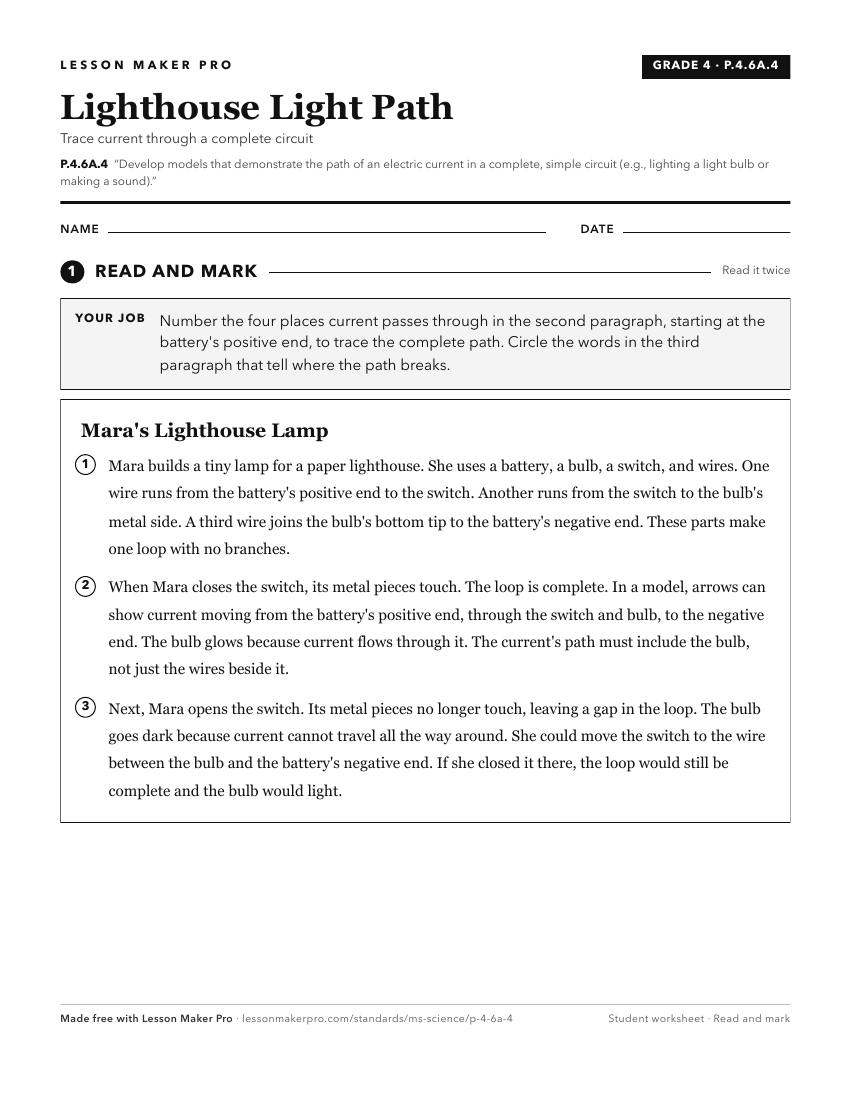
A ready-to-print activity worksheet aligned to P.4.6A.4, with an answer key for the teacher on its own page. No account needed.
PDF, US Letter, prints cleanly in black and white.
Download the worksheetKeep exploring
Related Standards
- PHS.9.1
Use digital resources and online simulations to investigate the basic principles of electricity, including static electricity, current electricity, and circuits...
- PHS.9
Students will explore basic principles of magnetism and electricity (e.g., static electricity, current electricity, and circuits).
- PHY.5.4
Develop and use models (e.g., circuit drawing and mathematical representation) to explain how electric circuits work by tracing the path of electrons, including...
- P.4.6A.3
Develop models demonstrating how heat and electrical energy can be transformed into other forms of energy (e.g., motion, sound, heat, or light).
Turn this exact standard into a lesson
Grade, subject, topic, and the complete standard are prefilled. Create one free, no account needed.
Also for this standard:Make a WorksheetMake a QuizMake a Sub Lesson