Mississippi Science PHY.5.4
The Standard
- PHY.5
- Students will investigate the key components of electricity and magnetism.
Develop and use models (e.g., circuit drawing and mathematical representation) to explain how electric circuits work by tracing the path of electrons, including concepts of energy transformation, transfer, conservation of energy, electric charge, and resistance using online simulations, probe systems, and/or laboratory experiences.
2026 Mississippi College- and Career-Readiness Standards for Science · Electricity and Magnetism
Teacher's field guide
What This Standard Means
What Students Need to Do
- Students draw a closed circuit and trace electrons through the wires and load from the battery’s negative terminal to its positive terminal. They use a model and V = IR to show how resistance affects current and how energy moves and changes form.
What Mastery Looks Like
- A student can draw a battery and bulb in a complete loop, mark electron direction, and explain that the bulb uses energy, not electrons. Given 6 V and 3 Ω, they calculate 2 A and identify light and heat as energy outputs.
Common Misconceptions
- Students may draw electrons stopping at the bulb or say the bulb uses up charge. They may also confuse electron direction with conventional current direction, or think resistance destroys energy.
How to Assess It
- On an exit ticket, ask students to draw a 6 V battery connected to a 3 Ω bulb and mark the electron path. Have them calculate the current and write where the battery’s energy goes.
Lesson moves
Ways to Teach It
Build a loop with a 3 V battery, matching bulb, and wires; move an inline ammeter before and after the bulb.
Show a sketch with electrons stopping at a bulb and ask: What is wrong with this drawing?
In PhET Circuit Construction Kit, build a 6 V circuit with a 3 Ω resistor, then calculate and check the current.
Trace the battery, switch, and bulb in a flashlight, then label where chemical energy becomes light and heat.
Free download
Printable PHY.5.4 Worksheet
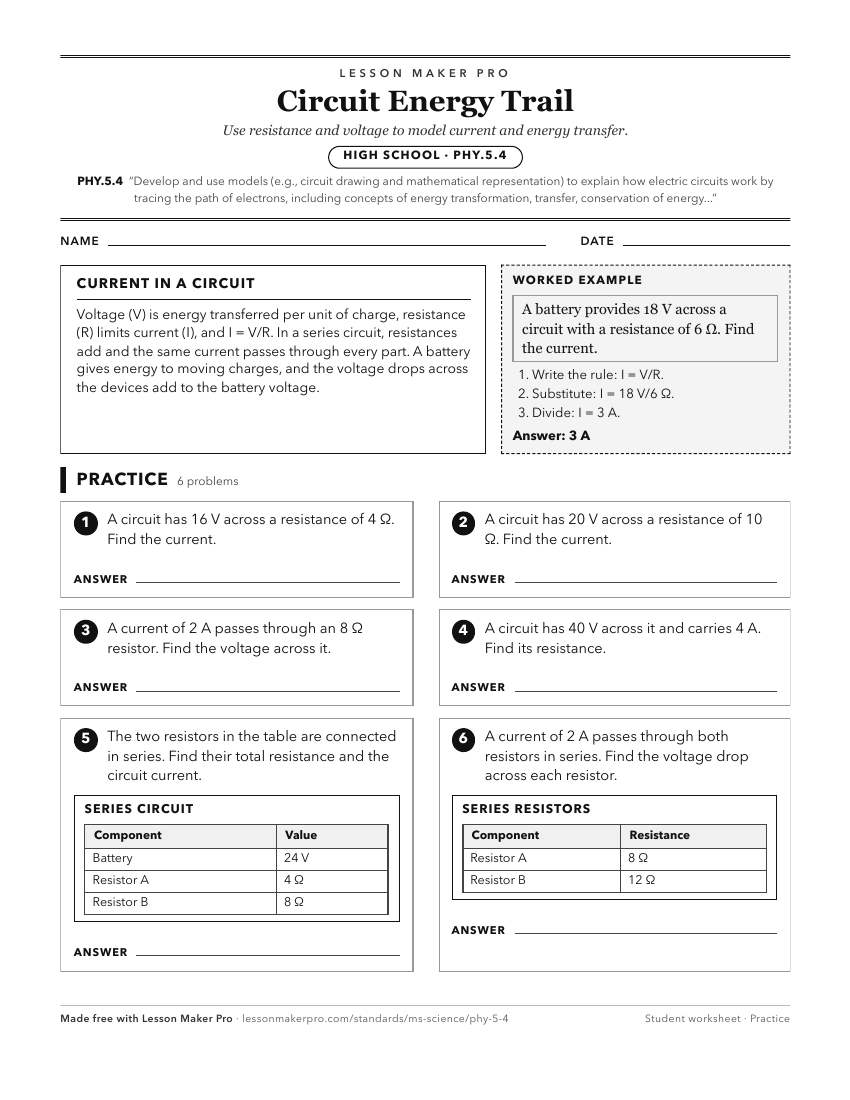
A ready-to-print activity worksheet aligned to PHY.5.4, with an answer key for the teacher on its own page. No account needed.
PDF, US Letter, prints cleanly in black and white.
Download the worksheetKeep exploring
Related Standards
- PHS.9.1
Use digital resources and online simulations to investigate the basic principles of electricity, including static electricity, current electricity, and circuits...
- PHY.3.3
Through real-world applications, draw conclusions about mechanical potential energy and kinetic energy using online simulations and/or laboratory experiences.
- P.4.6A.4
Develop models that demonstrate the path of an electric current in a complete, simple circuit (e.g., lighting a light bulb or making a sound).
- P.4.6A.3
Develop models demonstrating how heat and electrical energy can be transformed into other forms of energy (e.g., motion, sound, heat, or light).
Turn this exact standard into a lesson
Grade, subject, topic, and the complete standard are prefilled. Create one free, no account needed.
Also for this standard:Make a WorksheetMake a QuizMake a Sub Lesson