Mississippi Science PHY.3.3
The Standard
- PHY.3
- Students will develop an understanding of concepts related to work and energy.
Through real-world applications, draw conclusions about mechanical potential energy and kinetic energy using online simulations and/or laboratory experiences.
2026 Mississippi College- and Career-Readiness Standards for Science · Work and Energy
Teacher's field guide
What This Standard Means
What Students Need to Do
- Students use a ramp test or simulation to compare an object's height and speed at different points. They explain how energy shifts between gravitational potential energy and kinetic energy as it moves.
What Mastery Looks Like
- A student uses measurements to explain why a marble released higher on a ramp moves faster at the bottom. They can explain that friction transfers some energy to the surroundings rather than making it disappear.
Common Misconceptions
- Students may think a raised marble has no energy because it is not moving. They may also say energy disappears when the marble slows down, or that a heavier marble must roll faster from the same height.
How to Assess It
- Show a marble at the top and bottom of a ramp. Ask: Where does it have more gravitational potential energy, where does it have more kinetic energy, and what evidence supports your answers?
Lesson moves
Ways to Teach It
Release a marble from two marked heights on a ramp, then use phone slow motion to compare its speed at the bottom.
Show a skateboarder at the top and bottom of a ramp; ask students to explain where each type of energy is greatest.
Give pairs four roller-coaster position cards; have them rank potential and kinetic energy at each position and defend one ranking.
Pause a playground swing video at its highest and lowest points; have students label the energy at each point and explain why the swing slows.
Free download
Printable PHY.3.3 Worksheet
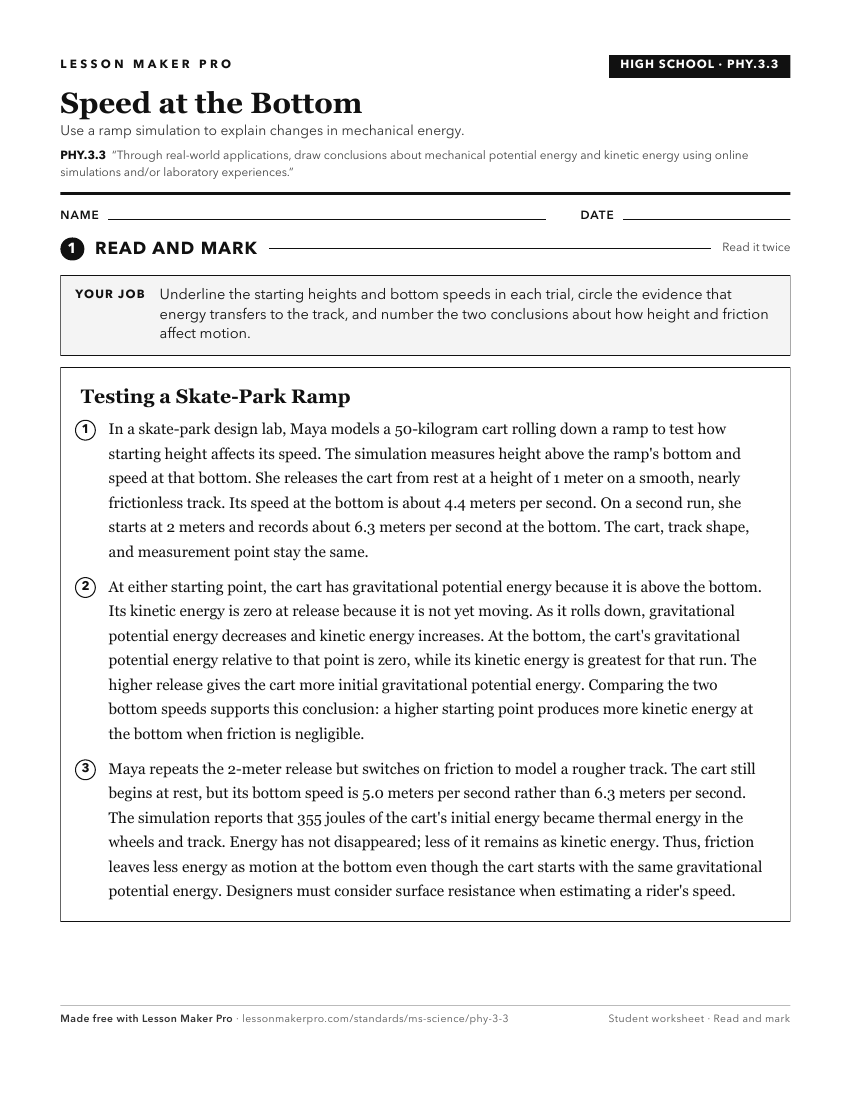
A ready-to-print activity worksheet aligned to PHY.3.3, with an answer key for the teacher on its own page. No account needed.
PDF, US Letter, prints cleanly in black and white.
Download the worksheetKeep exploring
Related Standards
- PHS.7.3
Using mathematical and computational analysis, calculate potential and kinetic energy based on given data. Use equations such as PE=mgh and KE=½ mv2.
- PHY.5.4
Develop and use models (e.g., circuit drawing and mathematical representation) to explain how electric circuits work by tracing the path of electrons, including...
- P.6.6.7
Determine the relationships between the concepts of potential, kinetic, and thermal energy.
- PHY.2.7
Analyze real-world applications to draw conclusions about Newton’s three laws of motion using online simulations, probe systems, and/or laboratory experiences.
Turn this exact standard into a lesson
Grade, subject, topic, and the complete standard are prefilled. Create one free, no account needed.
Also for this standard:Make a WorksheetMake a QuizMake a Sub Lesson