Mississippi Science PHS.7.3
The Standard
- PHS.7
- Students will examine different forms of energy and energy transformations.
Using mathematical and computational analysis, calculate potential and kinetic energy based on given data. Use equations such as PE=mgh and KE=½ mv2.
2026 Mississippi College- and Career-Readiness Standards for Science · Energy
Teacher's field guide
What This Standard Means
What Students Need to Do
- Students use mass and height to calculate gravitational potential energy. They use mass and speed to calculate kinetic energy, square the speed, and give both answers in joules.
What Mastery Looks Like
- Students choose the right equation and use kilograms, meters, and meters per second. They get the same answer by hand and with a spreadsheet formula.
Common Misconceptions
- Students may forget to square speed or square the entire kinetic energy expression. They may use grams instead of kilograms or measure height from a different starting level.
How to Assess It
- Exit ticket: A 2 kg cart is 3 m above the floor and moves at 4 m/s. Using g = 9.8 m/s², calculate its potential and kinetic energy in joules.
Lesson moves
Ways to Teach It
Weigh a toy car, place it at two marked heights on a ramp, measure each height above the floor, and calculate both potential energies.
Ask whether doubling a skateboarder's speed doubles or quadruples its kinetic energy, then have students defend an answer with two calculations.
In pairs, draw cart data cards, calculate both energies, and earn a point for correct values and units.
Calculate a 1,500 kg car's kinetic energy at 10 m/s and 20 m/s, then explain what the difference means for braking.
Free download
Printable PHS.7.3 Worksheet
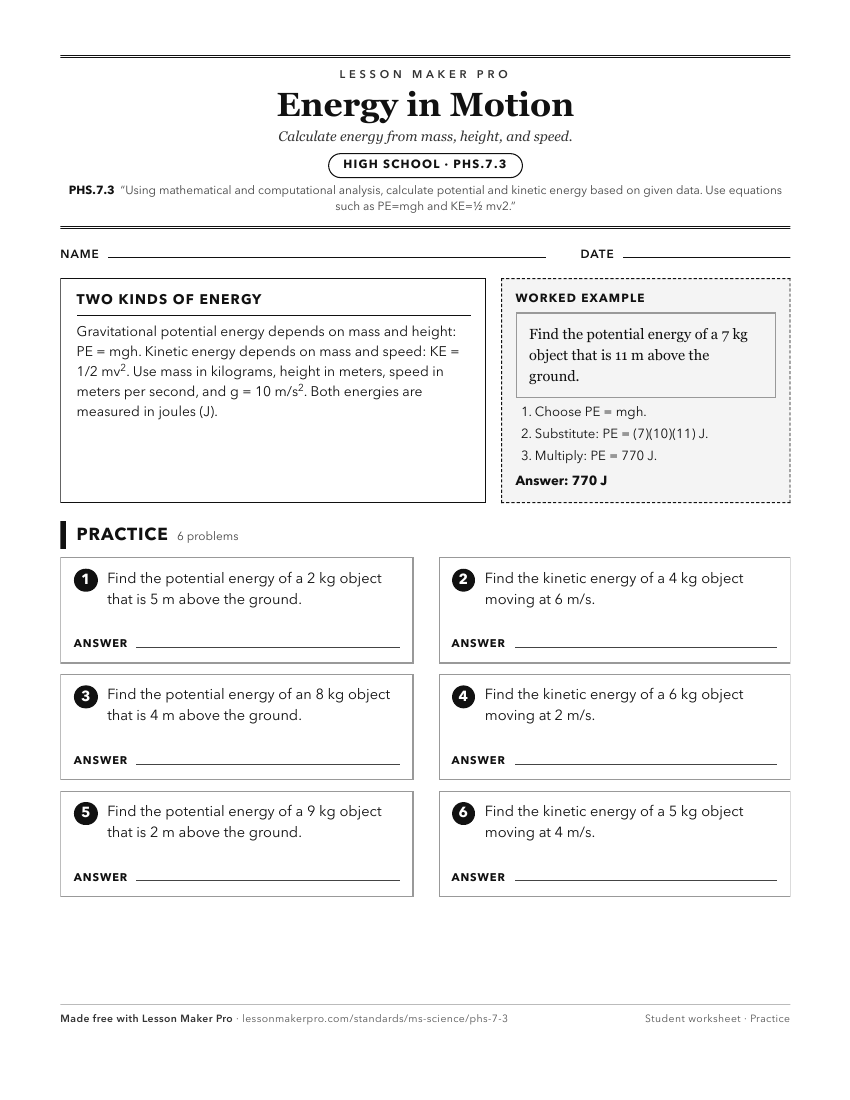
A ready-to-print activity worksheet aligned to PHS.7.3, with an answer key for the teacher on its own page. No account needed.
PDF, US Letter, prints cleanly in black and white.
Download the worksheetKeep exploring
Related Standards
- PHY.1.3
Use mathematical and computational analysis to solve problems using kinematic equations.
- PHY.3.3
Through real-world applications, draw conclusions about mechanical potential energy and kinetic energy using online simulations and/or laboratory experiences.
- PHS.5.7
Use mathematical and computational representations to create graphs and formulas that describe the relationships between force, work, and energy (i.e., W=F*d, K...
- P.6.6.7
Determine the relationships between the concepts of potential, kinetic, and thermal energy.
Turn this exact standard into a lesson
Grade, subject, topic, and the complete standard are prefilled. Create one free, no account needed.
Also for this standard:Make a WorksheetMake a QuizMake a Sub Lesson