Mississippi Science PHS.5.7
The Standard
- PHS.5
- Students will analyze the scientific principles of motion, force, and work.
Use mathematical and computational representations to create graphs and formulas that describe the relationships between force, work, and energy (i.e., W=F*d, KE=½ mv2, PE=mgh, W=∆KE).
2026 Mississippi College- and Career-Readiness Standards for Science · Newton’s Laws of Motion
Teacher's field guide
What This Standard Means
What Students Need to Do
- Students use measurements of force, distance, mass, speed, and height to write equations for work and energy. They graph the relationships and compare net work with changes in kinetic energy.
What Mastery Looks Like
- A student calculates work, kinetic energy, and gravitational potential energy with correct units. They label graph axes and explain why doubling speed quadruples kinetic energy. They check whether net work matches the change in kinetic energy.
Common Misconceptions
- Students may use the work done by one force to predict a cart's change in kinetic energy, ignoring friction. They may think doubling speed doubles kinetic energy, or leave height out when comparing gravitational potential energy.
How to Assess It
- Exit ticket: A 2 kg cart speeds up from 2 m/s to 4 m/s while a constant net force acts over 3 m. Find its change in kinetic energy and net force, then sketch net work against distance from 0 to 3 m.
Lesson moves
Ways to Teach It
Pull a cart steadily with a spring scale across taped distances, record the force, and graph calculated work against distance.
Ask students to calculate a cart's kinetic energy at 2 m/s and 4 m/s, then explain the difference in writing.
Give pairs a spreadsheet with cart masses and speeds; have them calculate kinetic energy, plot it against speed squared, and compare slopes.
Measure the height of a school staircase, then calculate the gain in gravitational potential energy for a 60 kg climber.
Free download
Printable PHS.5.7 Worksheet
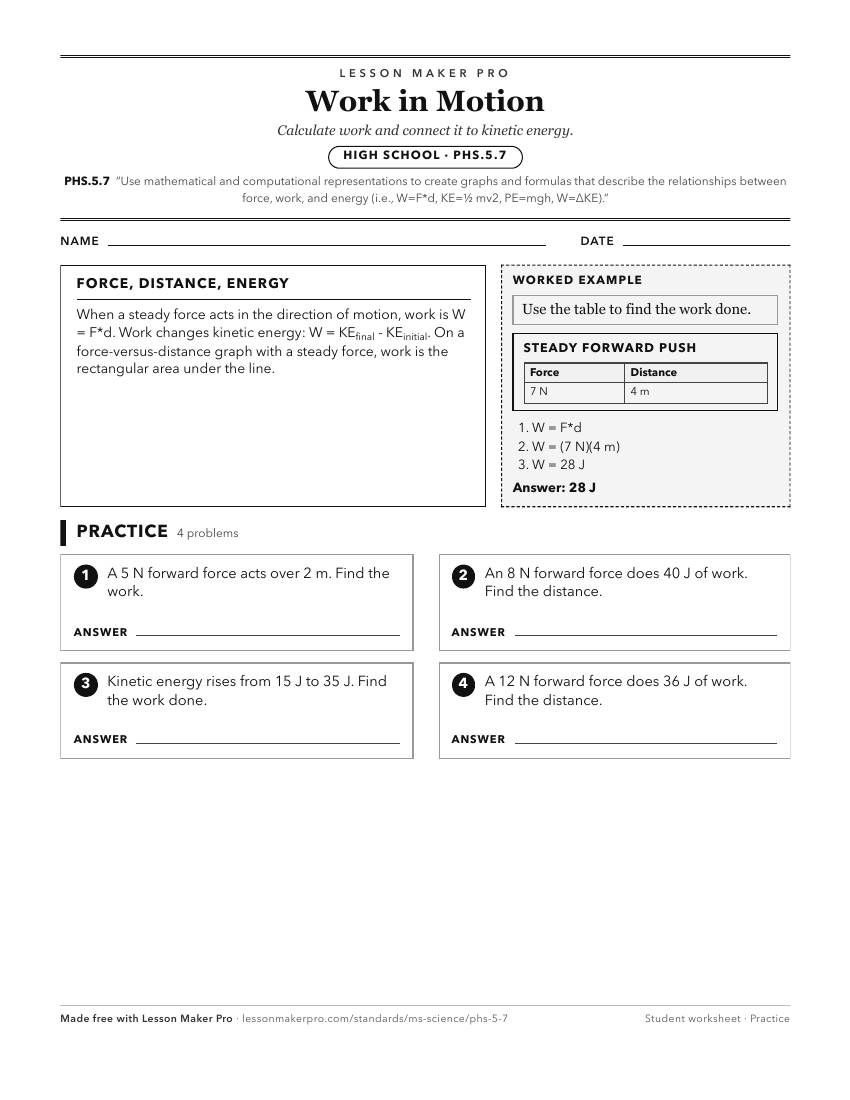
A ready-to-print activity worksheet aligned to PHS.5.7, with an answer key for the teacher on its own page. No account needed.
PDF, US Letter, prints cleanly in black and white.
Download the worksheetKeep exploring
Related Standards
- PHS.7.3
Using mathematical and computational analysis, calculate potential and kinetic energy based on given data. Use equations such as PE=mgh and KE=½ mv2.
- PHY.3.1
Use mathematical and computational analysis to qualitatively and quantitatively analyze the concept of work, energy, and power to explain and apply the conserva...
- PHS.5.4
Use mathematical and computational analyses to show the relationships among force, mass, and acceleration (i.e., Newton’s second law).
- P.6.6.2
Use mathematical computation and diagrams to calculate the sum of forces acting on various objects.
Turn this exact standard into a lesson
Grade, subject, topic, and the complete standard are prefilled. Create one free, no account needed.
Also for this standard:Make a WorksheetMake a QuizMake a Sub Lesson