Mississippi Science PHY.3.1
The Standard
- PHY.3
- Students will develop an understanding of concepts related to work and energy.
Use mathematical and computational analysis to qualitatively and quantitatively analyze the concept of work, energy, and power to explain and apply the conservation of energy.
2026 Mississippi College- and Career-Readiness Standards for Science · Work and Energy
Teacher's field guide
What This Standard Means
What Students Need to Do
- Students calculate work from force and displacement, then calculate power from work and time. They track energy as it changes form and use numbers or a spreadsheet to check that the total is accounted for.
What Mastery Looks Like
- Given a cart pulled 2 m with a 10 N force along its path in 4 s, a student finds 20 J of work and 5 W of average power. They can explain where the energy goes, including energy transferred to the surroundings by friction.
Common Misconceptions
- Students may say that holding a box still does work on the box, even though the box does not move. They may think energy disappears when friction slows a cart, or confuse power with the total energy transferred.
How to Assess It
- Exit ticket: A student lifts a 2 kg book 3 m in 2 s. Using g = 10 m/s², find the work done on the book, its gain in gravitational energy, and the student's average power.
Lesson moves
Ways to Teach It
Pull a cart 1 m with a spring scale, record the force, and calculate the work done on the cart.
Ask pairs: Does holding a backpack still do work on the backpack? Explain using displacement.
Enter force, distance, and time for three cart pulls in a spreadsheet, then calculate and compare work and power.
Read a 1,000 W hair dryer label, calculate the energy transferred in 30 seconds, and name where that energy goes.
Free download
Printable PHY.3.1 Worksheet
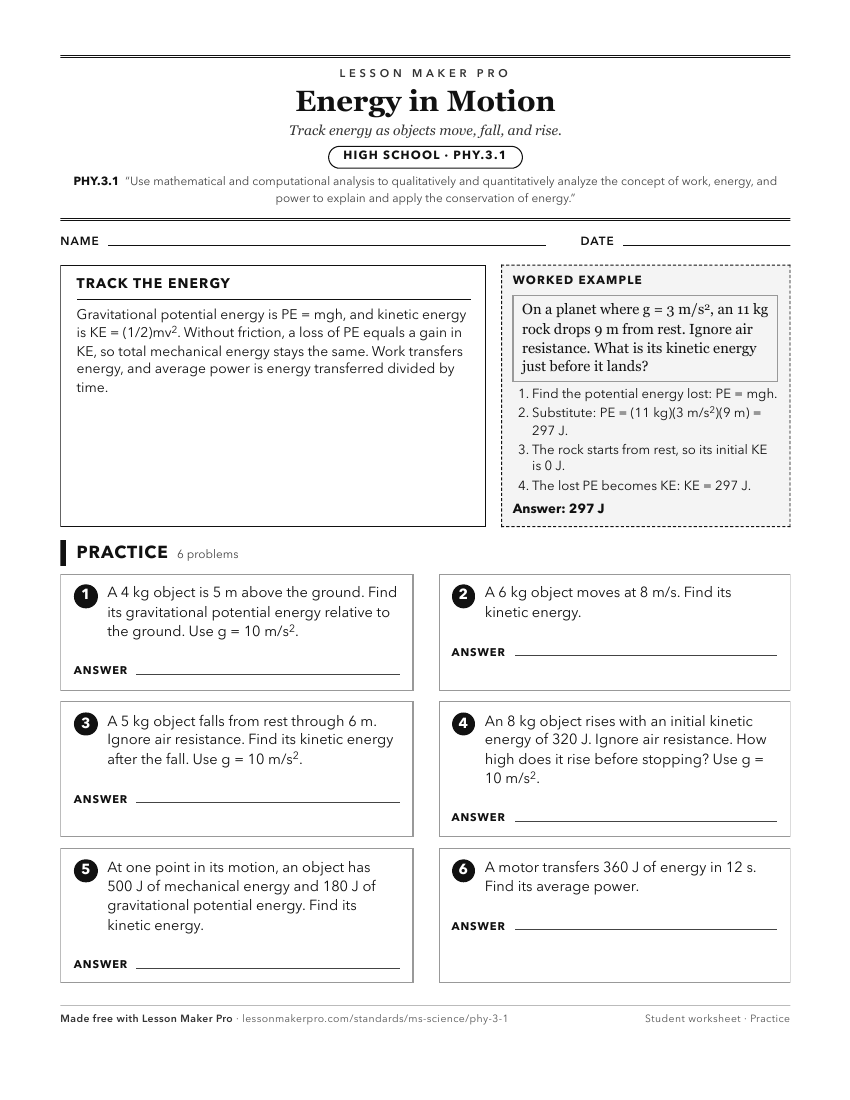
A ready-to-print activity worksheet aligned to PHY.3.1, with an answer key for the teacher on its own page. No account needed.
PDF, US Letter, prints cleanly in black and white.
Download the worksheetKeep exploring
Related Standards
- PHS.7.3
Using mathematical and computational analysis, calculate potential and kinetic energy based on given data. Use equations such as PE=mgh and KE=½ mv2.
- PHY.3
Students will develop an understanding of concepts related to work and energy.
- PHS.5.7
Use mathematical and computational representations to create graphs and formulas that describe the relationships between force, work, and energy (i.e., W=F*d, K...
- PHY.3.2
Use mathematical and computational analysis to explore conservation of momentum and impulse.
Turn this exact standard into a lesson
Grade, subject, topic, and the complete standard are prefilled. Create one free, no account needed.
Also for this standard:Make a WorksheetMake a QuizMake a Sub Lesson