Mississippi Science PHY.3
Standard Cluster
Students will develop an understanding of concepts related to work and energy. Use mathematical and computational analysis to qualitatively and quantitatively analyze the concept of work, energy, and power to explain and apply the conservation of energy. Use mathematical and computational analysis to explore conservation of momentum and impulse. Through real-world applications, draw conclusions about mechanical potential energy and kinetic energy using online simulations and/or laboratory experiences. Design and conduct investigations to compare conservation of momentum and conservation of kinetic energy in perfectly inelastic and elastic collisions using probe systems, online simulations, and/or laboratory experiences. Investigate, collect data, and summarize the principles of thermodynamics by exploring how heat energy is transferred from higher temperature to lower temperature until equilibrium is reached. Enrichment: Design, conduct, and communicate investigations that explore how temperature and thermal energy relate to molecular motion and states of matter. Enrichment: Use mathematical and computational analysis to analyze problems involving specific heat and heat capacity. Enrichment: Research to compare the first and second laws of thermodynamics as related to heat engines, refrigerators, and thermal efficiency. Explore the kinetic theory in terms of kinetic energy of ideal gases using digital resources. Enrichment: Research the efficiency of everyday machines (e.g., automobiles, hair dryers, refrigerators, and washing machines). Enrichment: Use an engineering design process to design and build a themed Rube Goldberg-type machine that has six or more steps and complete a desired task (e.g., pop a balloon, fill a bottle, shoot a projectile, or raise an object 35 cm) within an allotted time. Include a poster that demonstrates the calculations of the energy transformation or efficiency of the machine. *
2026 Mississippi College- and Career-Readiness Standards for Science · Work and Energy
Cluster contents
Standards in This Cluster
PHY.3 is a cluster heading. These are the individual standards under it.
- PHY.3.1
Use mathematical and computational analysis to qualitatively and quantitatively analyze the concept of work, energy, and power to explain and apply the conserva...
- PHY.3.2
Use mathematical and computational analysis to explore conservation of momentum and impulse.
- PHY.3.3
Through real-world applications, draw conclusions about mechanical potential energy and kinetic energy using online simulations and/or laboratory experiences.
- PHY.3.4
Design and conduct investigations to compare conservation of momentum and conservation of kinetic energy in perfectly inelastic and elastic collisions using pro...
- PHY.3.5
Investigate, collect data, and summarize the principles of thermodynamics by exploring how heat energy is transferred from higher temperature to lower temperatu...
- PHY.3.6
Enrichment: Design, conduct, and communicate investigations that explore how temperature and thermal energy relate to molecular motion and states of matter.
- PHY.3.7
Enrichment: Use mathematical and computational analysis to analyze problems involving specific heat and heat capacity.
- PHY.3.8
Enrichment: Research to compare the first and second laws of thermodynamics as related to heat engines, refrigerators, and thermal efficiency.
- PHY.3.9
Explore the kinetic theory in terms of kinetic energy of ideal gases using digital resources.
- PHY.3.10
Enrichment: Research the efficiency of everyday machines (e.g., automobiles, hair dryers, refrigerators, and washing machines).
- PHY.3.11
Enrichment: Use an engineering design process to design and build a themed Rube Goldberg-type machine that has six or more steps and complete a desired task (e....
Teacher's field guide
What This Cluster Means
What Students Need to Do
- Students calculate work, power, kinetic energy, and gravitational potential energy. They use momentum and impulse to analyze collisions. They use temperature data to explain how heat moves between objects.
What Mastery Looks Like
- Given cart masses and speeds, students predict what happens in a collision and compare kinetic energy before and after. They calculate the work and power needed to lift an object. From temperature readings, they identify which way heat flows and when two objects reach the same temperature.
Common Misconceptions
- Students often assume kinetic energy is conserved when carts stick together, or that energy disappears in a crash. They may count a force as work even when nothing moves, or confuse work with power. They may think heat flows from a cooler object to a warmer one.
How to Assess It
- Exit ticket: A 1 kg cart moving at 2 m/s hits an identical cart at rest, and they stick. Find their final speed and kinetic energy before and after the collision, then explain the difference.
Lesson moves
Ways to Teach It
Film two hook-and-loop carts colliding beside a meterstick, then use video frames to calculate momentum and kinetic energy before and after.
Ask pairs, 'Why does a cart crash make noise if energy is conserved?' Have them write a two-sentence energy account.
Give pairs equal-mass cart cards labeled 'bounce' or 'stick'; have them calculate final speeds and kinetic energies, then check a key.
Time a student carrying a 5 kg backpack up a measured staircase; calculate the work and power for the backpack at two walking speeds.
Free download
Printable PHY.3 Worksheet
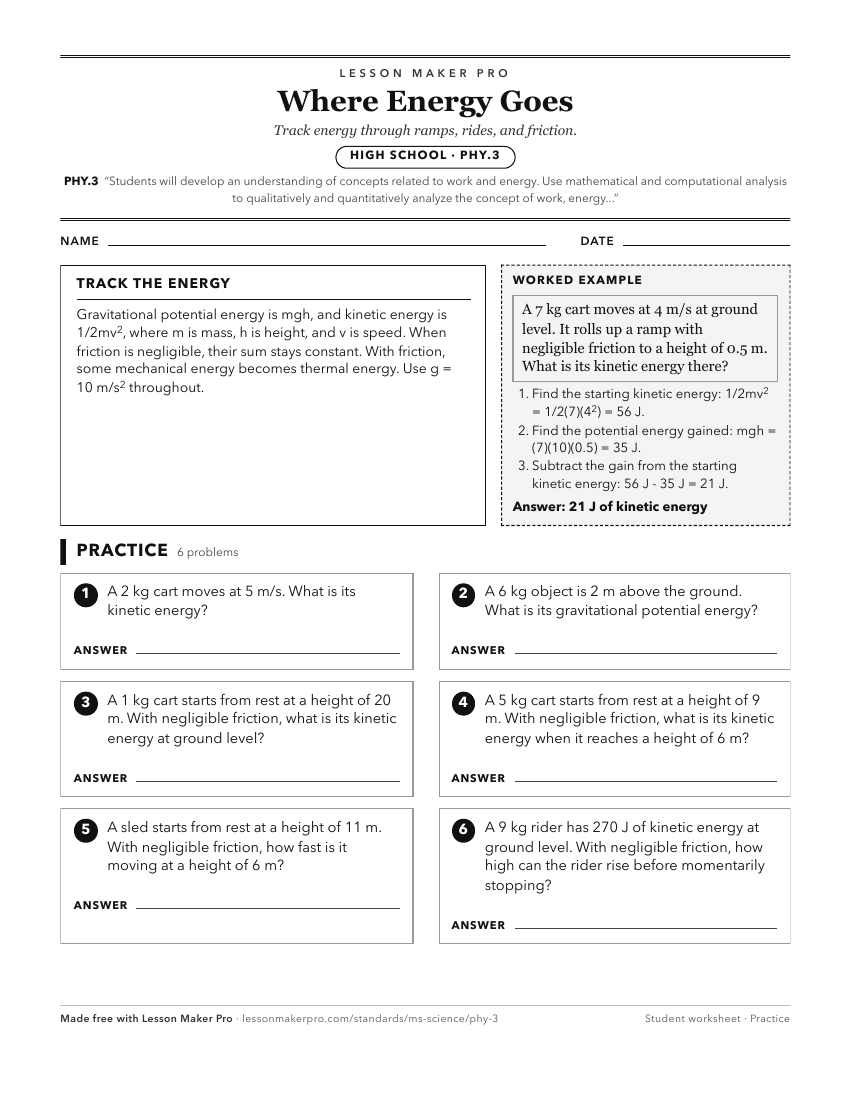
A ready-to-print activity worksheet aligned to PHY.3, with an answer key for the teacher on its own page. No account needed.
PDF, US Letter, prints cleanly in black and white.
Download the worksheetKeep exploring
Related Standards
- PHY.2
Students will develop an understanding of concepts related to Newtonian dynamics.
- PHS.5
Students will analyze the scientific principles of motion, force, and work.
- P.4.6B
Students will demonstrate an understanding of the properties of light as forms of energy.
- PHS.7
Students will examine different forms of energy and energy transformations.
Turn this cluster into a lesson
Grade, subject, topic, and the complete cluster are prefilled. Create one free, no account needed.
Also for this cluster:Make a WorksheetMake a QuizMake a Sub Lesson