Mississippi Science PHS.7
Standard Cluster
Students will examine different forms of energy and energy transformations. Using digital resources, explore forms of energy (e.g., potential, kinetic, mechanical, chemical, electrical, thermal, radiant, and nuclear). Use scientific investigations to explore the transformation of energy from one type to another (e.g., potential to kinetic energy, and mechanical, chemical, electrical, thermal, radiant, and nuclear energy interactions). Using mathematical and computational analysis, calculate potential and kinetic energy based on given data. Use equations such as PE=mgh and KE=½ mv2. Conduct investigations to provide evidence of the conservation of energy as energy is converted from one form of energy to another (e.g., wind to electric, chemical to thermal, mechanical to thermal, and potential to kinetic).
2026 Mississippi College- and Career-Readiness Standards for Science · Energy
Cluster contents
Standards in This Cluster
PHS.7 is a cluster heading. These are the individual standards under it.
- PHS.7.1
Using digital resources, explore forms of energy (e.g., potential, kinetic, mechanical, chemical, electrical, thermal, radiant, and nuclear).
- PHS.7.2
Use scientific investigations to explore the transformation of energy from one type to another (e.g., potential to kinetic energy, and mechanical, chemical, ele...
- PHS.7.3
Using mathematical and computational analysis, calculate potential and kinetic energy based on given data. Use equations such as PE=mgh and KE=½ mv2.
- PHS.7.4
Conduct investigations to provide evidence of the conservation of energy as energy is converted from one form of energy to another (e.g., wind to electric, chem...
Teacher's field guide
What This Cluster Means
What Students Need to Do
- Students identify energy forms in moving objects, fuels, circuits, light, and nuclear reactions. They track changes between forms, calculate gravitational potential and kinetic energy, and use measurements to account for energy transferred to the surroundings.
What Mastery Looks Like
- A student can trace energy changes in a device, including transfers to the surroundings. They calculate PE and KE from mass, height, and speed, with answers in joules. They use investigation data to explain why mechanical energy may decrease without energy disappearing.
Common Misconceptions
- Students may say energy disappears when friction slows an object. They may use height instead of speed to calculate KE, or forget to square speed. Some assume all initial PE becomes KE, even when energy transfers to the surroundings.
How to Assess It
- Give students a 2 kg cart released from a height of 1 m that reaches 3 m/s at the bottom. Ask them to calculate initial PE and final KE, then explain the difference. Use g = 10 m/s².
Lesson moves
Ways to Teach It
Release a cart down a ramp, measure its height and bottom speed with slow-motion video, then compare calculated PE and KE.
Show a wind turbine diagram and ask students to write where the wind's energy goes, including transfers to the surroundings as heat.
Give pairs mass, height, and speed cards; have them choose PE or KE, calculate joules, and check each other's work.
Use an online nuclear power plant diagram to trace nuclear energy through thermal, mechanical, and electrical forms, including heat transferred to the surroundings.
Free download
Printable PHS.7 Worksheet
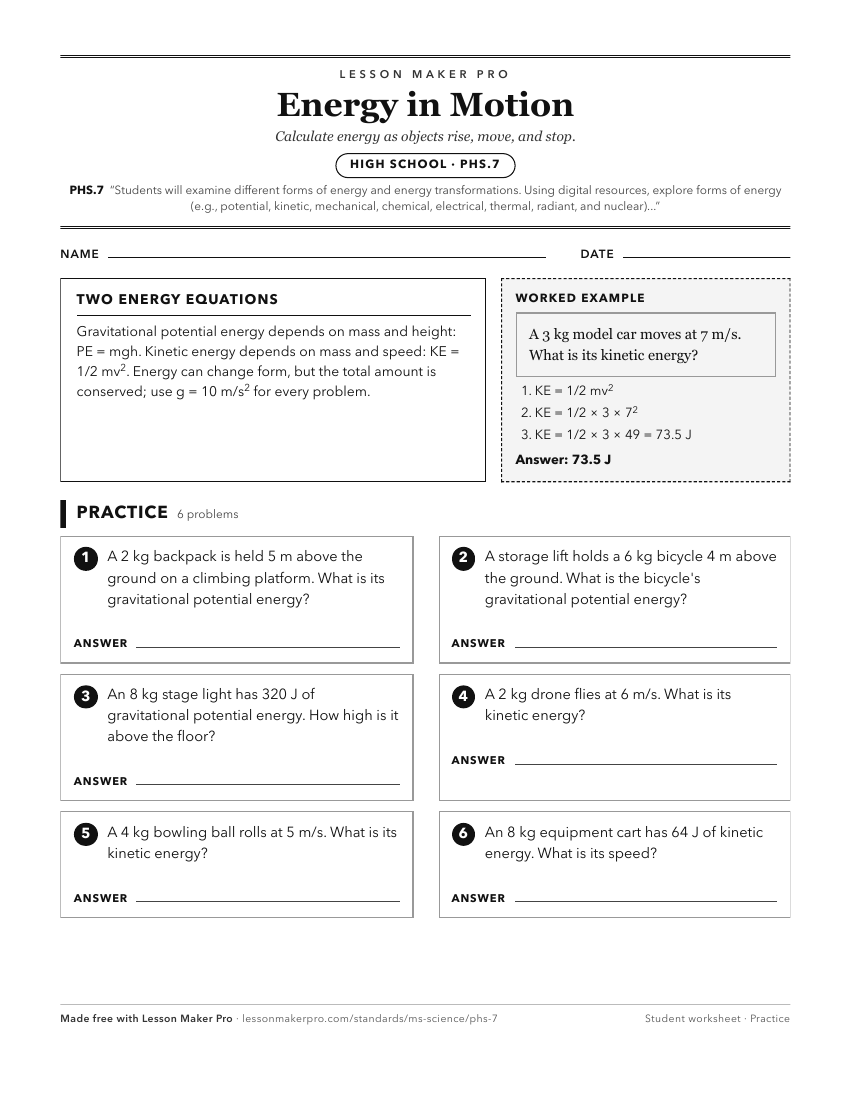
A ready-to-print activity worksheet aligned to PHS.7, with an answer key for the teacher on its own page. No account needed.
PDF, US Letter, prints cleanly in black and white.
Download the worksheetKeep exploring
Related Standards
- P.4.6A
Students will demonstrate an understanding of the common sources and uses of heat and electric energy and the materials used to transfer heat and electricity.
- PHY.3
Students will develop an understanding of concepts related to work and energy.
- P.4.6B
Students will demonstrate an understanding of the properties of light as forms of energy.
- E.4.10
Students will demonstrate an understanding of the various sources of energy used for human needs along with their effectiveness and possible impacts.
Turn this cluster into a lesson
Grade, subject, topic, and the complete cluster are prefilled. Create one free, no account needed.
Also for this cluster:Make a WorksheetMake a QuizMake a Sub Lesson