Mississippi Science P.4.6B
Standard Cluster
Students will demonstrate an understanding of the properties of light as forms of energy. Construct scientific evidence to support the claim that white light is made up of different colors. Include the work of Sir Isaac Newton to communicate results. Obtain and communicate information to explain how the visibility of an object is related to light. Develop and use models to communicate how light travels and behaves when it strikes an object, including reflection, refraction, and absorption. Plan and conduct scientific investigations to explain how light behaves when it strikes transparent, translucent, and opaque materials.
2026 Mississippi College- and Career-Readiness Standards for Science · Motion, Forces, and Energy
Cluster contents
Standards in This Cluster
P.4.6B is a cluster heading. These are the individual standards under it.
- P.4.6B.1
Construct scientific evidence to support the claim that white light is made up of different colors. Include the work of Sir Isaac Newton to communicate results.
- P.4.6B.2
Obtain and communicate information to explain how the visibility of an object is related to light.
- P.4.6B.3
Develop and use models to communicate how light travels and behaves when it strikes an object, including reflection, refraction, and absorption.
- P.4.6B.4
Plan and conduct scientific investigations to explain how light behaves when it strikes transparent, translucent, and opaque materials.
Teacher's field guide
What This Cluster Means
What Students Need to Do
- Students use prism observations and Newton’s work as evidence that white light contains different colors. They test clear, cloudy, and solid materials, then draw light paths to show how light makes objects visible and how it reflects, bends, or is absorbed.
What Mastery Looks Like
- Students explain why a prism produces a band of colors from white light. Their drawings show light reflecting from an object into an eye and bending as it enters water. They predict what happens when light strikes clear plastic, wax paper, and black paper.
Common Misconceptions
- Some students think a prism creates colors rather than separating colors in white light. Others think eyes send out light or that objects are visible in complete darkness. They may call wax paper transparent because some light passes through it, or draw light going straight through water.
How to Assess It
- Exit ticket: Draw white light passing through a prism onto a wall, then reaching an eye. Label what Newton found and explain why the colors on the wall are visible.
Lesson moves
Ways to Teach It
Shine a flashlight through clear plastic, wax paper, and cardboard; have students record what they can see on the other side.
Read a short account of Newton’s prism test, then ask: How did the colored band support his claim about white light?
Give pairs cards showing a mirror, a glass of water, and black paper; have them match each to reflection, refraction, or absorption and draw arrows.
Compare a clear window, frosted film, and a closed curtain; have students sketch light paths to explain what they can see through each.
Free download
Printable P.4.6B Worksheet
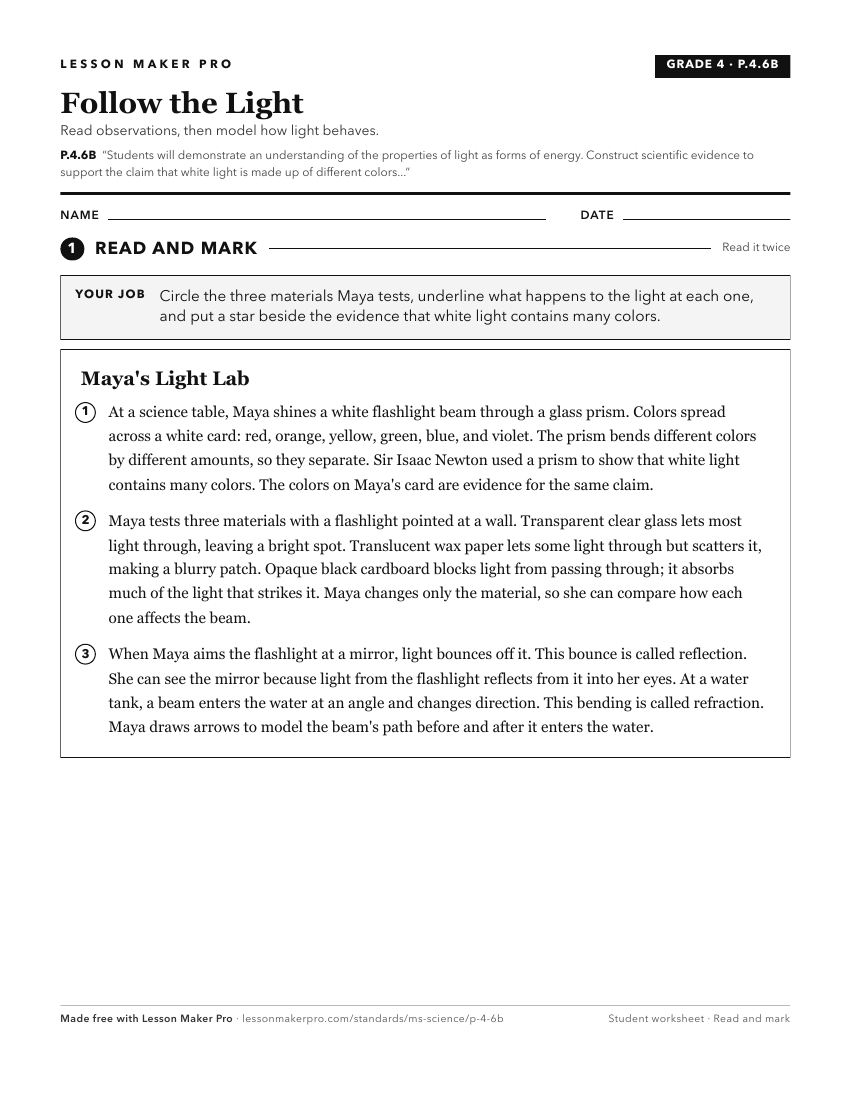
A ready-to-print activity worksheet aligned to P.4.6B, with an answer key for the teacher on its own page. No account needed.
PDF, US Letter, prints cleanly in black and white.
Download the worksheetKeep exploring
Related Standards
- E.K.8B
Students will demonstrate an understanding that the Sun provides the Earth with heat and light.
- P.1.6A
Students will demonstrate an understanding that light is required to make objects visible.
- P.4.6C
Students will demonstrate an understanding of the properties of sound as a form of energy.
- PHS.7
Students will examine different forms of energy and energy transformations.
Turn this cluster into a lesson
Grade, subject, topic, and the complete cluster are prefilled. Create one free, no account needed.
Also for this cluster:Make a WorksheetMake a QuizMake a Sub Lesson