Mississippi Science P.4.6C
Standard Cluster
Students will demonstrate an understanding of the properties of sound as a form of energy. Plan and conduct scientific investigations to test how different variables affect the properties of sound (i.e., pitch and volume). In relation to how sound is perceived by humans, analyze and interpret data from observations and measurements to report how changes in vibration affect the pitch and volume of sound. Obtain and communicate information about scientists who pioneered in the science of sound, (e.g., Alexander Graham Bell, Robert Boyle, Daniel Bernoulli, and Guglielmo Marconi).
2026 Mississippi College- and Career-Readiness Standards for Science · Motion, Forces, and Energy
Cluster contents
Standards in This Cluster
P.4.6C is a cluster heading. These are the individual standards under it.
- P.4.6C.1
Plan and conduct scientific investigations to test how different variables affect the properties of sound (i.e., pitch and volume).
- P.4.6C.2
In relation to how sound is perceived by humans, analyze and interpret data from observations and measurements to report how changes in vibration affect the pit...
- P.4.6C.3
Obtain and communicate information about scientists who pioneered in the science of sound, (e.g., Alexander Graham Bell, Robert Boyle, Daniel Bernoulli, and Gug...
Teacher's field guide
What This Cluster Means
What Students Need to Do
- Students test how changing a vibrating object's length or pluck strength affects pitch and volume. They record what they hear and explain the patterns using vibrations. They read about Alexander Graham Bell and share how his work helped people send speech over distance.
What Mastery Looks Like
- A student changes one thing at a time and records the result. They explain that faster vibrations make a higher pitch, while larger vibrations make a louder sound. They can give one accurate fact about Bell's work with sound.
Common Misconceptions
- Students may confuse high pitch with loud volume and assume plucking harder makes a note higher. They may also think an object must move visibly to make sound.
How to Assess It
- Give students these results: a 5 cm ruler overhang makes a high sound, a 15 cm overhang makes a low sound, and a harder pluck makes a louder sound. Ask them to explain what changed about the vibrations in each case.
Lesson moves
Ways to Teach It
Clamp a ruler to a desk, change its overhang to test pitch, then change pluck strength to test volume and record results.
Ask pairs to explain why a short ruler sounds higher but a hard pluck sounds louder, using their recorded results.
Give teams cards showing fast or slow vibrations and big or small movements; have them match each to pitch or volume descriptions.
Have students read a short Alexander Graham Bell biography, then explain how a telephone turns speech vibrations into signals and back into sound.
Free download
Printable P.4.6C Worksheet
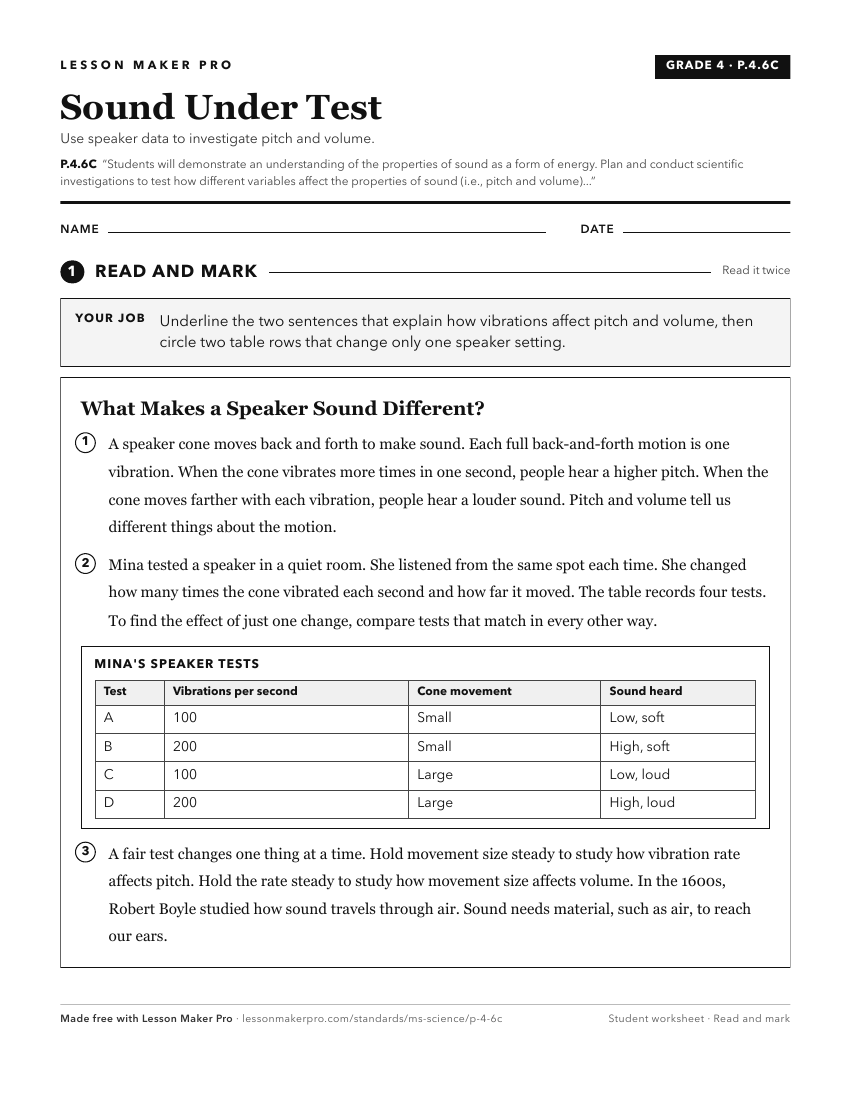
A ready-to-print activity worksheet aligned to P.4.6C, with an answer key for the teacher on its own page. No account needed.
PDF, US Letter, prints cleanly in black and white.
Download the worksheetKeep exploring
Related Standards
- P.1.6B
Students will demonstrate an understanding of sound.
- P.8.6
Students will demonstrate an understanding of the properties, behaviors, and application of waves.
- P.4.6B
Students will demonstrate an understanding of the properties of light as forms of energy.
- P.2.5
Students will demonstrate an understanding of the properties of matter.
Turn this cluster into a lesson
Grade, subject, topic, and the complete cluster are prefilled. Create one free, no account needed.
Also for this cluster:Make a WorksheetMake a QuizMake a Sub Lesson