Mississippi Science P.4.6C.2
The Standard
- P.4.6C
- Students will demonstrate an understanding of the properties of sound as a form of energy.
In relation to how sound is perceived by humans, analyze and interpret data from observations and measurements to report how changes in vibration affect the pitch and volume of sound.
2026 Mississippi College- and Career-Readiness Standards for Science · Motion, Forces, and Energy
Teacher's field guide
What This Standard Means
What Students Need to Do
- Students compare observations and measurements of vibrating objects. They use the data to explain that more vibrations each second make a higher pitch, while wider vibrations make a louder sound.
What Mastery Looks Like
- Given vibration rates and movement sizes, a student can identify which sound is higher and which is louder. They point to the data that supports each answer.
Common Misconceptions
- Students may think striking an object harder raises its pitch, when it mainly makes the sound louder. They may also assume a louder sound must have a higher pitch.
How to Assess It
- Source A vibrates 200 times each second and moves 2 mm from its resting position. Source B vibrates 300 times each second and moves 1 mm. Which sounds higher, which sounds louder, and what data supports each answer?
Lesson moves
Ways to Teach It
Hold a ruler against a desk; change its overhang and pluck strength separately, then record pitch, loudness, and visible movement.
Write 200 and 300 vibrations per second on the board; ask, 'Which would sound higher, and why?'
Hand out cards with vibration rates and movement sizes; have pairs rank the sounds by pitch, then by loudness.
Play a phone ringtone at two volume settings; ask what changes about the sound and whether its pitch changes.
Free download
Printable P.4.6C.2 Worksheet
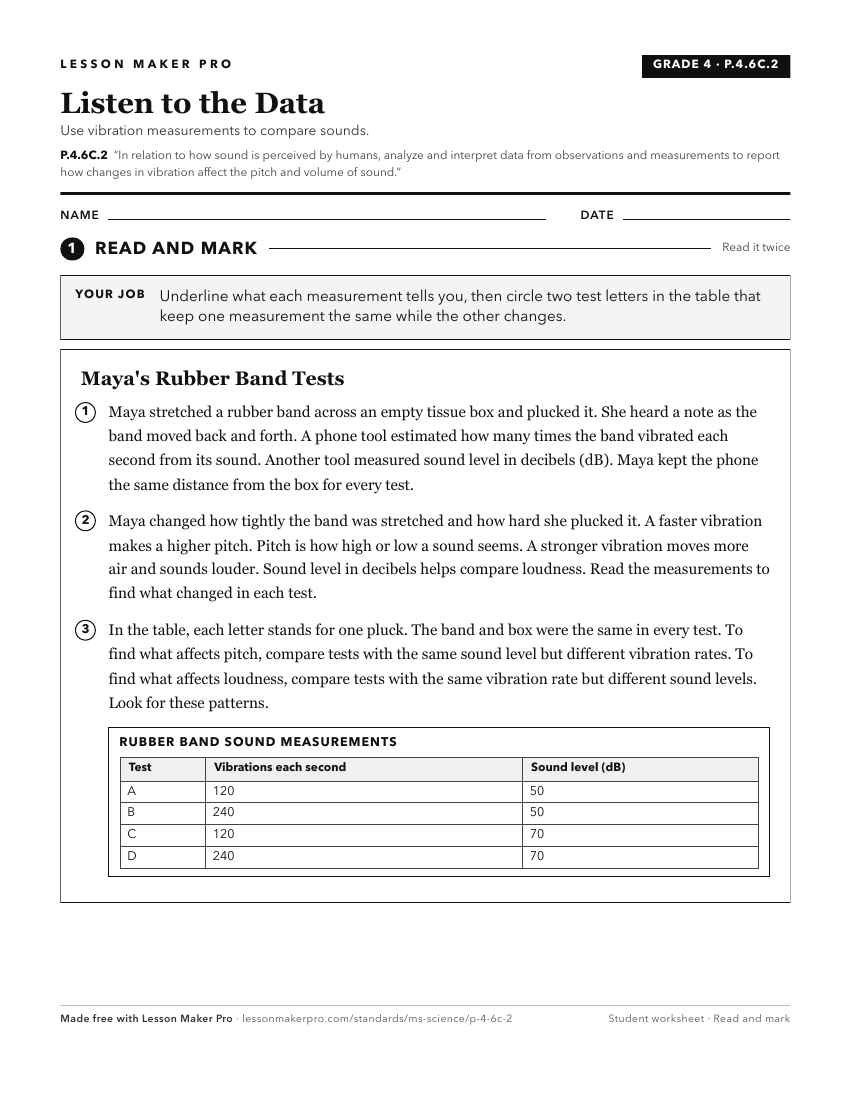
A ready-to-print activity worksheet aligned to P.4.6C.2, with an answer key for the teacher on its own page. No account needed.
PDF, US Letter, prints cleanly in black and white.
Download the worksheetKeep exploring
Related Standards
- P.4.6C.1
Plan and conduct scientific investigations to test how different variables affect the properties of sound (i.e., pitch and volume).
- PHS.6.5
Design and conduct experiments to investigate technological applications of sound (e.g., medical uses, music, acoustics, Doppler effects, and influences of math...
- P.1.6B.1
Conduct an investigation to provide evidence that vibrations create sound (e.g., pluck a guitar string) and that sound can create vibrations (e.g., feeling soun...
- P.8.6.5
Conduct scientific investigations that describe the behavior of sound when resonance changes (e.g., waves in a stretched string and design of musical instrument...
Turn this exact standard into a lesson
Grade, subject, topic, and the complete standard are prefilled. Create one free, no account needed.
Also for this standard:Make a WorksheetMake a QuizMake a Sub Lesson