Mississippi Science PHS.6.5
The Standard
- PHS.6
- Students will explore the characteristics of waves.
Design and conduct experiments to investigate technological applications of sound (e.g., medical uses, music, acoustics, Doppler effects, and influences of mathematical theory on music).
2026 Mississippi College- and Career-Readiness Standards for Science · Waves
Teacher's field guide
What This Standard Means
What Students Need to Do
- Students plan and run a fair test of how sound behaves in a device or space. They change one thing, collect repeated measurements, and use the results to explain a practical choice.
What Mastery Looks Like
- A student can compare two sound barriers while keeping the speaker volume and phone position fixed. They can use their readings to recommend a material for a quieter music room.
Common Misconceptions
- Students may treat pitch and loudness as the same thing, or assume a barrier blocks all sound. They may also move the phone between trials, then credit the material for a change caused by distance.
How to Assess It
- Have pairs test felt and cardboard between a speaker and a phone sound meter, with three readings per material. Ask them to name what they kept the same and recommend one material using their readings.
Lesson moves
Ways to Teach It
Give pairs felt, cardboard, and foam to test as sound barriers between a speaker and a phone sound meter.
Play a passing siren clip and ask students to explain in writing why the pitch changes as the vehicle moves past.
Give groups test-plan cards; award a point when they spot a changed distance or volume and fix the plan.
Record one handclap in an empty classroom and a carpeted room, then choose a spot for recording a school podcast.
Free download
Printable PHS.6.5 Worksheet
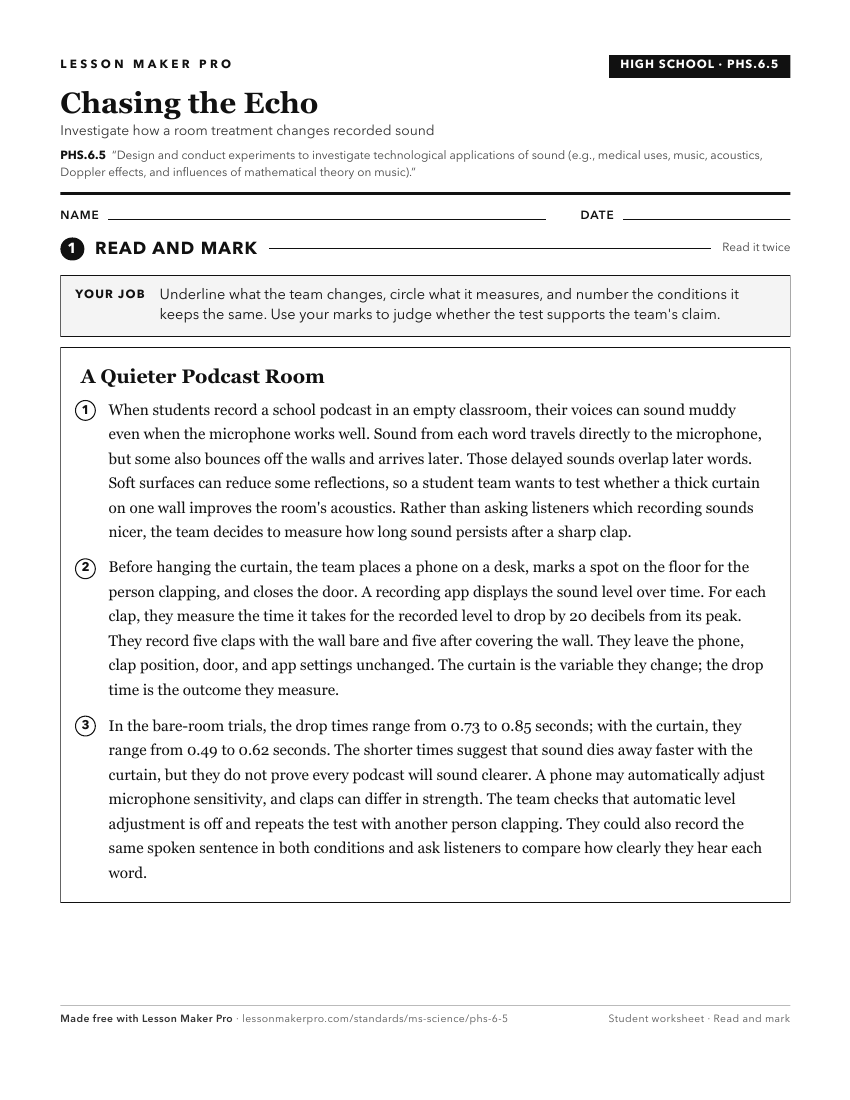
A ready-to-print activity worksheet aligned to PHS.6.5, with an answer key for the teacher on its own page. No account needed.
PDF, US Letter, prints cleanly in black and white.
Download the worksheetKeep exploring
Related Standards
- P.4.6C.1
Plan and conduct scientific investigations to test how different variables affect the properties of sound (i.e., pitch and volume).
- P.1.6B.1
Conduct an investigation to provide evidence that vibrations create sound (e.g., pluck a guitar string) and that sound can create vibrations (e.g., feeling soun...
- P.8.6.5
Conduct scientific investigations that describe the behavior of sound when resonance changes (e.g., waves in a stretched string and design of musical instrument...
- PHY.4.5
Design, investigate, and collect data on standing waves and waves in specific media (e.g., stretched string, water surface, and air) using online simulations, p...
Turn this exact standard into a lesson
Grade, subject, topic, and the complete standard are prefilled. Create one free, no account needed.
Also for this standard:Make a WorksheetMake a QuizMake a Sub Lesson