Mississippi Science P.4.6C.1
The Standard
- P.4.6C
- Students will demonstrate an understanding of the properties of sound as a form of energy.
Plan and conduct scientific investigations to test how different variables affect the properties of sound (i.e., pitch and volume).
2026 Mississippi College- and Career-Readiness Standards for Science · Motion, Forces, and Energy
Teacher's field guide
What This Standard Means
What Students Need to Do
- Students change one thing about a vibrating object, such as how far a ruler hangs over a desk or how hard they pluck it. They keep other conditions the same and record changes in pitch or volume.
What Mastery Looks Like
- Students can plan a fair test, repeat it, and record results in a table. They use their results to explain that a shorter ruler overhang sounds higher, while a harder pluck sounds louder.
Common Misconceptions
- Students may call a louder sound higher pitched. They may change ruler length and plucking force at the same time, making it hard to tell what caused the difference.
How to Assess It
- Have students pluck a ruler with 5 cm, then 10 cm, hanging over a desk edge. Ask them to record which sounds higher and name what they kept the same.
Lesson moves
Ways to Teach It
Hold a ruler over a desk edge, change its overhang, pluck it with similar force, and chart the pitch after three trials.
After the ruler test, ask partners, 'What changed, what stayed the same, and which sound was higher?'
Give pairs cards labeled short overhang, long overhang, gentle pluck, and hard pluck; have them predict pitch or volume changes, then test.
Play a song on a phone at two volume settings; ask whether the singer's pitch changes when you turn the sound up.
Free download
Printable P.4.6C.1 Worksheet
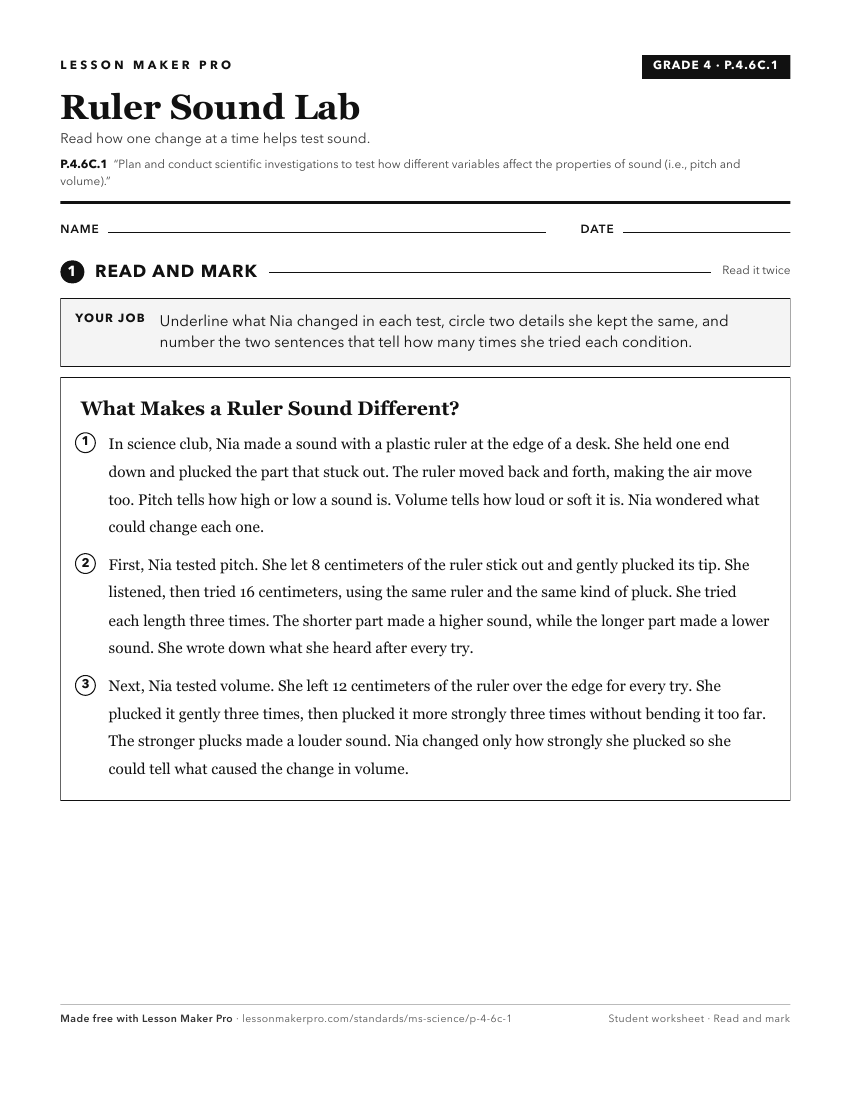
A ready-to-print activity worksheet aligned to P.4.6C.1, with an answer key for the teacher on its own page. No account needed.
PDF, US Letter, prints cleanly in black and white.
Download the worksheetKeep exploring
Related Standards
- PHS.6.5
Design and conduct experiments to investigate technological applications of sound (e.g., medical uses, music, acoustics, Doppler effects, and influences of math...
- P.8.6.5
Conduct scientific investigations that describe the behavior of sound when resonance changes (e.g., waves in a stretched string and design of musical instrument...
- P.4.6C.2
In relation to how sound is perceived by humans, analyze and interpret data from observations and measurements to report how changes in vibration affect the pit...
- P.8.6.4
Use scientific processes to plan and conduct controlled investigations to conclude sound is a wave phenomenon that is characterized by amplitude and frequency.
Turn this exact standard into a lesson
Grade, subject, topic, and the complete standard are prefilled. Create one free, no account needed.
Also for this standard:Make a WorksheetMake a QuizMake a Sub Lesson