Mississippi Science P.8.6.5
The Standard
- P.8.6
- Students will demonstrate an understanding of the properties, behaviors, and application of waves.
Conduct scientific investigations that describe the behavior of sound when resonance changes (e.g., waves in a stretched string and design of musical instruments).
2026 Mississippi College- and Career-Readiness Standards for Science · Motions, Forces, and Energy
Teacher's field guide
What This Standard Means
What Students Need to Do
- Students change a string’s length or tension and record how its sound changes. They also test when a sound makes another object vibrate strongly.
What Mastery Looks Like
- Students change one factor at a time and record the pitch they hear or measure. They can explain that a shorter or tighter string usually has a higher pitch, and that an object responds most strongly to a matching frequency.
Common Misconceptions
- Students may confuse pitch with loudness and think plucking harder makes a higher note. They may expect any nearby object to vibrate strongly, even when its natural frequency does not match the sound.
How to Assess It
- Exit ticket: A rubber band is shortened and plucked. Predict how its pitch changes, then explain why a second band tuned to the new pitch vibrates more than one tuned to the old pitch.
Lesson moves
Ways to Teach It
Hold a struck tuning fork over a plastic tube in water; raise the tube and mark the air length where the sound is loudest.
Ask students to write why one guitar string may vibrate when a nearby string is plucked at the same pitch.
Give pairs frequency cards labeled 220 Hz, 330 Hz, and 440 Hz; have them match sound sources to strings that would vibrate most strongly.
Turn a guitar tuning peg while students use a tuner app to record how the string’s pitch changes.
Free download
Printable P.8.6.5 Worksheet
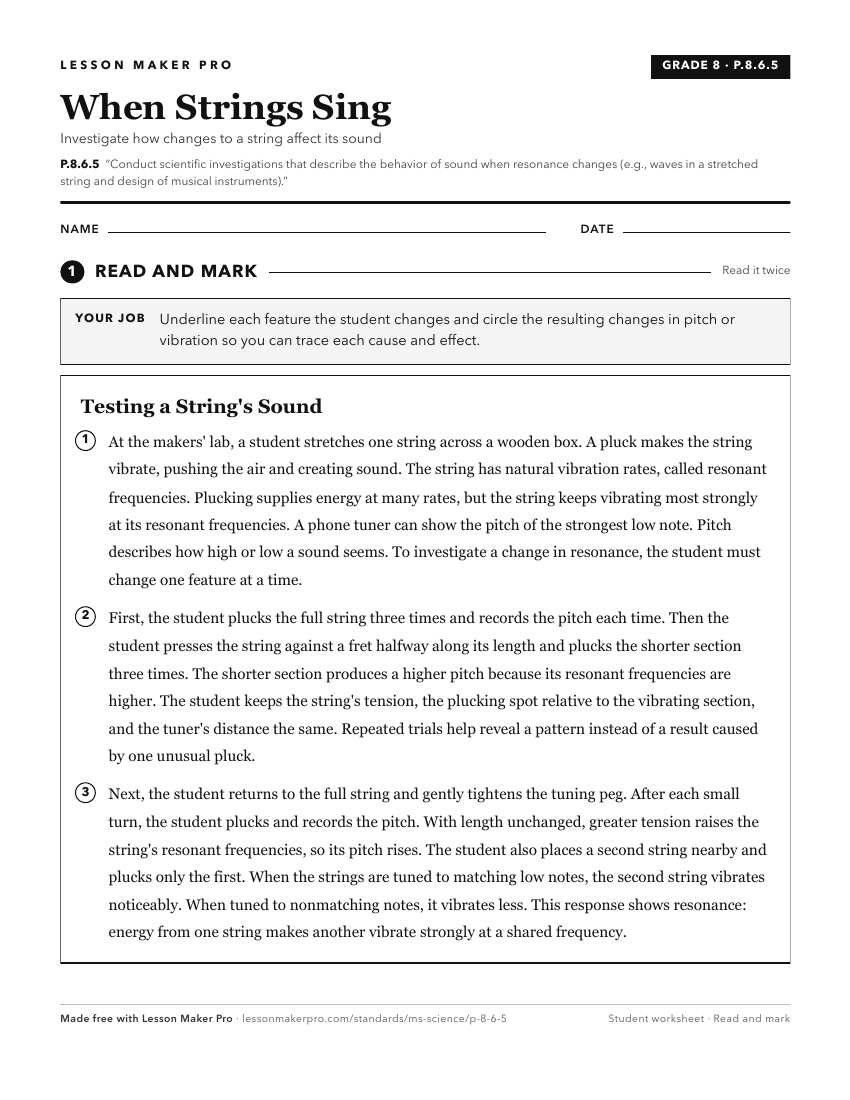
A ready-to-print activity worksheet aligned to P.8.6.5, with an answer key for the teacher on its own page. No account needed.
PDF, US Letter, prints cleanly in black and white.
Download the worksheetKeep exploring
Related Standards
- P.4.6C.1
Plan and conduct scientific investigations to test how different variables affect the properties of sound (i.e., pitch and volume).
- PHS.6.5
Design and conduct experiments to investigate technological applications of sound (e.g., medical uses, music, acoustics, Doppler effects, and influences of math...
- P.1.6B.1
Conduct an investigation to provide evidence that vibrations create sound (e.g., pluck a guitar string) and that sound can create vibrations (e.g., feeling soun...
- PHS.6.4
Enrichment: Use an engineering design process to design and build a musical instrument to demonstrate the influence of resonance on music. *
Turn this exact standard into a lesson
Grade, subject, topic, and the complete standard are prefilled. Create one free, no account needed.
Also for this standard:Make a WorksheetMake a QuizMake a Sub Lesson