Mississippi Science P.8.6
Standard Cluster
Students will demonstrate an understanding of the properties, behaviors, and application of waves. Interpret the characteristics and behaviors of sound and light waves to determine the relationship between matter and energy; determine the medium for transmission for each wave Investigate research-based mechanisms for capturing and converting wave energy (frequency, amplitude, wavelength, and speed) into electrical energy. Conduct simple investigations about the performance of waves to describe their behavior (e.g., refraction, reflection, transmission, and absorption) as they interact with various materials (e.g., lenses, mirrors, and prisms). Use scientific processes to plan and conduct controlled investigations to conclude sound is a wave phenomenon that is characterized by amplitude and frequency. Conduct scientific investigations that describe the behavior of sound when resonance changes (e.g., waves in a stretched string and design of musical instruments). Obtain and evaluate scientific information to explain the relationship between seeing color and the transmission, absorption, or reflection of light waves by various materials.
2026 Mississippi College- and Career-Readiness Standards for Science · Motions, Forces, and Energy
Cluster contents
Standards in This Cluster
P.8.6 is a cluster heading. These are the individual standards under it.
- P.8.6.1
Interpret the characteristics and behaviors of sound and light waves to determine the relationship between matter and energy; determine the medium for transmiss...
- P.8.6.2
Investigate research-based mechanisms for capturing and converting wave energy (frequency, amplitude, wavelength, and speed) into electrical energy.
- P.8.6.3
Conduct simple investigations about the performance of waves to describe their behavior (e.g., refraction, reflection, transmission, and absorption) as they int...
- P.8.6.4
Use scientific processes to plan and conduct controlled investigations to conclude sound is a wave phenomenon that is characterized by amplitude and frequency.
- P.8.6.5
Conduct scientific investigations that describe the behavior of sound when resonance changes (e.g., waves in a stretched string and design of musical instrument...
- P.8.6.6
Obtain and evaluate scientific information to explain the relationship between seeing color and the transmission, absorption, or reflection of light waves by va...
Teacher's field guide
What This Cluster Means
What Students Need to Do
- Students compare sound and light by amplitude, frequency, wavelength, and speed. They test how waves behave when they meet different materials and how changing a stretched string affects its sound. They explain how a device can turn wave energy into electrical energy.
What Mastery Looks Like
- Students link louder sounds to greater amplitude and higher pitch to greater frequency. They change one variable in a string test and explain why sound needs matter to travel, but light can cross space. They predict what a mirror, lens, or colored filter does to light and explain how a microphone makes an electrical signal.
Common Misconceptions
- Students may think louder sound has a higher pitch. Some think sound travels through empty space or that light needs air. Others think a red filter creates red light rather than transmitting red light and absorbing other colors.
How to Assess It
- Exit ticket: A student plucks a rubber band beside a phone microphone and shines white light through red film. Ask what changes when the band is plucked harder, why the microphone needs air, and why the film looks red.
Lesson moves
Ways to Teach It
Stretch a rubber band over a tissue box, change its tension, and use a phone tuner app to record each pitch.
Ask students to write two sentences explaining why sunlight reaches Earth through space but sound from the Sun does not.
Sort cards showing a prism, mirror, clear window, and black shirt into refraction, reflection, transmission, and absorption.
Give pairs a microphone diagram and have them trace how sound vibrations become the electrical signal in a phone call.
Free download
Printable P.8.6 Worksheet
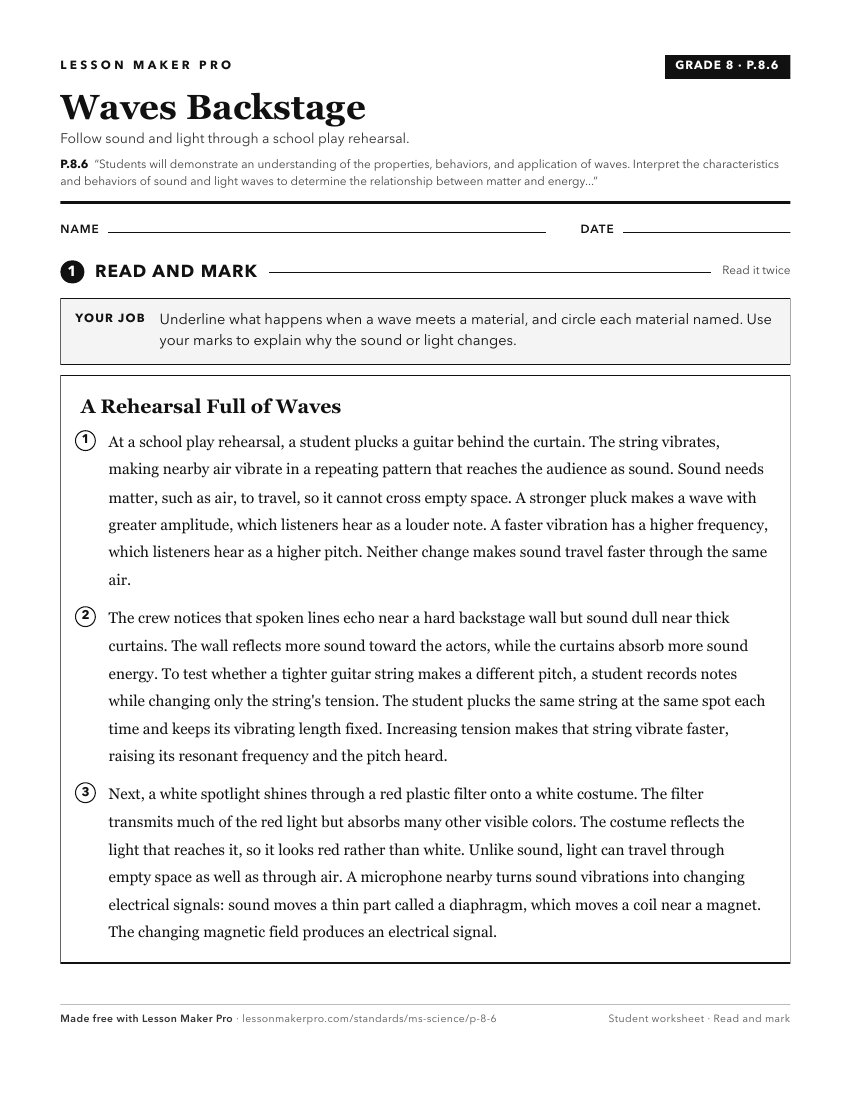
A ready-to-print activity worksheet aligned to P.8.6, with an answer key for the teacher on its own page. No account needed.
PDF, US Letter, prints cleanly in black and white.
Download the worksheetKeep exploring
Related Standards
Turn this cluster into a lesson
Grade, subject, topic, and the complete cluster are prefilled. Create one free, no account needed.
Also for this cluster:Make a WorksheetMake a QuizMake a Sub Lesson