Mississippi Science PHY.4
Standard Cluster
Students will investigate and explore wave properties. Analyze the characteristics and properties of simple harmonic motions, sound, and light. Describe and model through digital or physical means the characteristics and properties of mechanical waves by simulating and investigating properties of simple harmonic motion. Use mathematical and computational analysis to explore wave characteristics (e.g., velocity, period, frequency, amplitude, phase, and wavelength). Investigate and communicate the relationship between the energy of a wave in terms of amplitude and frequency using probe systems, online simulations, and/or laboratory experiences. Design, investigate, and collect data on standing waves and waves in specific media (e.g., stretched string, water surface, and air) using online simulations, probe systems, and/or laboratory experiences. Explore and explain the Doppler effect as it relates to a moving source and to a moving observer using online simulations, probe systems, and/or real-world experiences. Explain the laws of reflection and refraction and apply Snell’s law to describe the relationship between the angles of incidence and refraction. Use ray diagrams and thin lens equations to solve real-world problems involving object distance from lenses, using a lens bench, online simulations, and/or laboratory experiences. Research the different bands of electromagnetic radiation, including characteristics, properties, and similarities/differences. Enrichment: Research the ways absorption and emission spectra are used to study astronomy and the formation of the universe. Enrichment: Research digital nonfictional text to defend the wave-particle duality of light (i.e., wave model of light and particle model of light). Enrichment: Research uses of the electromagnetic spectrum or photoelectric effect.
2026 Mississippi College- and Career-Readiness Standards for Science · Waves
Cluster contents
Standards in This Cluster
PHY.4 is a cluster heading. These are the individual standards under it.
- PHY.4.1
Analyze the characteristics and properties of simple harmonic motions, sound, and light.
- PHY.4.2
Describe and model through digital or physical means the characteristics and properties of mechanical waves by simulating and investigating properties of simple...
- PHY.4.3
Use mathematical and computational analysis to explore wave characteristics (e.g., velocity, period, frequency, amplitude, phase, and wavelength).
- PHY.4.4
Investigate and communicate the relationship between the energy of a wave in terms of amplitude and frequency using probe systems, online simulations, and/or la...
- PHY.4.5
Design, investigate, and collect data on standing waves and waves in specific media (e.g., stretched string, water surface, and air) using online simulations, p...
- PHY.4.6
Explore and explain the Doppler effect as it relates to a moving source and to a moving observer using online simulations, probe systems, and/or real-world expe...
- PHY.4.7
Explain the laws of reflection and refraction and apply Snell’s law to describe the relationship between the angles of incidence and refraction.
- PHY.4.8
Use ray diagrams and thin lens equations to solve real-world problems involving object distance from lenses, using a lens bench, online simulations, and/or labo...
- PHY.4.9
Research the different bands of electromagnetic radiation, including characteristics, properties, and similarities/differences.
- PHY.4.10
Enrichment: Research the ways absorption and emission spectra are used to study astronomy and the formation of the universe.
- PHY.4.11
Enrichment: Research digital nonfictional text to defend the wave-particle duality of light (i.e., wave model of light and particle model of light).
- PHY.4.12
Enrichment: Research uses of the electromagnetic spectrum or photoelectric effect.
Teacher's field guide
What This Cluster Means
What Students Need to Do
- Students measure and model how waves move through strings, water, and air. They calculate speed, frequency, period, and wavelength, then use observations to explain sound, light, and wave energy.
What Mastery Looks Like
- A student can use measurements to calculate wave properties and identify nodes in a standing wave. They can explain a changing siren pitch, trace light through water or a lens, and compare bands of electromagnetic radiation.
Common Misconceptions
- Students may think a bigger amplitude makes a wave travel faster, or that the material moves along with the wave. They may mix up frequency and speed, or draw a light ray bending the wrong way as it enters water.
How to Assess It
- Exit ticket: A wave travels at 12 m/s and has a wavelength of 3 m. Find its frequency, then explain what happens to its energy when its amplitude increases.
Lesson moves
Ways to Teach It
Tie one end of a jump rope to a sturdy table leg, shake the other end, and sketch the nodes and loops you see.
Ask students to sketch wavefronts and explain why an ambulance siren sounds higher as it approaches and lower as it leaves.
Give pairs cards labeled 6 m/s and 2 m, 12 m/s and 3 m, and 20 m/s and 5 m; have them calculate frequency.
Put a pencil in a clear cup of water, then have students draw light rays to explain why the pencil looks bent.
Free download
Printable PHY.4 Worksheet
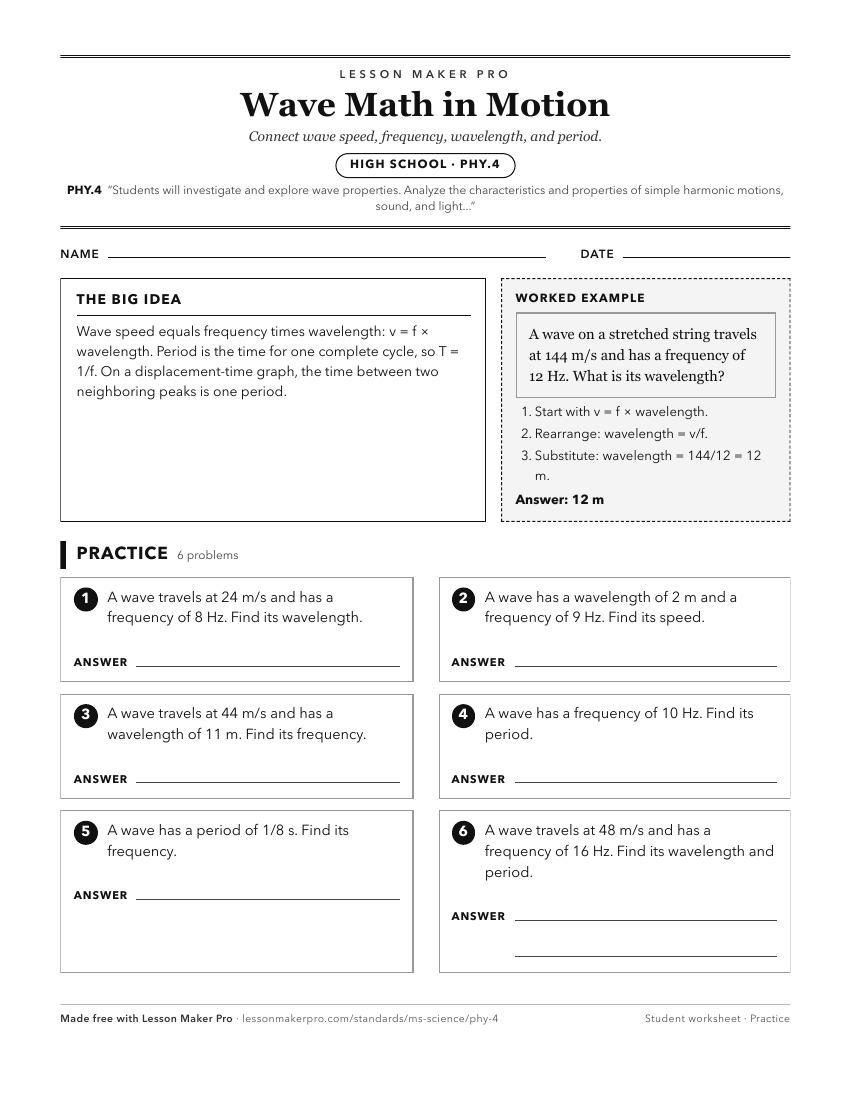
A ready-to-print activity worksheet aligned to PHY.4, with an answer key for the teacher on its own page. No account needed.
PDF, US Letter, prints cleanly in black and white.
Download the worksheetKeep exploring
Related Standards
Turn this cluster into a lesson
Grade, subject, topic, and the complete cluster are prefilled. Create one free, no account needed.
Also for this cluster:Make a WorksheetMake a QuizMake a Sub Lesson