Mississippi Science PHY.4.7
The Standard
- PHY.4
- Students will investigate and explore wave properties.
Explain the laws of reflection and refraction and apply Snell’s law to describe the relationship between the angles of incidence and refraction.
2026 Mississippi College- and Career-Readiness Standards for Science · Waves
Teacher's field guide
What This Standard Means
What Students Need to Do
- Students draw a normal where a light ray hits a boundary and measure angles from that line. They predict the reflected path and calculate the refracted path using the refractive indices of both materials.
What Mastery Looks Like
- Students draw reflected and refracted rays on the correct sides of a boundary. They calculate a refracted angle and check that the ray bends toward the normal when it enters a material with a higher refractive index.
Common Misconceptions
- Students often measure angles from the surface instead of the normal. They may think light always bends toward the normal, or confuse a reflected ray with a ray that passes into the second material.
How to Assess It
- Exit ticket: A ray in air hits glass at 30° to the normal. Have students draw the reflected ray and calculate the refracted angle using indices of 1.00 for air and 1.50 for glass.
Lesson moves
Ways to Teach It
Use a ray box, acrylic block, paper, and protractor to trace incoming, reflected, and refracted rays and measure their angles from the normal.
Ask students to explain why a ray entering glass bends toward the normal while the reflected ray stays in air.
Give pairs cards with incident angles and refractive indices; have them calculate refracted angles and sort the cards by bending direction.
Put a pencil in a clear cup of water, then draw a light ray from its submerged tip to your eye and mark where it bends.
Free download
Printable PHY.4.7 Worksheet
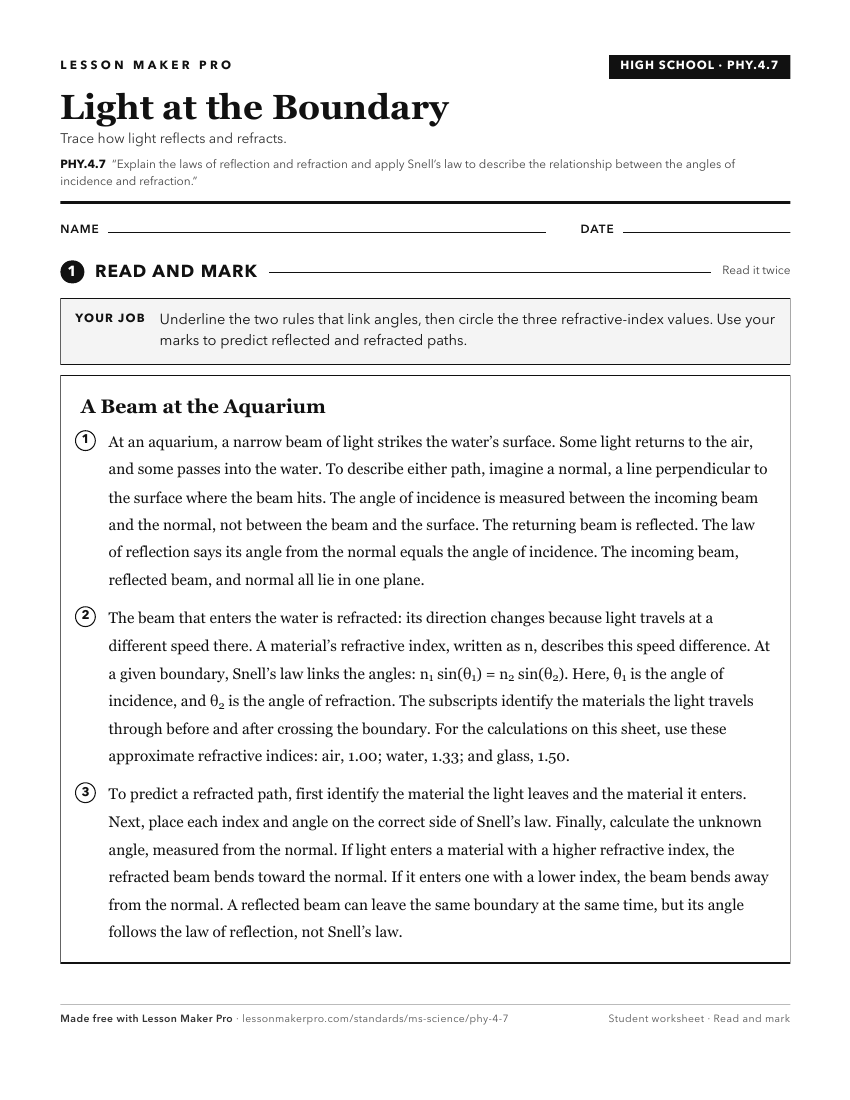
A ready-to-print activity worksheet aligned to PHY.4.7, with an answer key for the teacher on its own page. No account needed.
PDF, US Letter, prints cleanly in black and white.
Download the worksheetKeep exploring
Related Standards
- P.4.6B.4
Plan and conduct scientific investigations to explain how light behaves when it strikes transparent, translucent, and opaque materials.
- P.4.6B.3
Develop and use models to communicate how light travels and behaves when it strikes an object, including reflection, refraction, and absorption.
- P.8.6.3
Conduct simple investigations about the performance of waves to describe their behavior (e.g., refraction, reflection, transmission, and absorption) as they int...
- P.1.6A.1
Construct explanations using first-hand observations or other media to describe how reflected light makes an object visible.
Turn this exact standard into a lesson
Grade, subject, topic, and the complete standard are prefilled. Create one free, no account needed.
Also for this standard:Make a WorksheetMake a QuizMake a Sub Lesson