Mississippi Science P.8.6.3
The Standard
- P.8.6
- Students will demonstrate an understanding of the properties, behaviors, and application of waves.
Conduct simple investigations about the performance of waves to describe their behavior (e.g., refraction, reflection, transmission, and absorption) as they interact with various materials (e.g., lenses, mirrors, and prisms).
2026 Mississippi College- and Career-Readiness Standards for Science · Motions, Forces, and Energy
Teacher's field guide
What This Standard Means
What Students Need to Do
- Students test what happens when light meets a mirror, water, clear plastic, and dark paper. They use their observations to describe when light bounces, bends, passes through, or is mostly absorbed.
What Mastery Looks Like
- Students predict what light will do, then check with a flashlight. They draw light reflecting from a mirror and explain why a pencil looks bent in water. They tell how clear plastic passes light while dark paper absorbs most of it.
Common Misconceptions
- Students may think the pencil itself bends in water. They may also think dark paper absorbs all light, or that light never changes direction when it passes into a clear material.
How to Assess It
- Exit ticket: Draw what happens when light hits a mirror, enters water, passes through clear plastic, and hits black paper. Label each behavior and explain one label using an observation.
Lesson moves
Ways to Teach It
Shine a flashlight at a mirror, clear plastic, and black paper; view a pencil through water and sketch what changes.
Ask: Why does a pencil look bent in water even though its shape has not changed?
Sort beam-path cards for a mirror, water, a window, and black paper by what happens to the light.
Compare clear glasses, tinted sunglasses, and a bike reflector with a flashlight; explain what each does to the light.
Free download
Printable P.8.6.3 Worksheet
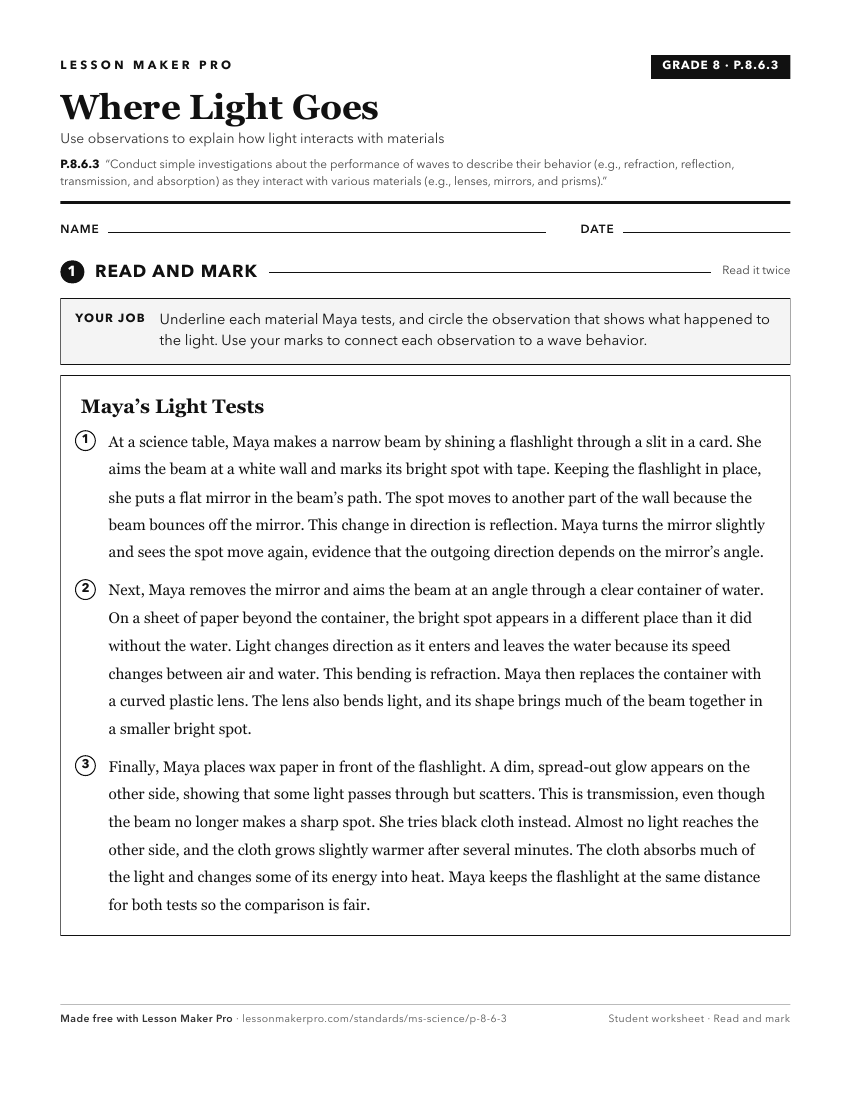
A ready-to-print activity worksheet aligned to P.8.6.3, with an answer key for the teacher on its own page. No account needed.
PDF, US Letter, prints cleanly in black and white.
Download the worksheetKeep exploring
Related Standards
- P.4.6B.4
Plan and conduct scientific investigations to explain how light behaves when it strikes transparent, translucent, and opaque materials.
- P.4.6B.3
Develop and use models to communicate how light travels and behaves when it strikes an object, including reflection, refraction, and absorption.
- PHY.4
Students will investigate and explore wave properties.
- PHY.4.5
Design, investigate, and collect data on standing waves and waves in specific media (e.g., stretched string, water surface, and air) using online simulations, p...
Turn this exact standard into a lesson
Grade, subject, topic, and the complete standard are prefilled. Create one free, no account needed.
Also for this standard:Make a WorksheetMake a QuizMake a Sub Lesson