Mississippi Science P.4.6B.3
The Standard
- P.4.6B
- Students will demonstrate an understanding of the properties of light as forms of energy.
Develop and use models to communicate how light travels and behaves when it strikes an object, including reflection, refraction, and absorption.
2026 Mississippi College- and Career-Readiness Standards for Science · Motion, Forces, and Energy
Teacher's field guide
What This Standard Means
What Students Need to Do
- Students draw arrows to show light traveling in straight lines until it reaches an object or a new material. They show light bouncing off a mirror, bending as it enters water, or being absorbed by dark paper.
What Mastery Looks Like
- A student can draw and label the light’s path for a mirror, a glass of water, and black paper. They can use each drawing to explain why a pencil looks bent in water or why a mirror shows an image.
Common Misconceptions
- Students may think the pencil itself bends when it enters water. They may also confuse light bouncing off a surface with light bending as it enters a new material.
How to Assess It
- On an exit ticket, ask students to draw arrows showing what happens when flashlight light hits a mirror, enters water, and hits black paper. Have them label each interaction.
Lesson moves
Ways to Teach It
Shine a flashlight at a mirror and black paper, then place a pencil in a clear cup of water and sketch each observation.
Show a pencil in a glass of water and ask, 'Is the pencil bent, or is the light changing direction?'
Give pairs picture cards of a mirror, water, and black paper; have them match each card to a light-path drawing.
Show photos of a reflective road sign and a black coat at night; ask students to draw where headlight beams go.
Free download
Printable P.4.6B.3 Worksheet
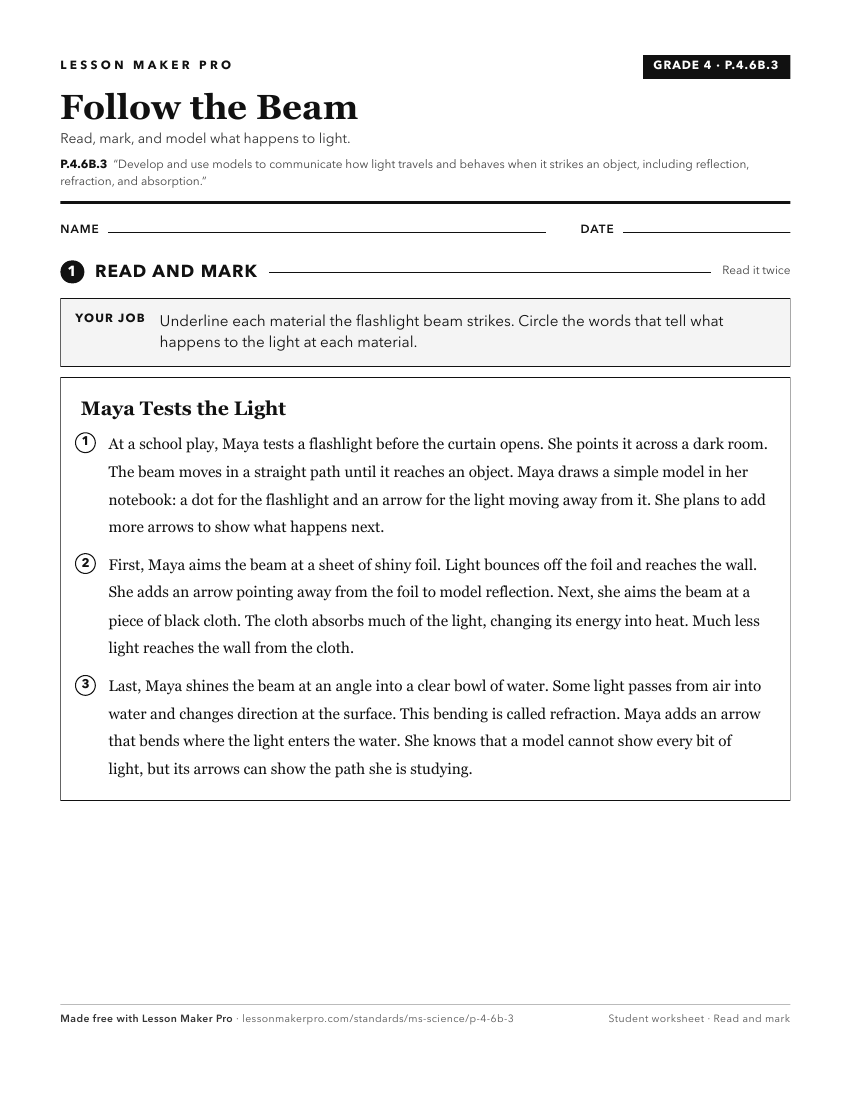
A ready-to-print activity worksheet aligned to P.4.6B.3, with an answer key for the teacher on its own page. No account needed.
PDF, US Letter, prints cleanly in black and white.
Download the worksheetKeep exploring
Related Standards
- P.4.6B.4
Plan and conduct scientific investigations to explain how light behaves when it strikes transparent, translucent, and opaque materials.
- P.4.6B.2
Obtain and communicate information to explain how the visibility of an object is related to light.
- P.8.6.3
Conduct simple investigations about the performance of waves to describe their behavior (e.g., refraction, reflection, transmission, and absorption) as they int...
- P.1.6A.1
Construct explanations using first-hand observations or other media to describe how reflected light makes an object visible.
Turn this exact standard into a lesson
Grade, subject, topic, and the complete standard are prefilled. Create one free, no account needed.
Also for this standard:Make a WorksheetMake a QuizMake a Sub Lesson