Mississippi Science PHS.6
Standard Cluster
Students will explore the characteristics of waves. Use models to analyze and describe examples of mechanical waves’ properties (e.g., wavelength, frequency, speed, amplitude, rarefaction, and compression). Analyze examples and evidence of transverse and longitudinal waves found in nature (e.g., earthquakes, ocean waves, and sound waves). Generate wave models to explore energy transference. Enrichment: Use an engineering design process to design and build a musical instrument to demonstrate the influence of resonance on music. * Design and conduct experiments to investigate technological applications of sound (e.g., medical uses, music, acoustics, Doppler effects, and influences of mathematical theory on music). Research real-world applications to create models or visible representations of the electromagnetic spectrum, including visible light, infrared radiation, and ultraviolet radiation. Enrichment: Use an engineering design process to design and construct an apparatus that forms images to project on a screen or magnify images using lenses and/or mirrors. * Enrichment: Debate the particle/wave behavior of light.
2026 Mississippi College- and Career-Readiness Standards for Science · Waves
Cluster contents
Standards in This Cluster
PHS.6 is a cluster heading. These are the individual standards under it.
- PHS.6.1
Use models to analyze and describe examples of mechanical waves’ properties (e.g., wavelength, frequency, speed, amplitude, rarefaction, and compression).
- PHS.6.2
Analyze examples and evidence of transverse and longitudinal waves found in nature (e.g., earthquakes, ocean waves, and sound waves).
- PHS.6.3
Generate wave models to explore energy transference.
- PHS.6.4
Enrichment: Use an engineering design process to design and build a musical instrument to demonstrate the influence of resonance on music. *
- PHS.6.5
Design and conduct experiments to investigate technological applications of sound (e.g., medical uses, music, acoustics, Doppler effects, and influences of math...
- PHS.6.6
Research real-world applications to create models or visible representations of the electromagnetic spectrum, including visible light, infrared radiation, and u...
- PHS.6.7
Enrichment: Use an engineering design process to design and construct an apparatus that forms images to project on a screen or magnify images using lenses and/o...
- PHS.6.8
Enrichment: Debate the particle/wave behavior of light.
Teacher's field guide
What This Cluster Means
What Students Need to Do
- Students use models to measure wavelength, amplitude, frequency, and speed. They compare how sound, ocean waves, and earthquake waves move energy and matter. They also model where visible, infrared, and ultraviolet light sit on a spectrum.
What Mastery Looks Like
- A student can label amplitude and wavelength on a transverse wave, and compressions and rarefactions on a longitudinal wave. They can calculate speed from frequency and wavelength, and explain why a vibrating air particle does not travel from a speaker to a listener. They can put infrared, visible, and ultraviolet light in order.
Common Misconceptions
- Students may think a taller wave always moves faster, or that air travels all the way from a speaker to a listener. They may confuse a compression with a crest. Some assume light needs air to travel because sound does.
How to Assess It
- Draw a slinky wave with compressions 0.5 m apart and four compressions passing a point each second. Ask students to mark one rarefaction, calculate the wave speed, and explain whether one coil travels the length of the slinky.
Lesson moves
Ways to Teach It
Stretch a slinky between two students; send sideways and push-pull pulses, then use tape on one coil to track its motion.
Show diagrams of earthquake P and S waves; ask, “Which pushes rock back and forth, and which moves it sideways?”
Give pairs cards with wavelength and frequency values; have them calculate wave speed and sort the cards from slowest to fastest.
Take UV beads and an infrared thermometer outside; compare the beads, a sunlit wall’s temperature, and the visible light you see.
Free download
Printable PHS.6 Worksheet
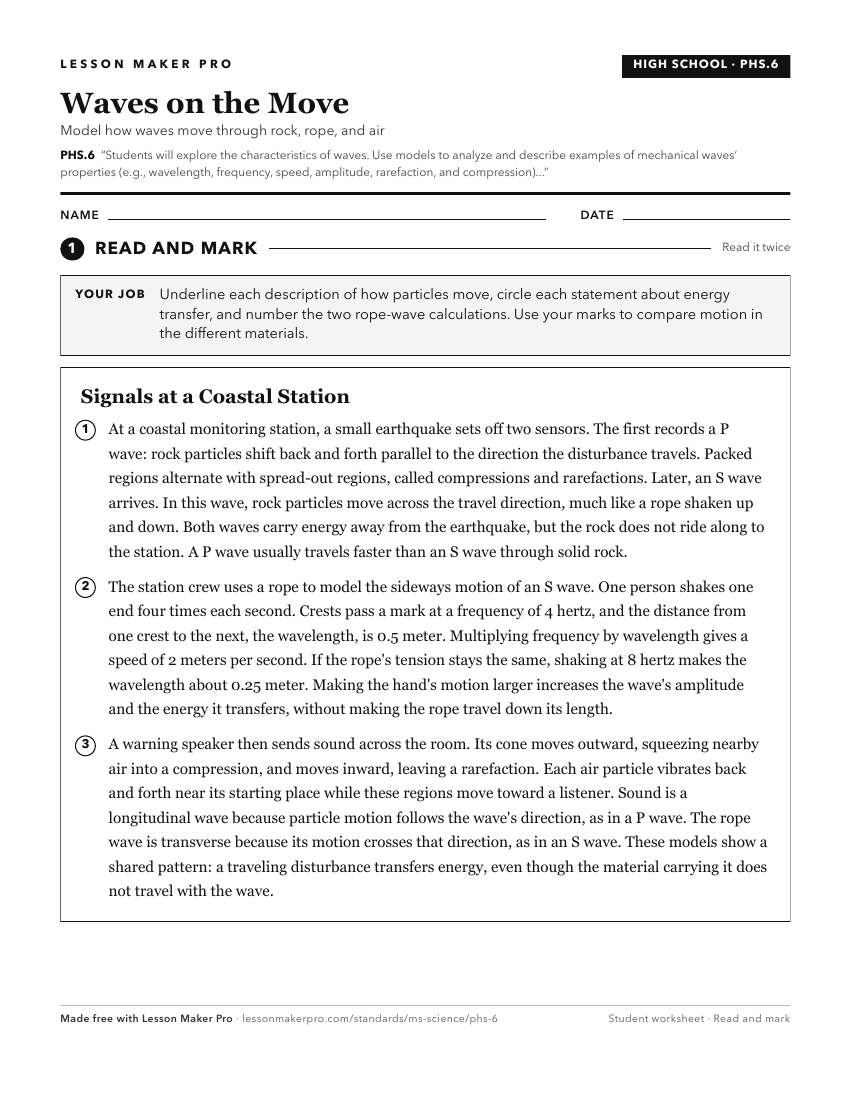
A ready-to-print activity worksheet aligned to PHS.6, with an answer key for the teacher on its own page. No account needed.
PDF, US Letter, prints cleanly in black and white.
Download the worksheetKeep exploring
Related Standards
- P.1.6B
Students will demonstrate an understanding of sound.
- P.8.6
Students will demonstrate an understanding of the properties, behaviors, and application of waves.
- MAQ.2.1
Characterize wave features and wave properties, including wavelength, period, wave speed, breakers, and constructive waves and their effects on shoreline commun...
- PHY.4
Students will investigate and explore wave properties.
Turn this cluster into a lesson
Grade, subject, topic, and the complete cluster are prefilled. Create one free, no account needed.
Also for this cluster:Make a WorksheetMake a QuizMake a Sub Lesson