Mississippi Science MAQ.2.1
The Standard
- MAQ.2
- Students will develop an understanding of the principles of fluid dynamics as it relates to both salt and freshwater systems.
Characterize wave features and wave properties, including wavelength, period, wave speed, breakers, and constructive waves and their effects on shoreline communities (e.g., headlands, embayments, shoreline erosion, and deposition).
2026 Mississippi College- and Career-Readiness Standards for Science · Fluid Dynamics
Teacher's field guide
What This Standard Means
What Students Need to Do
- Students measure the distance between wave crests and time how often crests arrive. They use those measurements to find wave speed and explain how breaking waves move sand along a shore.
What Mastery Looks Like
- A student can measure wavelength on a diagram, find period from arrival times, and calculate speed by dividing wavelength by period. They can explain why an exposed headland may erode while gentle waves build a beach in a sheltered bay.
Common Misconceptions
- Students may measure wavelength from crest to trough or confuse period with the time a wave takes to reach shore. They may think every breaker removes sand, though gentle waves can push more sand ashore than they pull back.
How to Assess It
- Exit ticket: Crests 6 meters apart pass a buoy every 3 seconds. Find the wavelength, period, and speed, then predict what happens to sand in a bay when swash is stronger than backwash.
Lesson moves
Ways to Teach It
Shape sand into a headland and bay in a shallow tray, rock the tray gently, and mark where sand moves.
Have students answer: Why might waves erode an exposed headland but build a beach inside a sheltered bay?
Give pairs cards showing crest spacing and arrival times; have them calculate wave speed and check each other's answers.
On a printed map of Monterey Bay and Point Pinos, mark a likely deposition zone and an erosion risk for a coastal path.
Free download
Printable MAQ.2.1 Worksheet
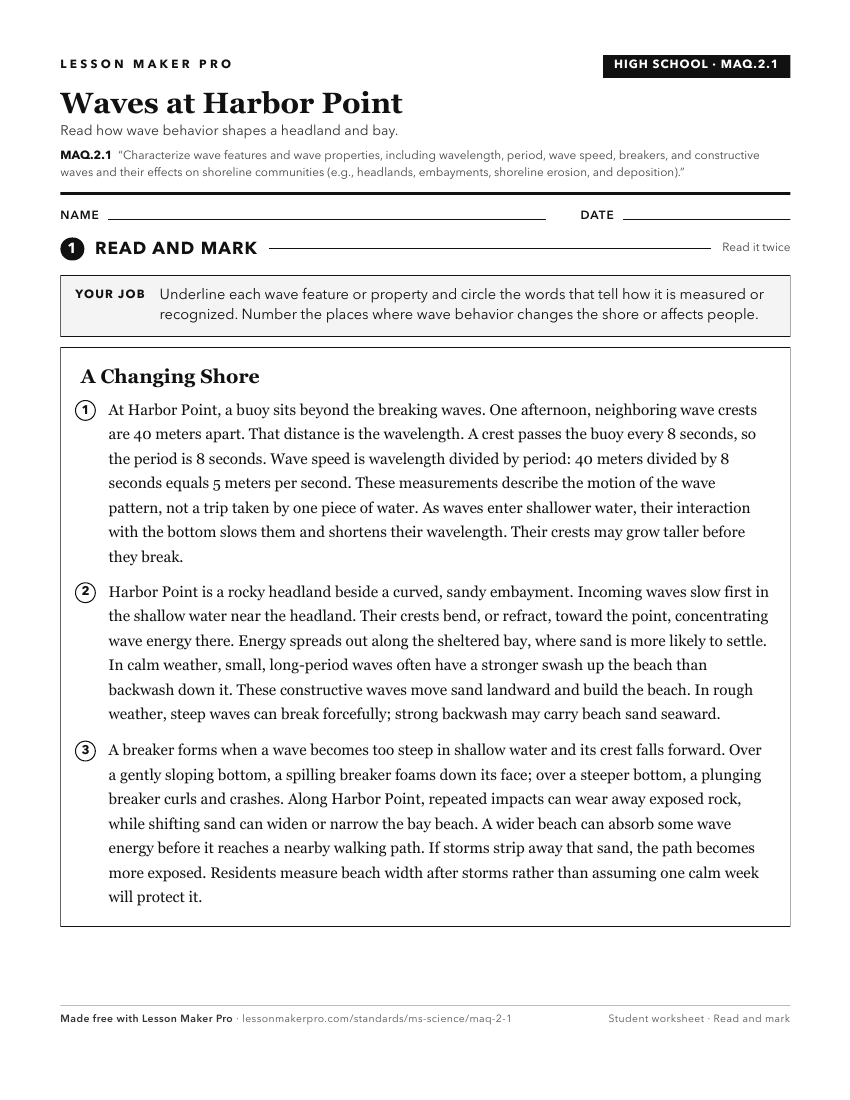
A ready-to-print activity worksheet aligned to MAQ.2.1, with an answer key for the teacher on its own page. No account needed.
PDF, US Letter, prints cleanly in black and white.
Download the worksheetKeep exploring
Related Standards
- PHS.6
Students will explore the characteristics of waves.
- E.4.9C.2
Develop and use models of natural processes to explain the effect of the movement of water on the ocean shore zone, including beaches, barrier islands, estuarie...
- PHS.6.1
Use models to analyze and describe examples of mechanical waves’ properties (e.g., wavelength, frequency, speed, amplitude, rarefaction, and compression).
- PHY.4.3
Use mathematical and computational analysis to explore wave characteristics (e.g., velocity, period, frequency, amplitude, phase, and wavelength).
Turn this exact standard into a lesson
Grade, subject, topic, and the complete standard are prefilled. Create one free, no account needed.
Also for this standard:Make a WorksheetMake a QuizMake a Sub Lesson