Mississippi Science PHS.6.1
The Standard
- PHS.6
- Students will explore the characteristics of waves.
Use models to analyze and describe examples of mechanical waves’ properties (e.g., wavelength, frequency, speed, amplitude, rarefaction, and compression).
2026 Mississippi College- and Career-Readiness Standards for Science · Waves
Teacher's field guide
What This Standard Means
What Students Need to Do
- Students use a rope or slinky to model a wave moving through material. They identify wavelength, amplitude, frequency, speed, compressions, and rarefactions in models and diagrams.
What Mastery Looks Like
- A student can label wavelength and amplitude on a rope sketch and compressions and rarefactions on a slinky sketch. They can calculate wave speed from wavelength and frequency, with units.
Common Misconceptions
- Students may measure amplitude from crest to trough instead of from the rest line. They may think a larger amplitude means a faster wave, or confuse the spread-out coils of a rarefaction with a compression.
How to Assess It
- Give students a rope sketch with crests 4 cm apart and 2 cm above the rest line, plus a slinky sketch with tight and spread coils. Ask them to label wavelength, amplitude, and one compression, then find the wave speed at 3 Hz.
Lesson moves
Ways to Teach It
Stretch a slinky across the floor, send repeated pushes, and mark two neighboring compressions with sticky notes.
Show two rope sketches with equal crest spacing but different heights; ask which has greater amplitude and what stays the same.
Give partners cards with wavelength and frequency values; have them calculate each wave speed and check each other's units.
Play 250 Hz and 500 Hz tones from a tone-generator app; ask students which has higher pitch and what changed in the wave.
Free download
Printable PHS.6.1 Worksheet
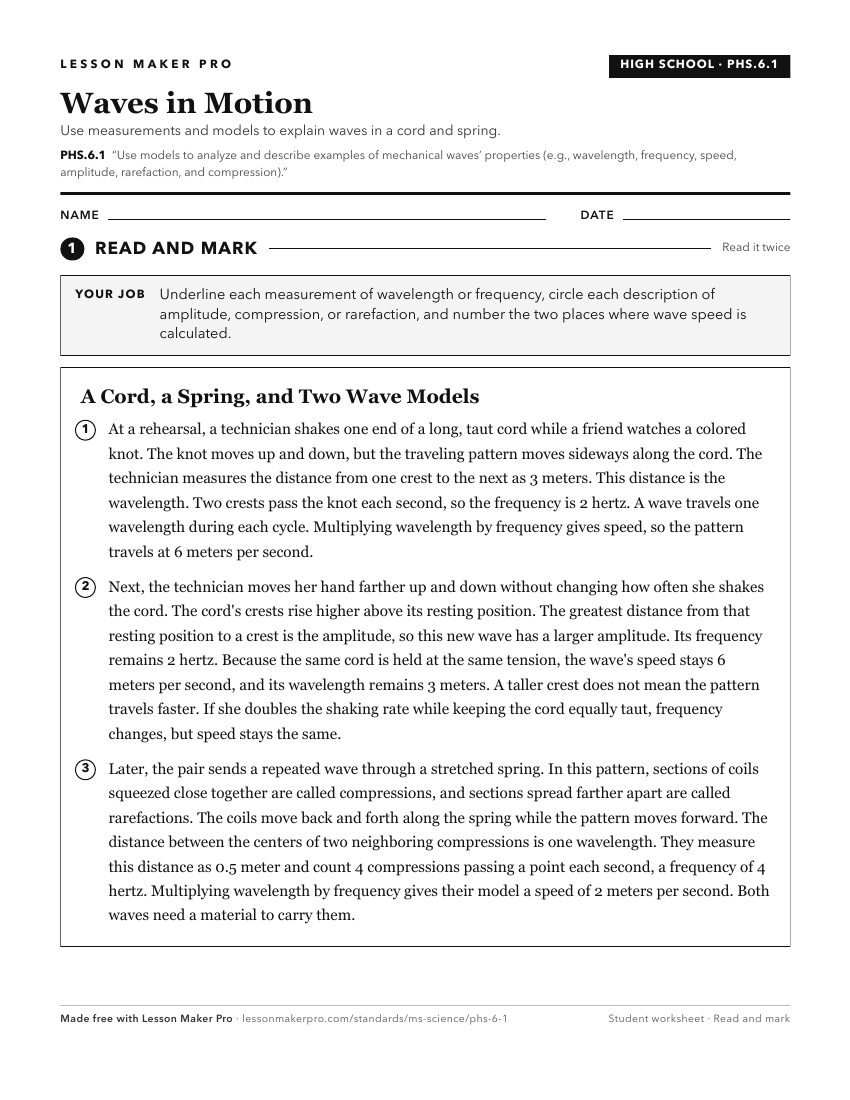
A ready-to-print activity worksheet aligned to PHS.6.1, with an answer key for the teacher on its own page. No account needed.
PDF, US Letter, prints cleanly in black and white.
Download the worksheetKeep exploring
Related Standards
- PHS.6.2
Analyze examples and evidence of transverse and longitudinal waves found in nature (e.g., earthquakes, ocean waves, and sound waves).
- PHY.4.3
Use mathematical and computational analysis to explore wave characteristics (e.g., velocity, period, frequency, amplitude, phase, and wavelength).
- PHY.4.2
Describe and model through digital or physical means the characteristics and properties of mechanical waves by simulating and investigating properties of simple...
- PHY.4.1
Analyze the characteristics and properties of simple harmonic motions, sound, and light.
Turn this exact standard into a lesson
Grade, subject, topic, and the complete standard are prefilled. Create one free, no account needed.
Also for this standard:Make a WorksheetMake a QuizMake a Sub Lesson