Mississippi Science PHY.4.1
The Standard
- PHY.4
- Students will investigate and explore wave properties.
Analyze the characteristics and properties of simple harmonic motions, sound, and light.
2026 Mississippi College- and Career-Readiness Standards for Science · Waves
Teacher's field guide
What This Standard Means
What Students Need to Do
- Students measure the period and amplitude of a mass bouncing on a spring. They read motion and wave graphs to compare sound pitch and loudness, and light color and brightness.
What Mastery Looks Like
- Given a motion graph, a student finds amplitude, period, and frequency. They use frequency to compare sound pitch and light color, and amplitude to compare sound loudness.
Common Misconceptions
- Students often confuse amplitude with frequency, saying a taller sound wave has a higher pitch. They may think a longer wavelength means a higher frequency, or that light needs air to travel as sound does.
How to Assess It
- Exit ticket: Draw a spring-motion graph with 3 cm peaks at 0, 2, and 4 seconds, and two sound waves with peaks 2 or 4 squares apart. Ask for the spring's amplitude and frequency, the higher-pitched sound, and whether red or blue light has higher frequency.
Lesson moves
Ways to Teach It
Hang a washer from a spring, time ten bounces, then measure its greatest distance from rest to find period and amplitude.
Show two sound wave sketches with equal spacing and different heights; ask, "Which changes, pitch or loudness, and why?"
Give pairs of spring graphs; students race to mark amplitude, period, and frequency on mini whiteboards, then check with a partner.
Play 440 Hz and 880 Hz tones, then shine a flashlight through red and blue filters; ask which has higher pitch and higher light frequency.
Free download
Printable PHY.4.1 Worksheet
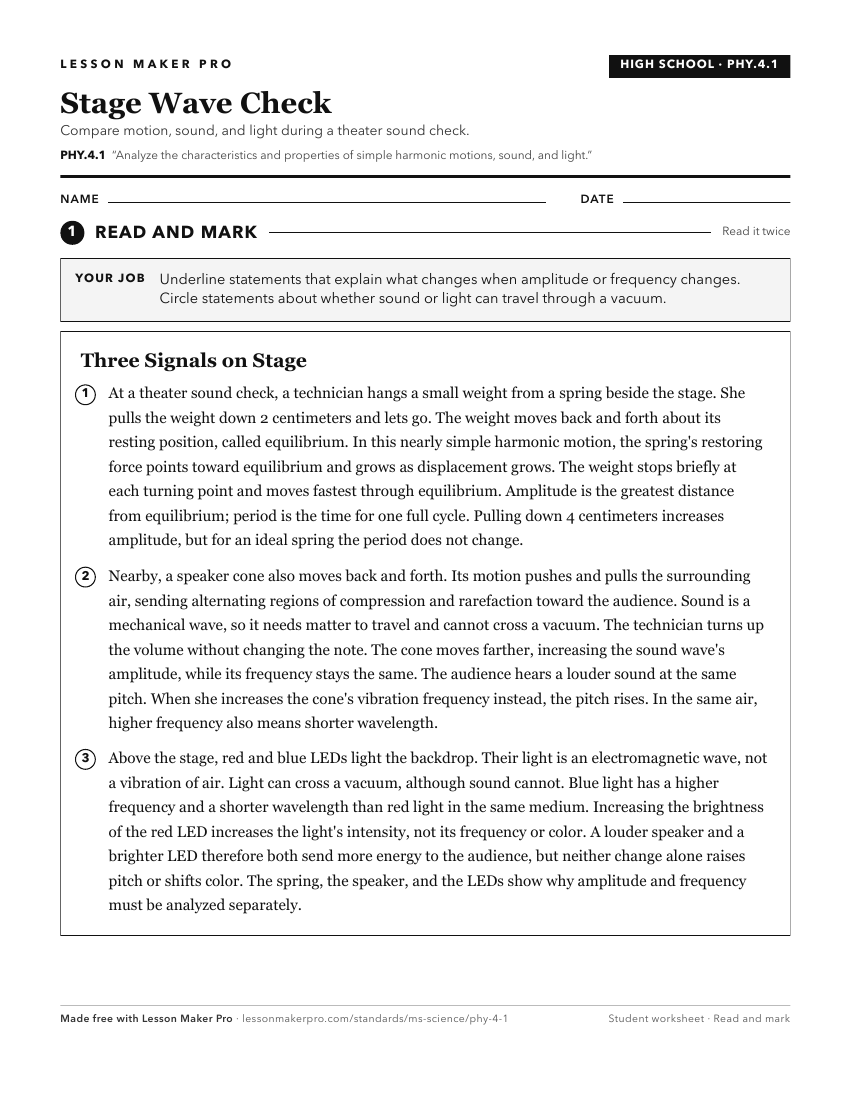
A ready-to-print activity worksheet aligned to PHY.4.1, with an answer key for the teacher on its own page. No account needed.
PDF, US Letter, prints cleanly in black and white.
Download the worksheetKeep exploring
Related Standards
- P.8.6.1
Interpret the characteristics and behaviors of sound and light waves to determine the relationship between matter and energy; determine the medium for transmiss...
- PHS.6.1
Use models to analyze and describe examples of mechanical waves’ properties (e.g., wavelength, frequency, speed, amplitude, rarefaction, and compression).
- PHY.4.3
Use mathematical and computational analysis to explore wave characteristics (e.g., velocity, period, frequency, amplitude, phase, and wavelength).
- PHY.4.2
Describe and model through digital or physical means the characteristics and properties of mechanical waves by simulating and investigating properties of simple...
Turn this exact standard into a lesson
Grade, subject, topic, and the complete standard are prefilled. Create one free, no account needed.
Also for this standard:Make a WorksheetMake a QuizMake a Sub Lesson