Mississippi Science PHS.6.2
The Standard
- PHS.6
- Students will explore the characteristics of waves.
Analyze examples and evidence of transverse and longitudinal waves found in nature (e.g., earthquakes, ocean waves, and sound waves).
2026 Mississippi College- and Career-Readiness Standards for Science · Waves
Teacher's field guide
What This Standard Means
What Students Need to Do
- Students compare the direction a wave travels with the direction particles move. They use sound, earthquake, and ocean wave examples to identify longitudinal, transverse, and mixed motion.
What Mastery Looks Like
- A student can explain that sound and seismic P waves move particles back and forth along the wave’s path, while seismic S waves move them across it. They can explain why an ocean surface wave is not purely transverse.
Common Misconceptions
- Students may draw air moving up and down as sound travels forward. They may call ocean waves purely transverse because they see only the surface rise and fall. Some swap the motions of seismic P and S waves.
How to Assess It
- Exit ticket: A seismic P wave compresses rock along its path, while an S wave shifts rock across its path. Draw particle-motion arrows and label each wave type.
Lesson moves
Ways to Teach It
Stretch a slinky across the floor; push its coils forward, then shake one end sideways, and have students sketch both motions.
Show a sketch of water particles moving in loops beneath an ocean wave, then ask why the wave is not purely transverse.
Give pairs sound, seismic P, seismic S, and ocean wave cards to match with particle-motion sketches.
Show a seismogram with P and S arrivals marked; ask students to match each arrival to push-pull or sideways rock motion.
Free download
Printable PHS.6.2 Worksheet
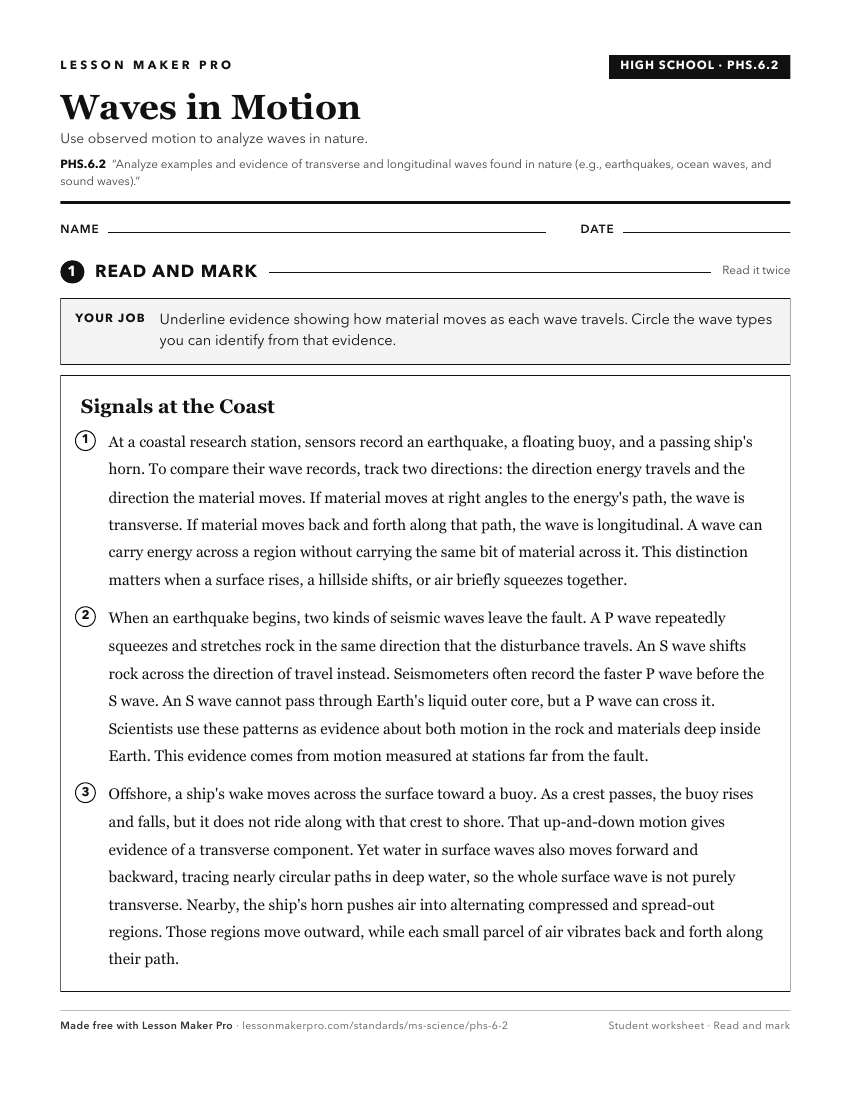
A ready-to-print activity worksheet aligned to PHS.6.2, with an answer key for the teacher on its own page. No account needed.
PDF, US Letter, prints cleanly in black and white.
Download the worksheetKeep exploring
Related Standards
- PHS.6.1
Use models to analyze and describe examples of mechanical waves’ properties (e.g., wavelength, frequency, speed, amplitude, rarefaction, and compression).
- PHY.4.3
Use mathematical and computational analysis to explore wave characteristics (e.g., velocity, period, frequency, amplitude, phase, and wavelength).
- PHY.4.5
Design, investigate, and collect data on standing waves and waves in specific media (e.g., stretched string, water surface, and air) using online simulations, p...
- PHY.4.1
Analyze the characteristics and properties of simple harmonic motions, sound, and light.
Turn this exact standard into a lesson
Grade, subject, topic, and the complete standard are prefilled. Create one free, no account needed.
Also for this standard:Make a WorksheetMake a QuizMake a Sub Lesson