Mississippi Science E.4.9C.2
The Standard
- E.4.9C
- Students will demonstrate an understanding of how natural processes and human activities affect the features of Earth's landforms and oceans.
Develop and use models of natural processes to explain the effect of the movement of water on the ocean shore zone, including beaches, barrier islands, estuaries, and inlets (e.g., marshes, bays, lagoons, fjords, or sound).
2026 Mississippi College- and Career-Readiness Standards for Science · Earth’s Systems and Cycles
Teacher's field guide
What This Standard Means
What Students Need to Do
- Students build and label a model of a coast. They use it to show how waves and currents move sand around beaches, barrier islands, estuaries, and inlets.
What Mastery Looks Like
- A student can point to where sand washes away and where it settles in their model. They can trace water through an inlet and explain how a barrier island shelters the estuary behind it.
Common Misconceptions
- Students may think waves only wash sand away, rather than moving it to another place. They may think barrier islands stay fixed or that an estuary contains only ocean water.
How to Assess It
- Exit ticket: Draw a beach, barrier island, inlet, and estuary before and after waves move sand. Add arrows for moving water, and mark one place sand washes away and one place it collects.
Lesson moves
Ways to Teach It
Build a sand barrier island with an inlet in a shallow tray, push waves with a spoon, and mark where sand collects.
Give students two shoreline sketches and ask them to write where sand washed away, where it collected, and why.
Give pairs before-and-after shoreline cards; have them match each pair and place sand tokens where water moved them.
Compare two dated aerial photos of a Gulf Coast beach; circle shoreline changes and explain how waves may have moved sand.
Free download
Printable E.4.9C.2 Worksheet
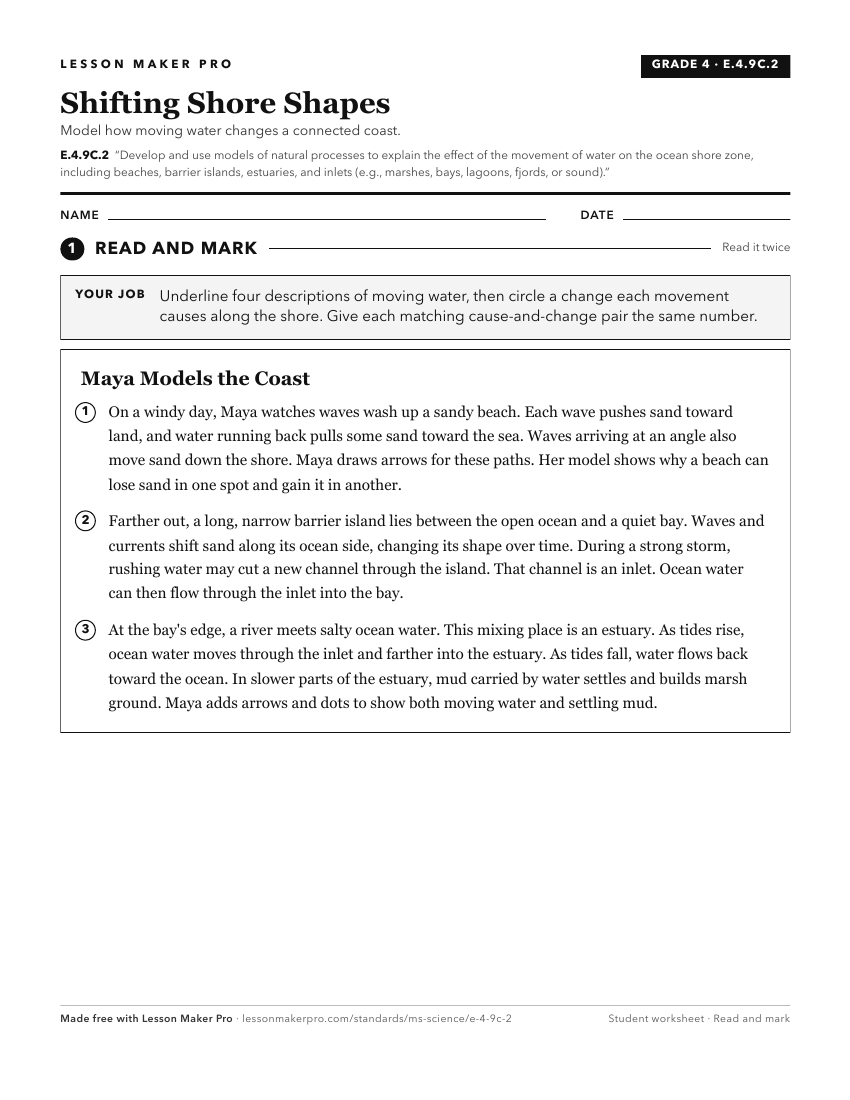
A ready-to-print activity worksheet aligned to E.4.9C.2, with an answer key for the teacher on its own page. No account needed.
PDF, US Letter, prints cleanly in black and white.
Download the worksheetKeep exploring
Related Standards
- MAQ.4.6
Research, analyze, and communicate the effects of natural phenomena (e.g., hurricanes, floods, drought, and sea-level rise) on the aquatic ecosystems.
- E.3.7B.3
Develop and use models of weathering, erosion, and deposition processes which explain the appearance of various Earth features (e.g., the Grand Canyon, Arches N...
- E.3.9.2
Construct explanations of how different landforms and surface features result from the location and movement of water on Earth’s surface (e.g., watersheds, drai...
- E.4.9A.1
Develop and use models to explain how the sun's energy drives the water cycle. (e.g., evaporation, condensation, precipitation, transpiration, runoff, and groun...
Turn this exact standard into a lesson
Grade, subject, topic, and the complete standard are prefilled. Create one free, no account needed.
Also for this standard:Make a WorksheetMake a QuizMake a Sub Lesson