Mississippi Science E.3.7B.3
The Standard
- E.3.7B
- Students will demonstrate an understanding of the composition of Earth and the processes which change Earth's landforms.
Develop and use models of weathering, erosion, and deposition processes which explain the appearance of various Earth features (e.g., the Grand Canyon, Arches National Park in Utah, Plymouth Bluff in Columbus, or Red Bluff in Marion County, Mississippi).
2026 Mississippi College- and Career-Readiness Standards for Science · Earth’s Structure and History
Teacher's field guide
What This Standard Means
What Students Need to Do
- Students build or draw models showing rock breaking apart, sediment moving, and sediment settling. They use their models to explain how a canyon, bluff, or sandbar got its shape.
What Mastery Looks Like
- A student can label weathering where rock breaks, erosion where water carries pieces away, and deposition where sediment collects. They can explain how these changes, repeated over a long time, shape the land.
Common Misconceptions
- Students may call every change erosion, even when rock only cracks or sand settles. They may think a canyon forms in one storm or that sediment disappears after water carries it away.
How to Assess It
- On an exit ticket, ask students to draw a river cutting a canyon with a sandbar downstream. Have them label where rock breaks, sediment moves, and sediment settles.
Lesson moves
Ways to Teach It
Pour water over a mound of damp sand in a tray, then have students sketch where sand moved and where it collected.
Show a photo of the Grand Canyon and ask, “What might running water change here over many years?”
Give pairs cards showing cracked rock, moving mud, and sand piles; have them match each card to weathering, erosion, or deposition.
Show a photo of a muddy creek after rain; have students mark where its bank might wear away and where sand might settle.
Free download
Printable E.3.7B.3 Worksheet
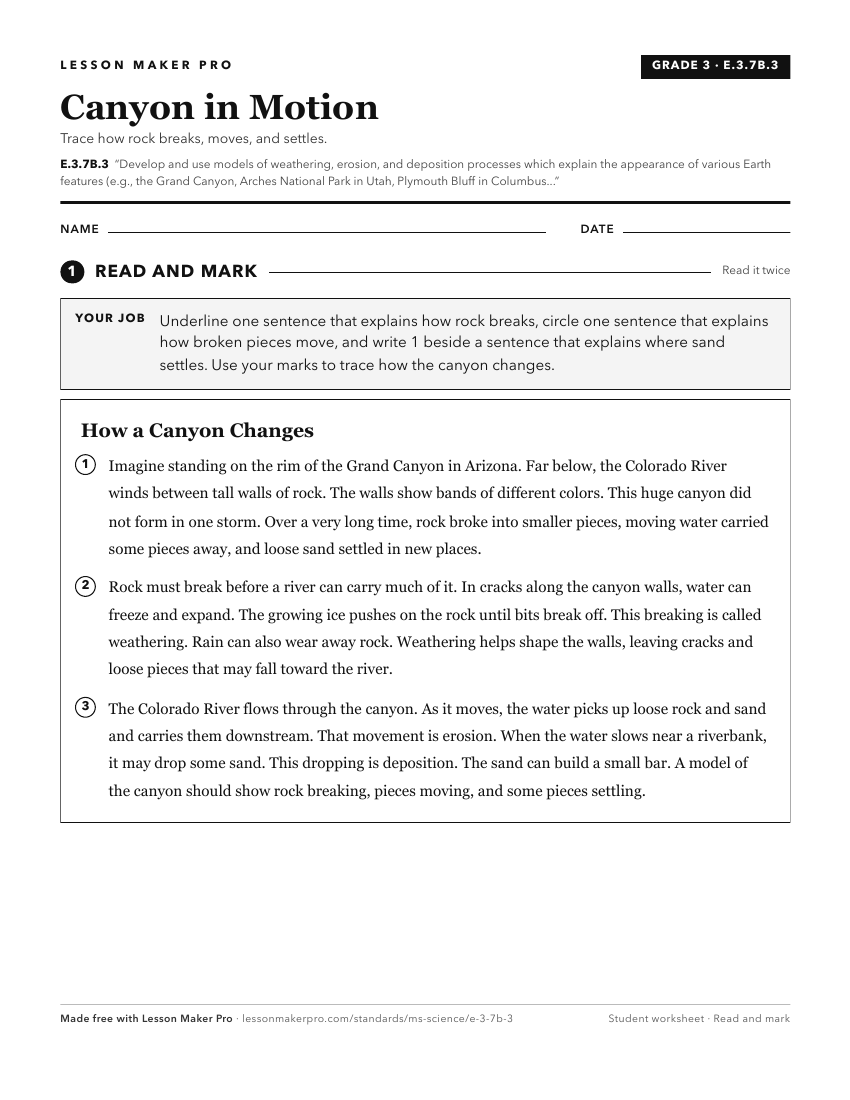
A ready-to-print activity worksheet aligned to E.3.7B.3, with an answer key for the teacher on its own page. No account needed.
PDF, US Letter, prints cleanly in black and white.
Download the worksheetKeep exploring
Related Standards
- E.4.9C.2
Develop and use models of natural processes to explain the effect of the movement of water on the ocean shore zone, including beaches, barrier islands, estuarie...
- E.3.7A.2
Develop and use models to demonstrate the processes involved in the development of various rock formations, including superposition, and how those formations ca...
- E.3.7B.4
Compare and contrast constructive (e.g., deposition, volcano) and destructive (e.g., weathering, erosion, earthquake) processes of the Earth.
- E.3.7B.2
Develop and use models to describe the characteristics of Earth's continental landforms and classify landforms as volcanoes, mountains, valleys, canyons, plains...
Turn this exact standard into a lesson
Grade, subject, topic, and the complete standard are prefilled. Create one free, no account needed.
Also for this standard:Make a WorksheetMake a QuizMake a Sub Lesson