Mississippi Science E.3.7B.4
The Standard
- E.3.7B
- Students will demonstrate an understanding of the composition of Earth and the processes which change Earth's landforms.
Compare and contrast constructive (e.g., deposition, volcano) and destructive (e.g., weathering, erosion, earthquake) processes of the Earth.
2026 Mississippi College- and Career-Readiness Standards for Science · Earth’s Structure and History
Teacher's field guide
What This Standard Means
What Students Need to Do
- Students compare ways Earth’s surface builds up and breaks down. They explain how volcanoes and deposited sand add land, while weathering breaks rock, erosion carries material away, and earthquakes can crack or lift the ground.
What Mastery Looks Like
- A student can look at a washing riverbank and a growing sandbar, then explain where the sand went. They can tell weathering from erosion and explain why an earthquake might both crack and raise land.
Common Misconceptions
- Students may think eroded soil disappears instead of settling somewhere else. They may call sand carried by water weathering, or assume earthquakes only break land apart.
How to Assess It
- Show a drawing of a river carrying sand from a bank to a sandbar. Ask students to label where erosion and deposition happen and explain which place loses land and which gains it.
Lesson moves
Ways to Teach It
Pour water over a tilted tray of sand, then mark where sand washed away and where it piled up.
Show photos of a new volcanic island and a crumbling riverbank, then ask students how each changes the land.
Sort sketch cards of a volcanic island, cracked rock, washed-away riverbank, sandbar, and earthquake-damaged hillside into building or breaking down land.
After rain, photograph soil washed from a schoolyard path and piled at its edge, then label erosion and deposition.
Free download
Printable E.3.7B.4 Worksheet
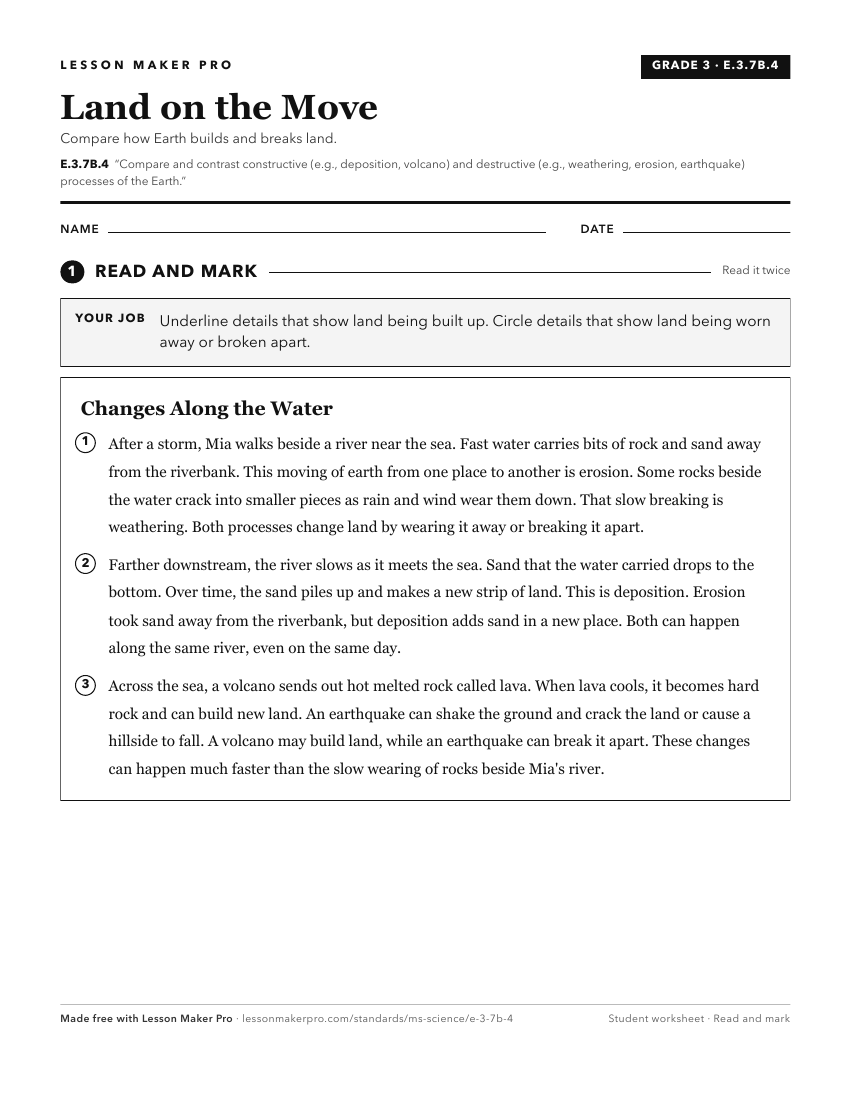
A ready-to-print activity worksheet aligned to E.3.7B.4, with an answer key for the teacher on its own page. No account needed.
PDF, US Letter, prints cleanly in black and white.
Download the worksheetKeep exploring
Related Standards
- E.8.9A
Students will demonstrate an understanding that physical processes and major geological events (e.g., plate movement, volcanic activity, mountain building, weat...
- E.8.9A.4
Research and assess the credibility of scientific ideas to debate and discuss how Earth's constructive and destructive processes have changed Earth's surface at...
- E.3.7B.3
Develop and use models of weathering, erosion, and deposition processes which explain the appearance of various Earth features (e.g., the Grand Canyon, Arches N...
- E.4.9C.1
Analyze and interpret data to describe (i.e., NASA, NOAA, USGS) and predict how natural processes (e.g., weathering, erosion, deposition, earthquakes, tsunamis,...
Turn this exact standard into a lesson
Grade, subject, topic, and the complete standard are prefilled. Create one free, no account needed.
Also for this standard:Make a WorksheetMake a QuizMake a Sub Lesson