Mississippi Science P.1.6B
Standard Cluster
Students will demonstrate an understanding of sound. Conduct an investigation to provide evidence that vibrations create sound (e.g., pluck a guitar string) and that sound can create vibrations (e.g., feeling sound through a speaker). Create a device that uses light and/or sound to communicate over a distance (e.g., signal lamp with a flashlight). Use an engineering design process to define the problem, design, construct, evaluate, and improve the device. *
2026 Mississippi College- and Career-Readiness Standards for Science · Motions, Forces, and Energy
Cluster contents
Standards in This Cluster
P.1.6B is a cluster heading. These are the individual standards under it.
- P.1.6B.1
Conduct an investigation to provide evidence that vibrations create sound (e.g., pluck a guitar string) and that sound can create vibrations (e.g., feeling soun...
- P.1.6B.2
Create a device that uses light and/or sound to communicate over a distance (e.g., signal lamp with a flashlight). Use an engineering design process to define t...
Teacher's field guide
What This Cluster Means
What Students Need to Do
- Students pluck a rubber band and watch it shake as it makes sound. They watch rice move near a playing speaker. They choose a message, build a light or sound signal, test it across the room, and improve it.
What Mastery Looks Like
- A student explains that a shaking rubber band makes sound and that sound from a speaker can shake nearby rice. They send a flashlight signal to a partner across the room and change it if the partner misreads it.
Common Misconceptions
- Some students think the finger's pluck makes the sound, rather than the band's continued shaking. Others think the speaker must touch the rice to move it, or that flashes carry a message without an agreed meaning.
How to Assess It
- Exit ticket: On pictures of a plucked rubber band and rice near a playing speaker, circle what shakes. Draw one change you made to a flashlight signal your partner missed.
Lesson moves
Ways to Teach It
Pluck a rubber band stretched over a box; watch rice on plastic wrap over a bowl shake near a playing speaker.
Ask pairs, 'What should one flash mean, and how will you know your partner saw it across the room?'
Play signal relay: attach a paper shutter to a flashlight, send a two-flash code across the room, then revise it after a missed message.
Show a photo of a lighthouse, then test whether a flashlight or a clap sends a clearer signal across the room.
Free download
Printable P.1.6B Worksheet
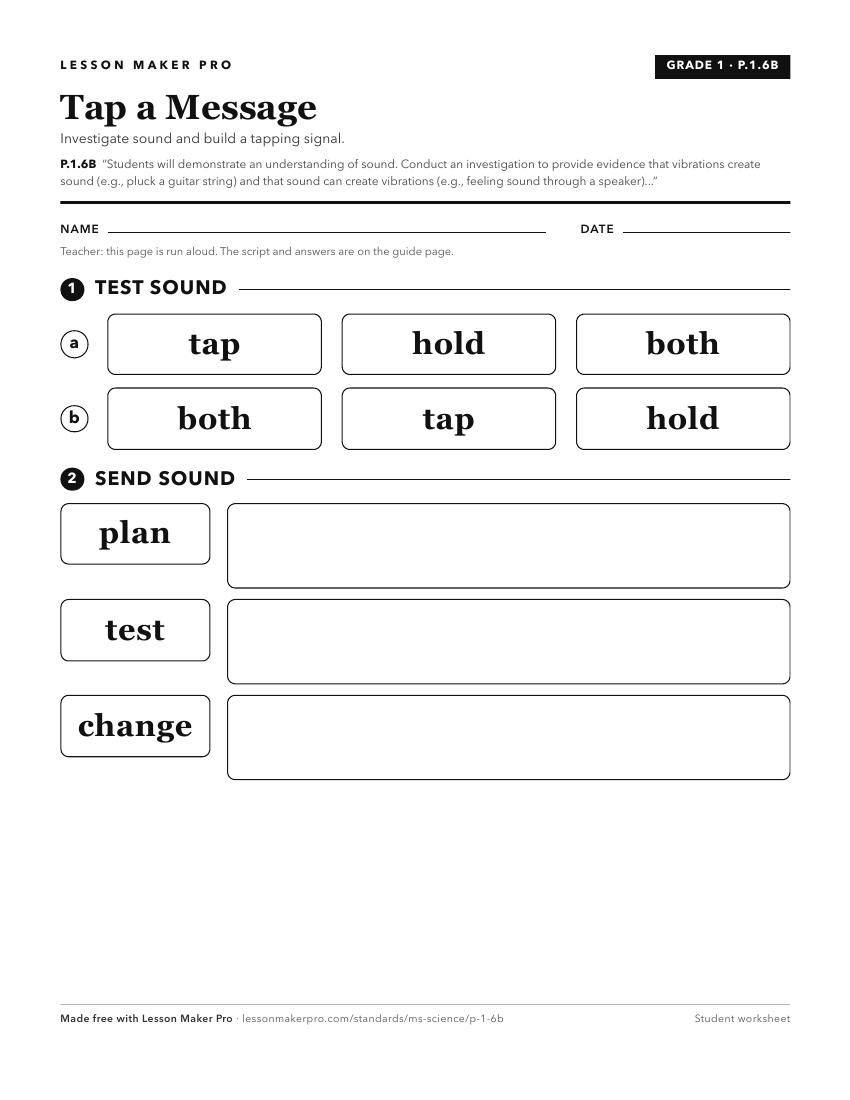
A ready-to-print activity worksheet aligned to P.1.6B, with an answer key for the teacher on its own page. No account needed.
PDF, US Letter, prints cleanly in black and white.
Download the worksheetKeep exploring
Related Standards
- P.4.6C
Students will demonstrate an understanding of the properties of sound as a form of energy.
- P.8.6
Students will demonstrate an understanding of the properties, behaviors, and application of waves.
- P.5.5A
Students will demonstrate an understanding of the physical properties of matter.
- P.2.5
Students will demonstrate an understanding of the properties of matter.
Turn this cluster into a lesson
Grade, subject, topic, and the complete cluster are prefilled. Create one free, no account needed.
Also for this cluster:Make a WorksheetMake a QuizMake a Sub Lesson