Mississippi Science PHS.6.3
The Standard
- PHS.6
- Students will explore the characteristics of waves.
Generate wave models to explore energy transference.
2026 Mississippi College- and Career-Readiness Standards for Science · Waves
Teacher's field guide
What This Standard Means
What Students Need to Do
- Students build or draw a wave model that shows how energy moves from a source. They use it to predict how one marked point moves as the wave passes.
What Mastery Looks Like
- A student can send a pulse down a rope and show that a tape marker moves up and down while the pulse moves along the rope. They can explain that a taller pulse carries more energy when the rope and pulse shape stay the same.
Common Misconceptions
- Students may think the rope travels with the pulse, rather than moving near its starting position. They may also think a taller pulse must travel faster.
How to Assess It
- Exit ticket: Sketch a pulse moving right along a rope with one taped spot. Show the pulse’s direction and the spot’s motion, then explain what changes if the pulse gets taller.
Lesson moves
Ways to Teach It
Tape a paper flag to a long rope, send pulses down it, and watch the flag move up and down.
Ask: If the pulse reaches the far end, why does the paper flag stay near its starting point?
Give pairs cards showing otherwise identical pulses of different heights on one rope, and have them rank the pulses by energy carried.
Have students sketch how a phone speaker sends energy through air to an ear, marking air movement and energy direction.
Free download
Printable PHS.6.3 Worksheet
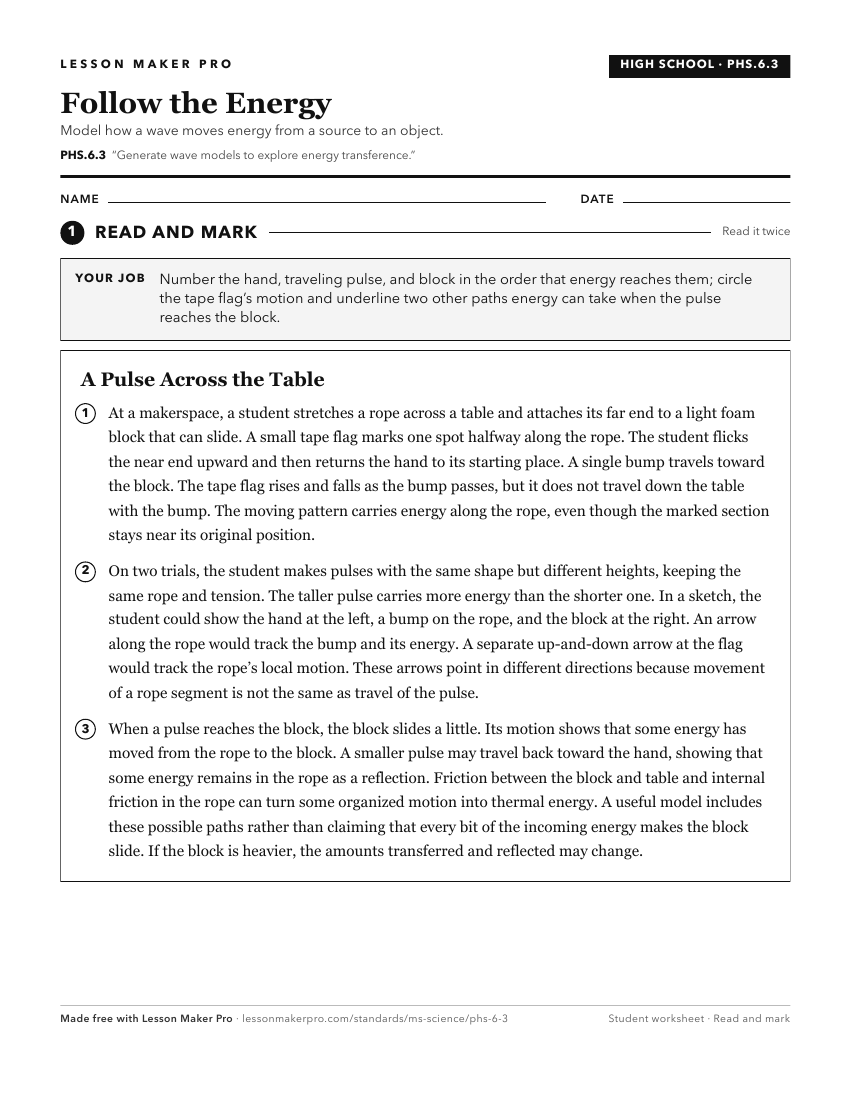
A ready-to-print activity worksheet aligned to PHS.6.3, with an answer key for the teacher on its own page. No account needed.
PDF, US Letter, prints cleanly in black and white.
Download the worksheetKeep exploring
Related Standards
- PHS.6.1
Use models to analyze and describe examples of mechanical waves’ properties (e.g., wavelength, frequency, speed, amplitude, rarefaction, and compression).
- P.4.6A.3
Develop models demonstrating how heat and electrical energy can be transformed into other forms of energy (e.g., motion, sound, heat, or light).
- P.8.6.2
Investigate research-based mechanisms for capturing and converting wave energy (frequency, amplitude, wavelength, and speed) into electrical energy.
- PHY.4.4
Investigate and communicate the relationship between the energy of a wave in terms of amplitude and frequency using probe systems, online simulations, and/or la...
Turn this exact standard into a lesson
Grade, subject, topic, and the complete standard are prefilled. Create one free, no account needed.
Also for this standard:Make a WorksheetMake a QuizMake a Sub Lesson