Mississippi Science P.8.6.2
The Standard
- P.8.6
- Students will demonstrate an understanding of the properties, behaviors, and application of waves.
Investigate research-based mechanisms for capturing and converting wave energy (frequency, amplitude, wavelength, and speed) into electrical energy.
2026 Mississippi College- and Career-Readiness Standards for Science · Motions, Forces, and Energy
Teacher's field guide
What This Standard Means
What Students Need to Do
- Students measure amplitude, wavelength, frequency, and speed in wave diagrams or models. They use a researched device diagram to explain how wave motion becomes electricity.
What Mastery Looks Like
- Students measure amplitude from the rest line to a crest and wavelength from crest to crest. They calculate frequency and speed from observations, then trace how a moving buoy drives a generator.
Common Misconceptions
- Students may measure amplitude from crest to trough or confuse wavelength with wave height. They may treat frequency and speed as the same thing. Some think a bobbing buoy makes electricity without a generator.
How to Assess It
- Show a scaled wave sketch with a rest line. Say four crests pass in two seconds and one crest moves two meters in one second. Ask students to mark amplitude and wavelength, find frequency and speed, and explain how a buoy drives a generator.
Lesson moves
Ways to Teach It
Send small and large ripples across a tray of water, measure how far a cork rises, and sketch how its motion could drive a generator.
Show an oscillating water column diagram and ask, 'What moves first, and what turns the generator?'
Match cards showing crest spacing, height above rest, crests per second, and distance per second to the four wave measurements.
Read a NOAA buoy report for wave height and period, then explain how those conditions might affect a floating generator.
Free download
Printable P.8.6.2 Worksheet
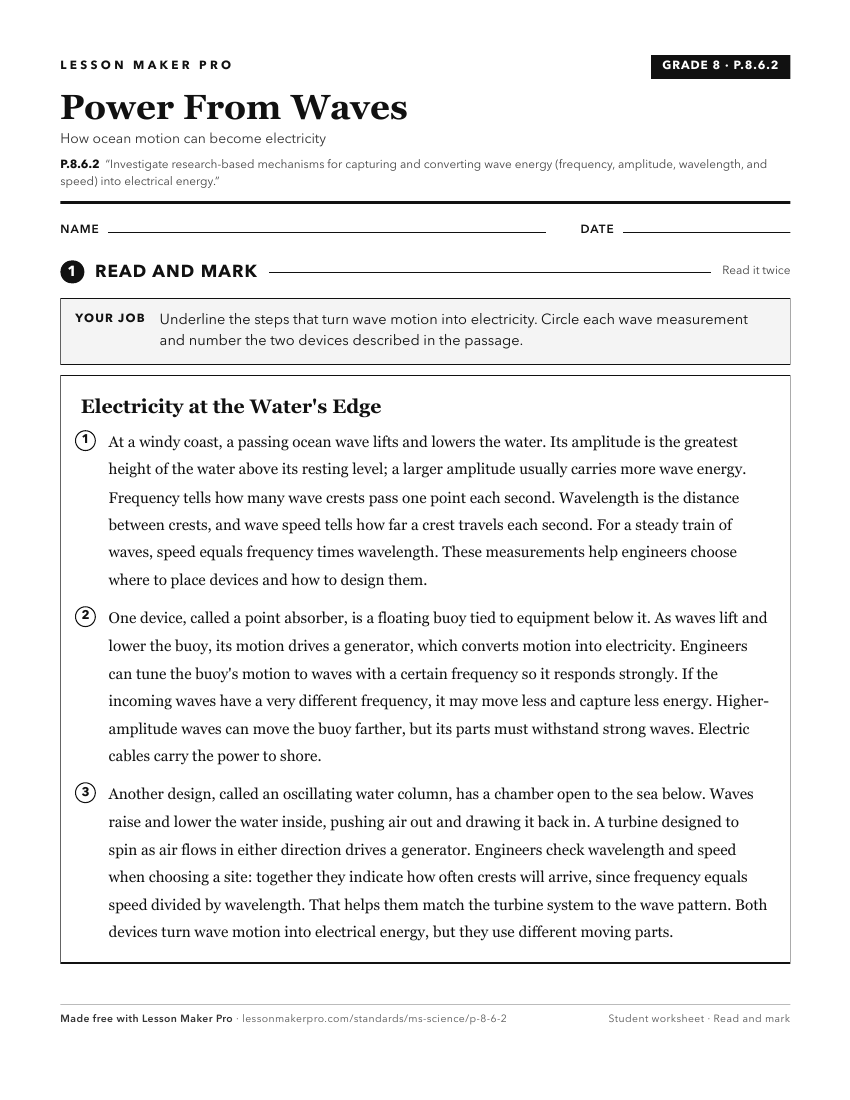
A ready-to-print activity worksheet aligned to P.8.6.2, with an answer key for the teacher on its own page. No account needed.
PDF, US Letter, prints cleanly in black and white.
Download the worksheetKeep exploring
Related Standards
- PHS.7.4
Conduct investigations to provide evidence of the conservation of energy as energy is converted from one form of energy to another (e.g., wind to electric, chem...
- PHS.7.2
Use scientific investigations to explore the transformation of energy from one type to another (e.g., potential to kinetic energy, and mechanical, chemical, ele...
- PHS.6.3
Generate wave models to explore energy transference.
- PHY.4.4
Investigate and communicate the relationship between the energy of a wave in terms of amplitude and frequency using probe systems, online simulations, and/or la...
Turn this exact standard into a lesson
Grade, subject, topic, and the complete standard are prefilled. Create one free, no account needed.
Also for this standard:Make a WorksheetMake a QuizMake a Sub Lesson