Mississippi Science PHY.4.9
The Standard
- PHY.4
- Students will investigate and explore wave properties.
Research the different bands of electromagnetic radiation, including characteristics, properties, and similarities/differences.
2026 Mississippi College- and Career-Readiness Standards for Science · Waves
Teacher's field guide
What This Standard Means
What Students Need to Do
- Students research the main bands of electromagnetic radiation and compare their wavelengths, frequencies, energies, and uses. They explain what the bands share and how they differ.
What Mastery Looks Like
- A student can put the bands in order by wavelength and explain that frequency and photon energy increase as wavelength decreases. They can give a use for each band and explain that all electromagnetic waves travel through a vacuum.
Common Misconceptions
- Students may think only visible light is electromagnetic radiation. They may also think a longer wavelength means more energy, or that all radiation is harmful.
How to Assess It
- Exit ticket: Put radio waves, infrared, visible light, ultraviolet, and X-rays in order of increasing frequency. Circle the highest-energy band and name one property all five share.
Lesson moves
Ways to Teach It
Shine a flashlight through a prism onto white paper, then have students sketch the colors and label them as visible light.
Ask pairs: If radio waves and X-rays travel at the same speed in a vacuum, why do they have different uses?
Give teams seven band cards and have them race to order them from longest wavelength to shortest, then check with a reference chart.
Have students read a sunscreen label and a local UV index forecast, then write which band the sunscreen targets.
Free download
Printable PHY.4.9 Worksheet
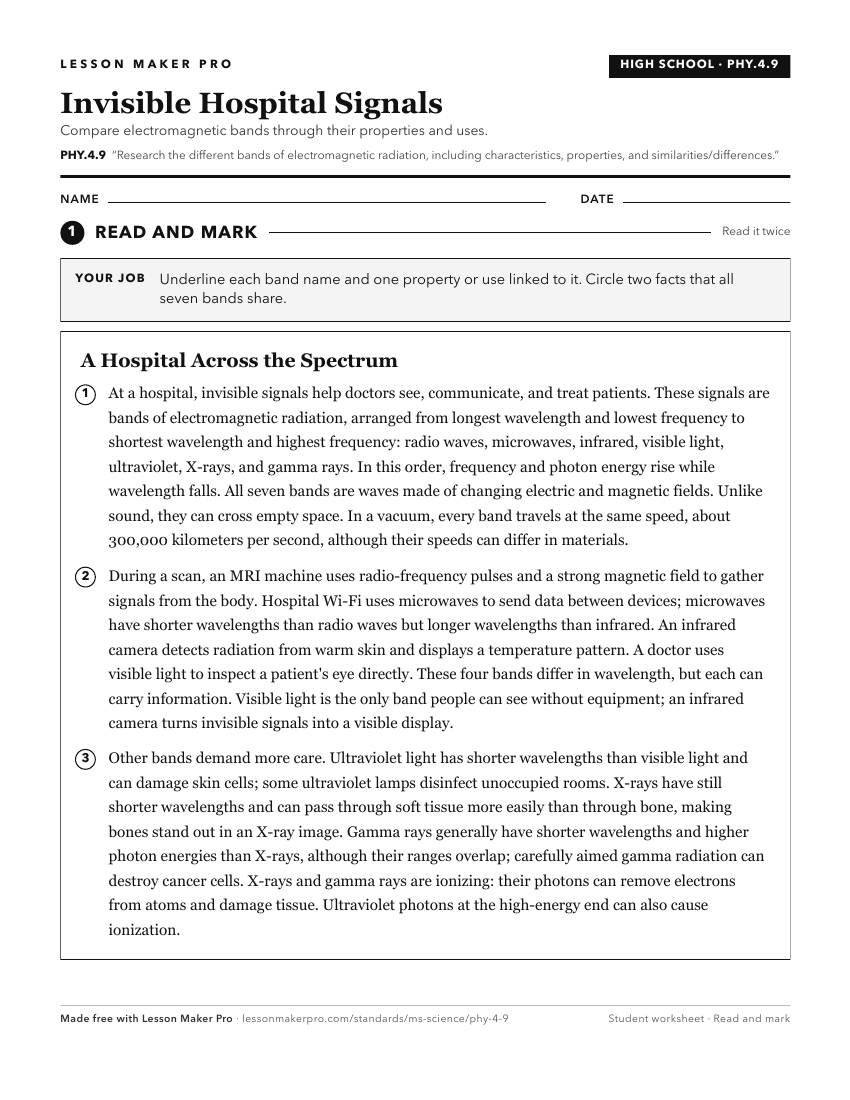
A ready-to-print activity worksheet aligned to PHY.4.9, with an answer key for the teacher on its own page. No account needed.
PDF, US Letter, prints cleanly in black and white.
Download the worksheetKeep exploring
Related Standards
- P.8.6.1
Interpret the characteristics and behaviors of sound and light waves to determine the relationship between matter and energy; determine the medium for transmiss...
- PHY.4.10
Enrichment: Research the ways absorption and emission spectra are used to study astronomy and the formation of the universe.
- CHE.2.3
Investigate absorption and emission spectra to interpret explanations of electrons at discrete energy levels using tools such as online simulations, spectromete...
- PHS.6.6
Research real-world applications to create models or visible representations of the electromagnetic spectrum, including visible light, infrared radiation, and u...
Turn this exact standard into a lesson
Grade, subject, topic, and the complete standard are prefilled. Create one free, no account needed.
Also for this standard:Make a WorksheetMake a QuizMake a Sub Lesson