Mississippi Science PHY.4.11
The Standard
- PHY.4
- Students will investigate and explore wave properties.
Enrichment: Research digital nonfictional text to defend the wave-particle duality of light (i.e., wave model of light and particle model of light).
2026 Mississippi College- and Career-Readiness Standards for Science · Waves
Teacher's field guide
What This Standard Means
What Students Need to Do
- Students find reliable online science texts about light. They use interference as evidence for a wave model and the photoelectric effect as evidence for a particle model. They cite sources to explain why both models are needed.
What Mastery Looks Like
- A student explains how bright and dark spots from a diffraction grating support the wave model. They explain why light below a threshold frequency cannot eject electrons from a metal, however bright it is. They cite an online source for each explanation.
Common Misconceptions
- Students may think brighter light always ejects electrons, even below the threshold frequency. Some take interference as proof that photons do not exist. Others think wave-like and particle-like light are two separate kinds of light.
How to Assess It
- Exit ticket: A grating makes bright and dark spots. Bright red light fails to eject electrons from a metal, but dim violet light succeeds. Explain both results and cite the online sources you used.
Lesson moves
Ways to Teach It
Project a low-power laser through a diffraction grating onto white paper; sketch the bright spots and keep the beam away from eyes.
Read two university science pages, one on interference and one on the photoelectric effect; write a claim citing evidence from both.
Sort cards showing interference fringes, diffraction spots, an electron ejection threshold, and faster electrons under higher-frequency light; justify each match.
Use a solar panel diagram to mark where photons transfer energy to electrons, then compare that evidence with the grating pattern.
Free download
Printable PHY.4.11 Worksheet
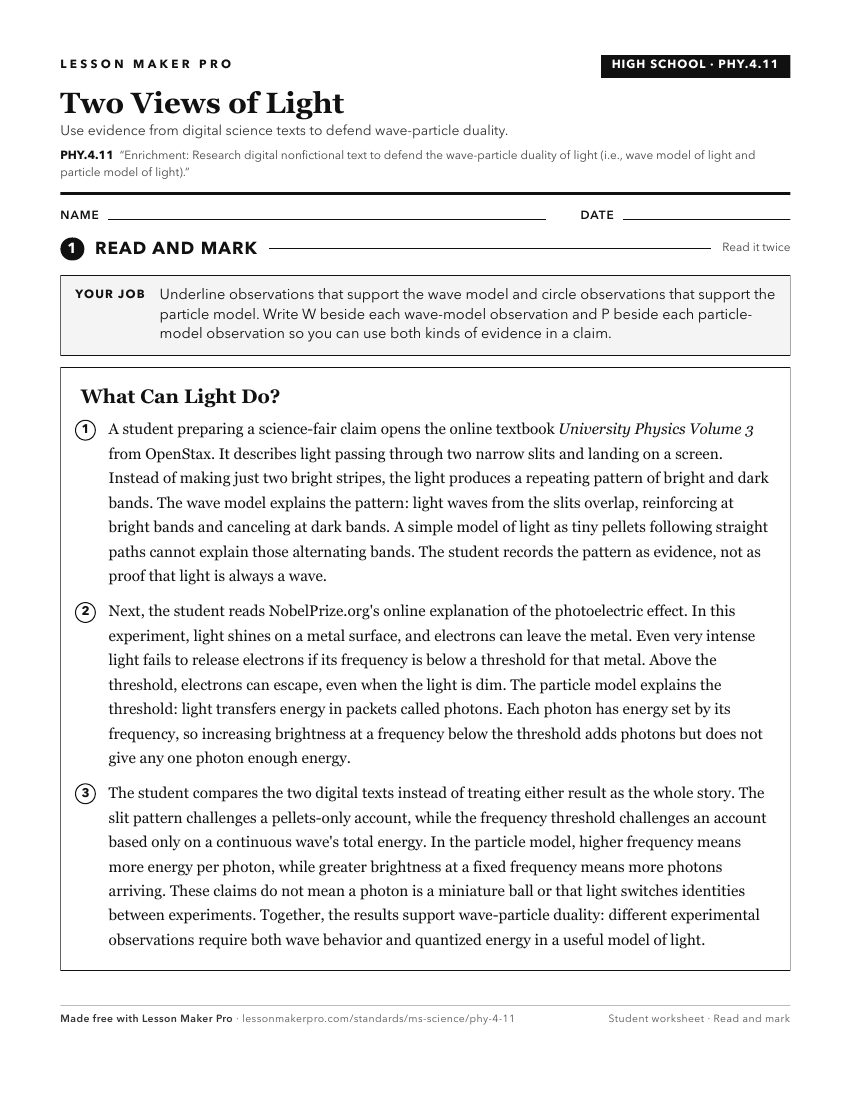
A ready-to-print activity worksheet aligned to PHY.4.11, with an answer key for the teacher on its own page. No account needed.
PDF, US Letter, prints cleanly in black and white.
Download the worksheetKeep exploring
Related Standards
- P.4.6B.3
Develop and use models to communicate how light travels and behaves when it strikes an object, including reflection, refraction, and absorption.
- PHS.6.8
Enrichment: Debate the particle/wave behavior of light.
- PHY.4.12
Enrichment: Research uses of the electromagnetic spectrum or photoelectric effect.
- CHE.7.2
Enrichment: Use an engineering design process to develop models (e.g., online simulations or student interactive activities) to explain and predict the behavior...
Turn this exact standard into a lesson
Grade, subject, topic, and the complete standard are prefilled. Create one free, no account needed.
Also for this standard:Make a WorksheetMake a QuizMake a Sub Lesson