Mississippi Science PHY.4.8
The Standard
- PHY.4
- Students will investigate and explore wave properties.
Use ray diagrams and thin lens equations to solve real-world problems involving object distance from lenses, using a lens bench, online simulations, and/or laboratory experiences.
2026 Mississippi College- and Career-Readiness Standards for Science · Waves
Teacher's field guide
What This Standard Means
What Students Need to Do
- Students draw rays to locate an image made by a thin lens. They use focal length and image distance to calculate how far the object is from the lens.
What Mastery Looks Like
- Students label the distances from the lens on a ray diagram. They calculate an object distance that matches where a sharp image appears on a screen.
Common Misconceptions
- Students often measure image distance from the object instead of the lens. They may think every image can appear on a screen, even when the object is inside the focal length.
How to Assess It
- Exit ticket: A converging lens has a 10 cm focal length and forms a sharp image on a screen 30 cm from the lens. Find the object distance and sketch two rays. Look for 15 cm and rays meeting at the screen.
Lesson moves
Ways to Teach It
On a lens bench, place a screen 30 cm from a 10 cm converging lens, move a lit arrow until its image is sharp, then measure object distance.
Show two magnifier sketches, one object inside the focal length and one outside, then ask which image a screen can catch.
Give pairs cards showing focal lengths and image distances greater than each focal length; race to calculate object distance and check with ray sketches.
Give students a projector lens labeled 20 cm and a wall 2 m away; have them calculate where to place a slide.
Free download
Printable PHY.4.8 Worksheet
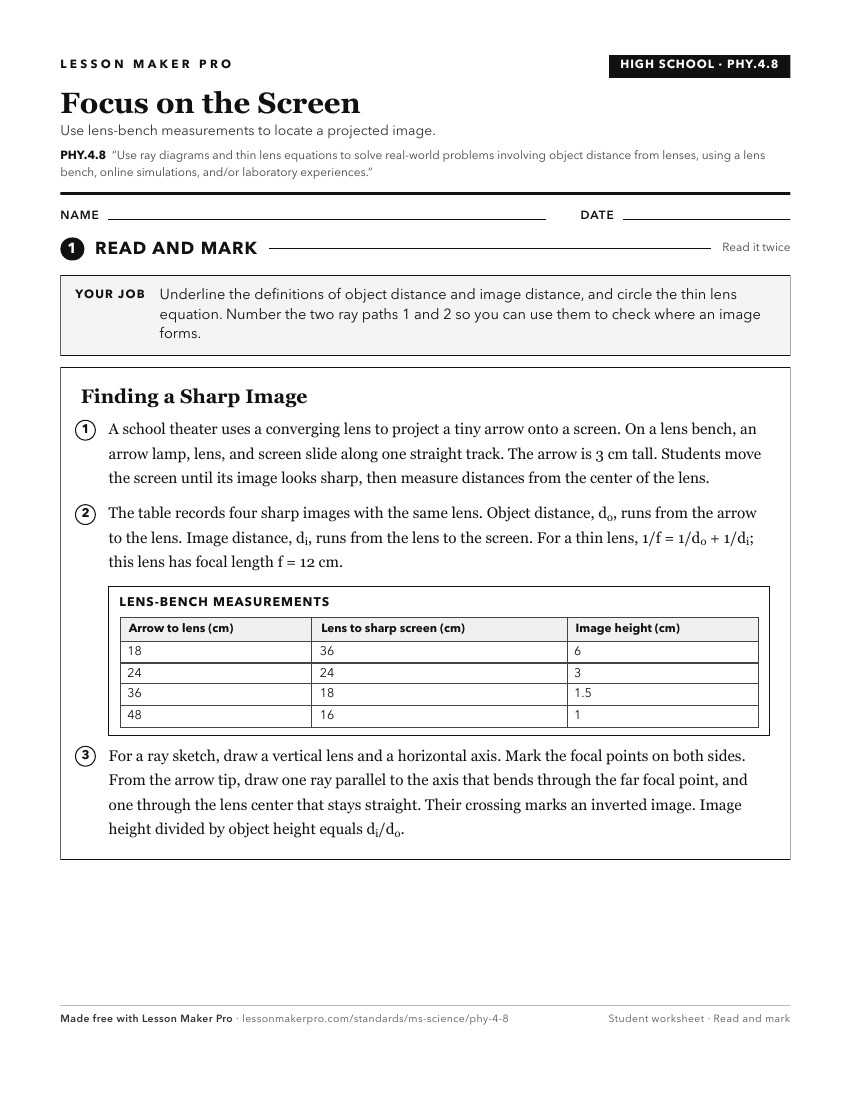
A ready-to-print activity worksheet aligned to PHY.4.8, with an answer key for the teacher on its own page. No account needed.
PDF, US Letter, prints cleanly in black and white.
Download the worksheetKeep exploring
Related Standards
- P.4.6B.3
Develop and use models to communicate how light travels and behaves when it strikes an object, including reflection, refraction, and absorption.
- P.8.6.3
Conduct simple investigations about the performance of waves to describe their behavior (e.g., refraction, reflection, transmission, and absorption) as they int...
- PHY.2.3
Use mathematical and graphical techniques to solve vector problems and find net forces acting on a body using free-body diagrams and/or online simulations.
- PHY.2.7
Analyze real-world applications to draw conclusions about Newton’s three laws of motion using online simulations, probe systems, and/or laboratory experiences.
Turn this exact standard into a lesson
Grade, subject, topic, and the complete standard are prefilled. Create one free, no account needed.
Also for this standard:Make a WorksheetMake a QuizMake a Sub Lesson