Mississippi Science PHY.2.3
The Standard
- PHY.2
- Students will develop an understanding of concepts related to Newtonian dynamics.
Use mathematical and graphical techniques to solve vector problems and find net forces acting on a body using free-body diagrams and/or online simulations.
2026 Mississippi College- and Career-Readiness Standards for Science · Newton’s Laws
Teacher's field guide
What This Standard Means
What Students Need to Do
- Students draw force arrows on one object, then add them to find the net force. They use a scale drawing or horizontal and vertical components when forces point in different directions.
What Mastery Looks Like
- Given a cart pulled at an angle, students draw the forces acting on the cart and find the net force. They can use both components and a scale drawing to show its size and direction.
Common Misconceptions
- Students may add opposing forces instead of subtracting them, or think a moving object must have a net force in its direction of travel. They may put a force exerted by the object on its own free-body diagram.
How to Assess It
- A puck on a frictionless table feels a 4 N push east and a 3 N push north. Have students draw its free-body diagram and find the net force's size and direction.
Lesson moves
Ways to Teach It
Pull a ring with two spring scales, record both readings, then draw the force arrows to scale on graph paper and find their resultant.
Show an 8 N push right and 8 N friction left, then ask: Can the box still move right? Explain.
Give pairs cards with labeled force arrows; have them draw one object's free-body diagram and calculate its horizontal and vertical net forces.
Model a sled pulled with 10 N at 30° above level ground against 3 N friction; calculate its horizontal net force.
Free download
Printable PHY.2.3 Worksheet
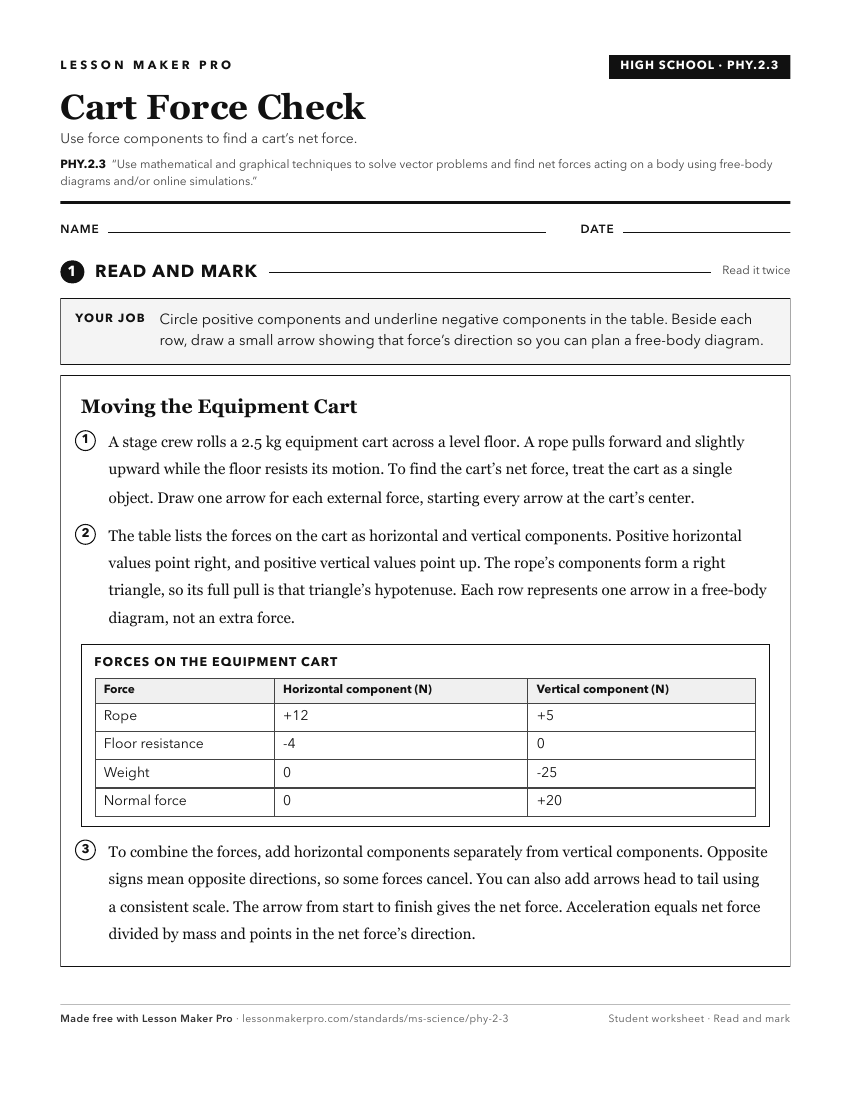
A ready-to-print activity worksheet aligned to PHY.2.3, with an answer key for the teacher on its own page. No account needed.
PDF, US Letter, prints cleanly in black and white.
Download the worksheetKeep exploring
Related Standards
- PHY.2.5
Use mathematical and computational analysis to derive simple equations of motion for various systems using Newton’s second law (e.g., net force equations).
- PHY.2.1
Identify forces acting on a system by applying Newton’s laws mathematically and graphically (e.g., vector and scalar quantities).
- PHY.2.6
Use mathematical and computational analysis to explore forces (e.g., friction, force applied, normal, and tension).
- P.6.6.2
Use mathematical computation and diagrams to calculate the sum of forces acting on various objects.
Turn this exact standard into a lesson
Grade, subject, topic, and the complete standard are prefilled. Create one free, no account needed.
Also for this standard:Make a WorksheetMake a QuizMake a Sub Lesson