Mississippi Science E.4.10
Standard Cluster
Students will demonstrate an understanding of the various sources of energy used for human needs along with their effectiveness and possible impacts. Organize simple data sets to compare energy and pollution output of various traditional, non-renewable resources (e.g., coal, crude oil, wood). Use technology or informational text to investigate, evaluate, and communicate various forms of clean energy generation.
2026 Mississippi College- and Career-Readiness Standards for Science · Earth’s Resources
Cluster contents
Standards in This Cluster
E.4.10 is a cluster heading. These are the individual standards under it.
Teacher's field guide
What This Cluster Means
What Students Need to Do
- Students use a small data table to compare the energy and pollution from coal, fuel made from oil, and wood. They use a fact sheet to explain how solar, wind, or water power works and name one drawback.
What Mastery Looks Like
- A student graphs energy and pollution for equal amounts of fuel, then uses the numbers to support a choice. They can explain that solar panels make electricity without burning fuel, but need sunlight.
Common Misconceptions
- Students may think the fuel that gives the most energy must also cause the least pollution. Some call solar power pollution-free or assume wood is always renewable, even when trees are not replanted.
How to Assess It
- Give this sample data for equal amounts burned: coal (8 energy, 7 pollution), gasoline (9, 6), wood (4, 5). Ask students to draw paired bars, choose the least-polluting fuel that meets an 8-unit energy goal, and name one drawback of solar power.
Lesson moves
Ways to Teach It
Give pairs a sample table for coal, gasoline, and wood, then have them build energy and pollution bar graphs with colored cubes.
Ask students to write which fuel they would choose for a power plant, citing its energy and pollution numbers.
Play 'Pick a power source' with fuel and solar cards; teams choose an option that meets a posted energy goal and pollution limit.
Open the local utility's power source chart and have students compare its largest source with solar power using a printed fact card.
Free download
Printable E.4.10 Worksheet
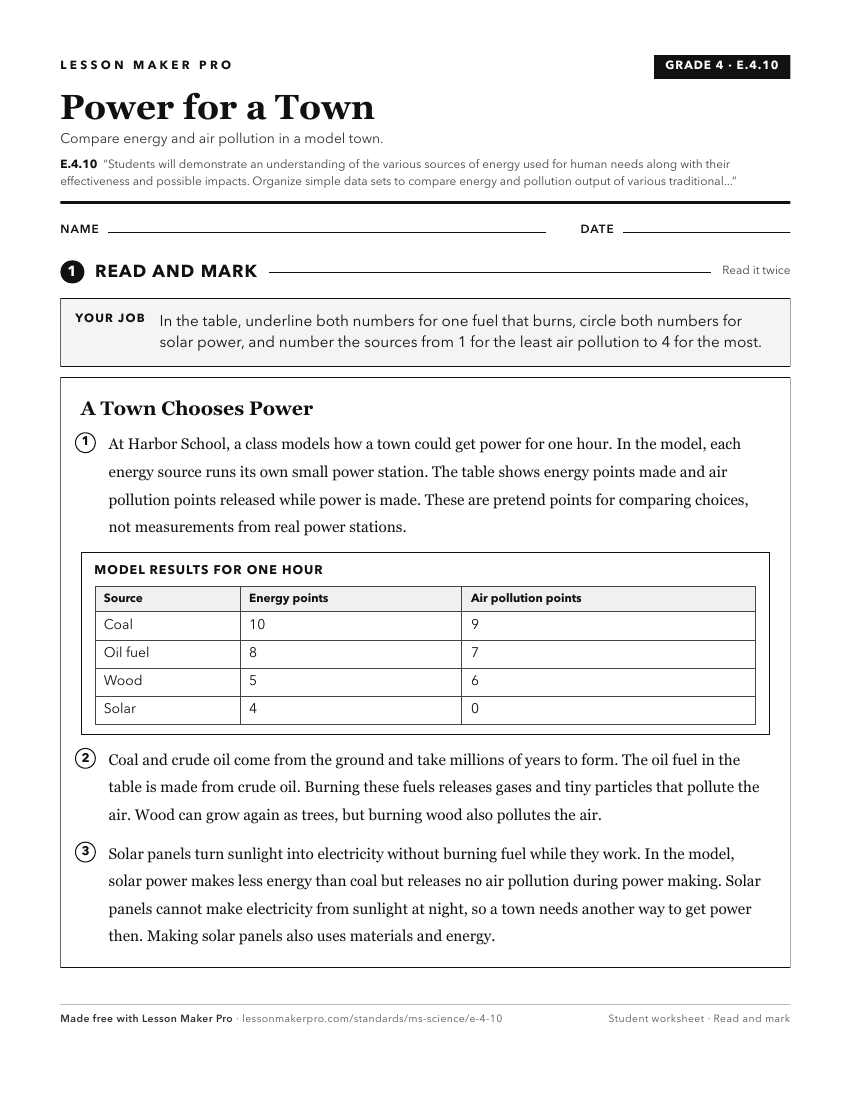
A ready-to-print activity worksheet aligned to E.4.10, with an answer key for the teacher on its own page. No account needed.
PDF, US Letter, prints cleanly in black and white.
Download the worksheetKeep exploring
Related Standards
- E.3.10
Students will demonstrate an understanding that all materials, energy, and fuels that humans use are derived from natural sources.
- P.4.6A
Students will demonstrate an understanding of the common sources and uses of heat and electric energy and the materials used to transfer heat and electricity.
- E.2.10
Students will demonstrate an understanding of how humans use Earth’s resources.
- E.K.10
Students will demonstrate an understanding of how humans use Earth’s resources.
Turn this cluster into a lesson
Grade, subject, topic, and the complete cluster are prefilled. Create one free, no account needed.
Also for this cluster:Make a WorksheetMake a QuizMake a Sub Lesson