Mississippi Science E.3.10
Standard Cluster
Students will demonstrate an understanding that all materials, energy, and fuels that humans use are derived from natural sources. Identify some of Earth's resources that are used in everyday life such as water, wind, soil, forests, oil, natural gas, and minerals and classify as renewable or nonrenewable. Obtain and communicate information to exemplify how humans attain, use, and protect renewable and nonrenewable Earth resources. Use maps and historical information to identify natural resources in the state connecting (a) how resources are used for human needs and (b) how the use of those resources impacts the environment. Design a process for cleaning a polluted environment (e.g., simulating an oil spill in the ocean or a flood in a city and creating a solution for containment and/or cleanup). Use an engineering design process to define the problem, design, construct, evaluate, and improve the environment. *
2026 Mississippi College- and Career-Readiness Standards for Science · Earth’s Resources
Cluster contents
Standards in This Cluster
E.3.10 is a cluster heading. These are the individual standards under it.
- E.3.10.1
Identify some of Earth's resources that are used in everyday life such as water, wind, soil, forests, oil, natural gas, and minerals and classify as renewable o...
- E.3.10.2
Obtain and communicate information to exemplify how humans attain, use, and protect renewable and nonrenewable Earth resources.
- E.3.10.3
Use maps and historical information to identify natural resources in the state connecting (a) how resources are used for human needs and (b) how the use of thos...
- E.3.10.4
Design a process for cleaning a polluted environment (e.g., simulating an oil spill in the ocean or a flood in a city and creating a solution for containment an...
Teacher's field guide
What This Cluster Means
What Students Need to Do
- Students trace everyday materials, fuels, and energy to natural sources and sort resources by whether they can be replaced. They use Mississippi maps and old photos to explain how people use resources and affect the environment. They build, test, and improve a cleanup plan for a pretend spill.
What Mastery Looks Like
- A student can explain that paper comes from trees, diesel from oil, and wind can make electricity. They can find a resource on a Mississippi map, describe how people get and use it, and name an environmental cost and a way to protect it. They can test a spill cleanup tool, record what remains, and improve the tool.
Common Misconceptions
- Students may call oil renewable because more can form, or assume a cut forest grows back quickly. Some think electricity comes from an outlet rather than a natural energy source. They may think scooping oil off water removes every trace.
How to Assess It
- Show a Mississippi forest map and an old logging photo. Ask: "Where do people get wood, can it be replaced, how can cutting trees harm the land, and what could protect the forest?"
Lesson moves
Ways to Teach It
Give teams a tray of oil and water; have them name the cleanup problem, test cotton and spoons, then improve one tool.
Show a Mississippi forest map and an old logging photo; ask where wood is found, how people use it, and what logging changes.
Hand out cards labeled water, wind, soil, trees, oil, gas, and minerals; students sort by replacement time and defend two choices.
Locate Mississippi oil fields on a map; trace diesel from drilling to a school bus, then name one way to save fuel.
Free download
Printable E.3.10 Worksheet
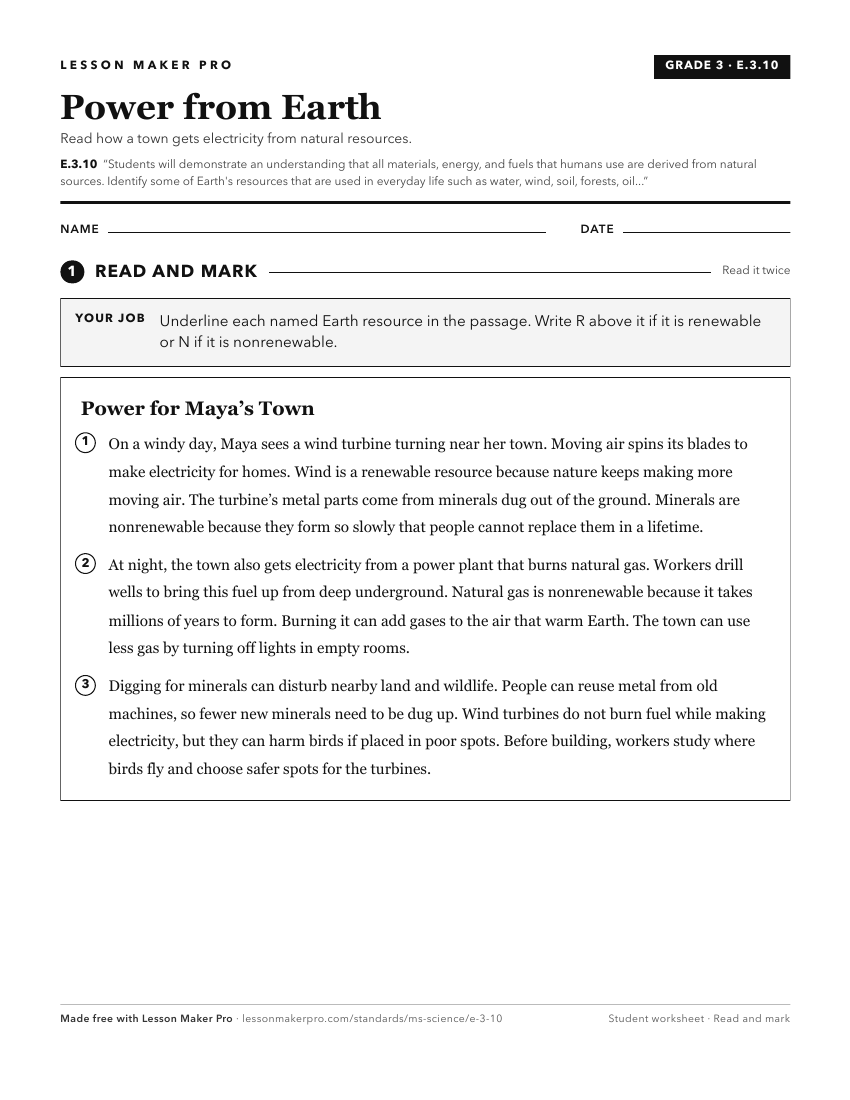
A ready-to-print activity worksheet aligned to E.3.10, with an answer key for the teacher on its own page. No account needed.
PDF, US Letter, prints cleanly in black and white.
Download the worksheetKeep exploring
Related Standards
- E.2.10
Students will demonstrate an understanding of how humans use Earth’s resources.
- E.K.10
Students will demonstrate an understanding of how humans use Earth’s resources.
- E.4.10
Students will demonstrate an understanding of the various sources of energy used for human needs along with their effectiveness and possible impacts.
- ESS.4
Students will develop an understanding of Earth’s resources and the impact of human activities.
Turn this cluster into a lesson
Grade, subject, topic, and the complete cluster are prefilled. Create one free, no account needed.
Also for this cluster:Make a WorksheetMake a QuizMake a Sub Lesson